
 0
0



- Home
- Blog
- Industry Insights
- 7 Rules for Buying the Right Garment Equipment
7 Rules for Buying the Right Garment Equipment
In garment manufacturing, choosing the right machinery supplier is not only a purchasing decision. It can affect production efficiency, equipment reliability, product quality, delivery schedules, and long-term factory competitiveness.
Garment factories often need to manage many types of machines across different departments, from fabric preparation and inspection to cutting, fusing, pressing, finishing, quality control, and packing. Each department may also have different priorities. The purchasing team may focus on cost. The technical team may care more about machine quality and maintenance. Management may consider supplier relationship, long-term support, and business continuity.
These different priorities can create internal conflict, especially when problems appear later: delayed delivery, unstable machine performance, poor after-sales service, spare parts shortages, or unexpected quality issues. A supplier that looks cheaper at the beginning may become more expensive if downtime, repairs, and communication costs increase over time.
This is why garment factories should evaluate suppliers from a long-term operational perspective. The right supplier should not only sell equipment. It should help the factory solve production problems, support daily operation, and prepare for future automation and digital transformation.
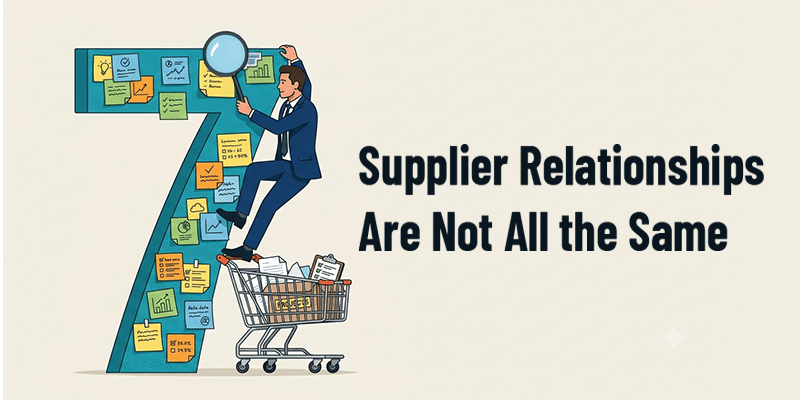
Supplier Relationships Are Not All the Same
Not every supplier relationship has the same value. Some suppliers are suitable only for one-time purchases. Others may become long-term partners, contract suppliers, strategic partners, or even part of a deeper business collaboration.
For low-risk or occasional purchases, a simple transaction may be enough. But for important machinery, frequently used equipment, high-cost systems, or production-critical materials, factories should consider a more stable supplier relationship.
A long-term supplier can better understand the factory’s production process, machine history, maintenance needs, and future expansion plans. This helps reduce communication time and makes it easier to solve problems when quality, delivery, or technical issues occur.
Before choosing a supplier, garment factories should involve different departments in the evaluation process. Purchasing, production, technical, maintenance, and management teams may all see different risks. A cross-functional review helps the factory avoid choosing based only on price.
Why Supplier Selection Is More Important After Automation
After the global supply chain disruptions in recent years, many traditional manufacturers have realized the importance of digitalization and production visibility.
In the garment industry, automation is no longer limited to one machine. Factories are increasingly looking at how different machines can connect, how production data can be collected, and how managers can use dashboards to understand production status.
This changes how factories should evaluate suppliers. A supplier’s value is no longer only about hardware quality. It also includes software support, integration capability, service response, data readiness, and the ability to support future factory upgrades.
As garment manufacturing becomes more connected, suppliers that understand both machinery and production workflow will become more valuable.
1. Product Quality and Technical Innovation
Product quality is still the foundation of supplier selection. Garment production involves many connected processes. If one machine fails, the impact may spread to the next process and delay the whole production line.
A good supplier should understand the industry, not just the machine itself. It should be able to recommend equipment based on fabric type, production volume, factory layout, workflow, and operator requirements.
Technical innovation is also important. The garment industry faces pressure to improve efficiency, reduce waste, and operate more sustainably. Suppliers that continue to improve equipment design, develop automation functions, and explore AI or IoT applications can help factories prepare for long-term changes in the industry.
When evaluating technical innovation, factories should ask whether the supplier is solving real production problems or only adding features that do not create practical value.
2. Cost-Effectiveness
Cost matters, but the lowest price is not always the best choice.
A machine with a lower purchase price may create higher costs later if it breaks down often, uses expensive spare parts, requires slow service support, or cannot integrate with the factory’s existing workflow.
Cost-effectiveness should include purchase price, machine performance, maintenance cost, after-sales service, spare parts availability, training, system compatibility, and expected lifetime value.
In the Industry 4.0 era, factories also need to consider whether the supplier can support both hardware and software needs. Some suppliers may outsource software, integration, or service work. This is not necessarily a problem, but factories should clearly understand who is responsible when technical issues occur.
The key question is not “Which supplier is the cheapest?” but “Which supplier provides the best value over time?”
3. Supply Chain Stability
Supplier stability directly affects production efficiency and delivery performance.
A reliable supplier should have stable production capacity, a clear spare parts system, practical maintenance support, and a track record of serving similar factories. This becomes even more important when global labor shortages, material delays, or logistics issues affect manufacturing.
When evaluating supplier stability, factories should look at the supplier’s experience, reputation, financial health, market feedback, production capacity, and service network.
A supplier with unstable delivery, unclear communication, or weak technical support can create risks beyond the original equipment purchase.
For garment factories with tight delivery schedules, supplier stability should be treated as part of production risk management.
4. Customer Service and Technical Support
After-sales service is one of the most important factors when choosing a garment machinery supplier.
Even high-quality machines need installation, training, adjustment, maintenance, and technical support. When a machine stops, the speed and quality of service response can directly affect production downtime.
A good supplier should provide practical support, including machine installation, operator training, troubleshooting, maintenance guidance, spare parts supply, and remote or on-site support when needed.
For overseas factories, service response becomes even more important. If the factory cannot get timely support, a small machine issue may quickly become a production delay.
Factories should evaluate not only what the supplier promises before the sale, but also how it supports customers after delivery.
5. One-Stop Service
Garment factories often use many different machines across several production stages. Managing too many suppliers can increase communication time, training complexity, maintenance burden, and responsibility disputes.
A supplier that offers one-stop service can help simplify purchasing and coordination. This is especially valuable when machines need to work together across fabric preparation, inspection, cutting, fusing, pressing, finishing, packing, or quality control.
One-stop service does not mean every factory must buy everything from one supplier. It means the supplier should understand how different processes connect and be able to recommend practical solutions instead of isolated machines.
For factories planning automation upgrades, a supplier with broader product coverage and workflow knowledge can reduce coordination costs and make equipment planning more efficient.
6. Long-Term Partnership
A strong supplier relationship can create value beyond the first purchase.
When a supplier works with a factory over time, it can better understand production habits, equipment history, operator skill levels, maintenance needs, and future expansion plans. This allows the supplier to provide more practical suggestions and faster support.
Long-term cooperation may also lead to better service terms, more suitable machine recommendations, more stable spare parts planning, and smoother communication.
For important machinery or high-frequency production processes, factories should not treat every purchase as a one-time transaction. A long-term partnership can help reduce uncertainty and improve operational continuity.
7. Sustainability and Corporate Responsibility
Sustainability is becoming more important in garment manufacturing. Brands, consumers, and regulators are paying more attention to energy use, material waste, labor conditions, and environmental impact.
When choosing a supplier, factories should consider whether the supplier supports more efficient production, waste reduction, energy-saving equipment, responsible manufacturing, and long-term industry improvement.
Sustainability should not be treated only as a marketing message. In practical terms, better equipment efficiency, lower defect rates, reduced material waste, and improved production visibility can all support more responsible manufacturing.
Choosing a supplier with a long-term sustainability mindset can help factories meet future customer expectations and strengthen their own brand image.
Conclusion: The Right Supplier Supports More Than Equipment Purchasing
In a competitive and fast-changing garment industry, supplier selection is no longer only about price. A good supplier should provide reliable equipment, practical service support, technical knowledge, integration capability, and long-term value.
For garment factories, one-stop service and long-term partnership can reduce purchasing complexity, improve communication efficiency, and support production continuity. As automation and digitalization become more important, suppliers that understand both machinery and factory workflow will become stronger partners for future growth.
OSHIMA supports garment manufacturers with a broad range of equipment, including fabric preparation machines, inspection machines, cutting room solutions, fusing machines, pressing equipment, heat press machines, needle detection systems, and industrial boilers. With service support in key garment manufacturing regions such as Vietnam, Cambodia, Myanmar, and Bangladesh, OSHIMA helps factories maintain smoother production and respond to daily production needs.
Beyond equipment supply, OSHIMA continues to develop automation, AI, and IoT applications for garment manufacturing. The goal is to help factories improve efficiency, reduce errors, strengthen production visibility, and move toward more sustainable manufacturing.
Choosing the right supplier means choosing a partner that understands your production challenges and can support your factory beyond the first purchase.

Article Classification
Recent Articles
- Why Are Garment Factories Struggling to Recruit Young Workers?
- What Does the World Cup Have in Common with Apparel Sourcing?
- Why Garment Factories Need Process Stability in a Slower Market?
- Why Scale and Low Cost Are No Longer Enough for Bangladesh Apparel Manufacturing?
- Why Extreme Heat Is Becoming a New Risk for Apparel Supply Chains?