
 0
0



- Home
- Blog
- Industry Insights
- What Does the World Cup Have in Common with Apparel Sourcing?
What Does the World Cup Have in Common with Apparel Sourcing?
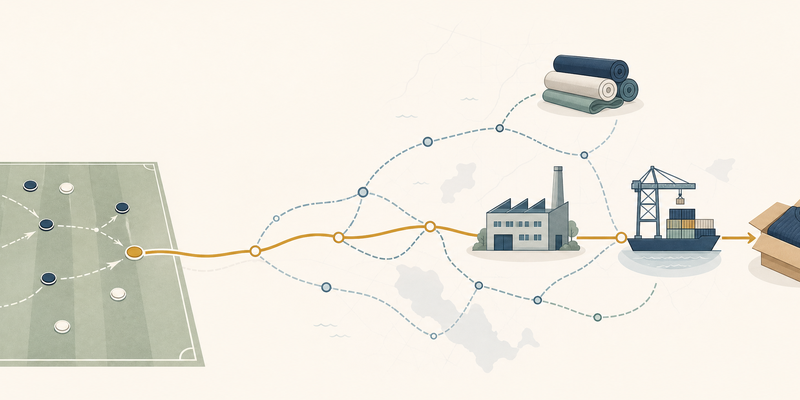
Major football tournaments have a way of exposing uncertainty very quickly. Across past World Cups, strong teams have arrived with experienced players, established systems, and long histories of success, yet still left the tournament earlier than expected. Germany and the Netherlands are familiar examples. Their strength did not disappear, but in a tournament, one difficult match, one unexpected moment, or one decision under pressure can change the result.
Apparel sourcing can look similar when conditions are stable. A brand may work with an established production country, capable factories, and suppliers that have delivered consistently for years. Prices are competitive, quality is steady, communication works, and the supply base understands the product. There are good reasons to continue placing business there.
Risk starts to increase when too much of the supply chain gradually depends on the same conditions. A strong sourcing base can remain strong while the brand has less room to respond when something outside the factory changes.
A Strong Production Base Can Still Carry Concentrated Risk
Factory performance is only one part of the sourcing environment
Brands usually concentrate production for practical reasons. Large apparel-producing countries often have deeper supplier networks, experienced workers, established material sources, technical capability, and enough capacity to handle large programs. Keeping more volume within the same network can also simplify development, costing, quality control, and communication.
For established programs, this can be highly efficient.
The factory itself, however, operates within a much larger environment. Production also depends on trade policy, tariffs, labor availability, energy supply, currency movements, ports, customs, shipping capacity, weather, and the broader political and economic conditions of the country.
A capable factory may be ready to start while fabric is delayed at customs. Finished garments may be packed while shipping space becomes limited. A change in tariff treatment can alter the cost of an order even though factory performance has not changed. Currency or financing pressure can also affect suppliers that previously appeared stable.
These conditions may sit outside the production line, but they still reach the order through cost, lead time, and delivery.
A production country can therefore perform well for many years while the brand gradually becomes more dependent on the conditions surrounding it. That dependence is easy to overlook while everything is moving normally.
A Long Supplier List Does Not Always Mean the Risk Is Spread Out
Several factories can still depend on the same materials, country, port, or logistics route
Supplier diversification is often measured by factory count. A brand works with five factories instead of one, so the sourcing structure appears more flexible.
In practice, those factories may still depend on the same country, fabric mills, nominated trim suppliers, port, shipping routes, or trade policies.
Apparel production has many layers before a finished garment reaches the buyer. Fabric may come from one market, trims from another, garment production from another, while washing, finishing, inspection, packaging, and international transportation add further dependencies. The sewing factory may be ready while another part of that chain holds the order back.
Several factories using the same major fabric source still create material concentration. Multiple suppliers shipping through the same port still carry logistics concentration. A broad factory network concentrated in one country remains exposed to the same changes in tariffs, energy supply, labor conditions, or national policy.
Looking only at the number of suppliers therefore gives an incomplete picture.
A more useful review follows the order through the supply chain and identifies the parts that would be difficult to replace quickly: production capacity, important materials, nominated trims, specialist processes, approvals, transportation routes, or geographic concentration.
Once Delivery Slips the Cost Goes Beyond Freight
Late shipments can affect launch timing, inventory, cash flow, markdowns, and customer commitments
Concentrated sourcing often remains attractive because it improves efficiency while conditions are normal. Larger order volumes can support better pricing, development becomes easier, and sourcing teams spend less time coordinating smaller suppliers across several markets.
The cost changes when an interruption occurs.
A delayed garment shipment rarely affects transportation alone. It may disrupt a product launch, retail allocation, replenishment planning, inventory levels, cash flow, or delivery commitments to customers. Goods arriving after the intended selling period can also increase markdown pressure.
At that point, the original FOB saving becomes only one part of the calculation.
Air freight, expedited materials, production changes, penalties, discounts, excess inventory, and lost sales can quickly outweigh the savings achieved through the lowest-cost sourcing route.
This does not mean every order should move to a more expensive country or supplier. It does mean that cost needs to be considered together with how difficult an order would be to recover once production or delivery begins to move off schedule.
Flexibility Has to Exist Before an Order Is Under Pressure
Alternative capacity needs to be understood before it becomes urgent
Moving production is rarely as simple as sending a purchase order to another factory.
A new supplier needs time to understand the product, confirm materials and quality requirements, complete the necessary approvals, and work through actual production. Moving to another country can introduce further differences in material availability, logistics, duties, technical capability, and lead time.
A second source on a supplier list therefore does not automatically mean production can move immediately.
Brands and manufacturers need some understanding of what can actually be transferred when conditions change and which parts of the order would still depend on the original source.
The same applies beyond the sewing factory. Several factories may rely on the same nominated fabric, trim supplier, specialist process, port, or logistics route. When these dependencies remain concentrated, adding more factory names does not necessarily create the same amount of flexibility.
Understanding these connections before a disruption occurs gives both brands and manufacturers a more realistic view of the options available when production conditions begin to change.
Supply Chain Flexibility Also Depends on What the Factory Can See
External risks cannot be controlled, but production conditions should not remain unclear
Many of the risks surrounding apparel sourcing sit outside the factory. A manufacturer cannot control tariffs, exchange rates, port congestion, shipping routes, political changes, or extreme weather.
What the factory can manage is its own production.
When orders are running normally, production information may still be handled through meetings, spreadsheets, reports, and communication between departments. Once capacity becomes tight or a delivery date begins to move, delays in information become much more noticeable.
Factory management needs to know what has been completed, where production is slowing down, whether quality conditions have changed, and what still needs to happen before the order can move to the next stage. Brands need the same clarity when delivery plans or sourcing arrangements need to be reviewed.
This is where production data becomes relevant from the equipment side.
Within OSHIMA's garment-production solutions, equipment and connected production systems increasingly consider how useful production information can be recorded and carried through the manufacturing process rather than remaining only at an individual machine. This information cannot change tariffs, exchange rates, shipping conditions, or geopolitical events, but it can help factories see the part of the production process they are responsible for managing more clearly.
When production teams can review actual conditions without relying entirely on verbal updates or records collected after a problem has already developed, they have better information for responding to changes in capacity, quality, and lead time. For brands, clearer factory information also makes discussions more practical when plans need to be adjusted.
Know Which Part of the Supply Chain Would Be Hardest to Replace
The most stable dependencies are often the ones that receive the least attention
World Cup results offer a useful comparison. A strong team still wants its best players, experience, and established system. An unexpected early exit does not mean those strengths were the wrong choice. It shows that strength cannot remove every variable.
Apparel sourcing works in much the same way. There is no reason to move away from a capable production country or a reliable long-term supplier simply because risk exists. What deserves attention is where too much of the supply chain depends on the same conditions and how difficult those dependencies would be to replace.
When reviewing a sourcing setup, it is worth looking beyond the number of factories. Consider where most production capacity sits, whether several suppliers depend on the same materials, which processes have few alternatives, which ports and logistics routes carry most shipments, and how clearly factories can see and communicate their own production situation.
The parts that have worked smoothly for years are often the easiest to overlook. Knowing which of them would take months rather than days to rebuild gives brands and manufacturers a clearer idea of how much room they actually have when conditions change.


Article Classification
Recent Articles
- Why Are Garment Factories Struggling to Recruit Young Workers?
- What Does the World Cup Have in Common with Apparel Sourcing?
- Why Garment Factories Need Process Stability in a Slower Market?
- Why Scale and Low Cost Are No Longer Enough for Bangladesh Apparel Manufacturing?
- Why Extreme Heat Is Becoming a New Risk for Apparel Supply Chains?