
 0
0



- Home
- Blog
- Applications & Solutions
- What Changes When Fabric Defect Data Reaches the Cutting Plan?
What Changes When Fabric Defect Data Reaches the Cutting Plan?
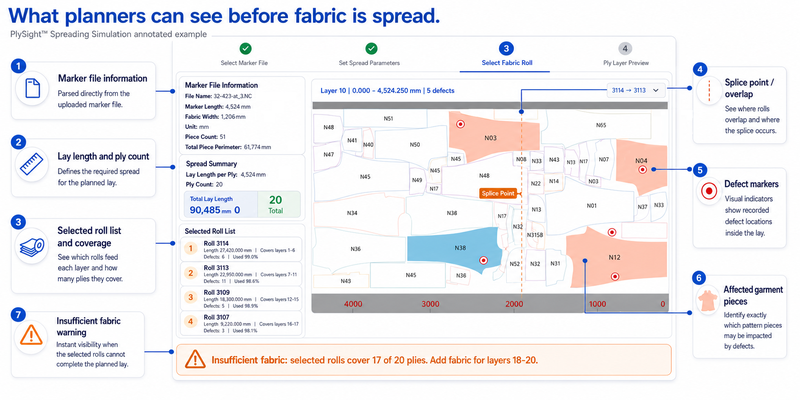
In many garment factories, fabric inspection and cutting planning are both well-established processes, but the information between them does not always move as smoothly as the fabric itself. The inspection team may already know where defects are located on a roll, while the cutting room is planning markers, ply counts and roll allocation separately.
The problem usually becomes more visible after cutting. A defect that appeared as one point on an inspection report may end up across a front panel, sleeve or collar. By then, the fabric has already been spread and cut, and the affected piece may need to be removed and produced again.
Bringing defect information into the cutting plan before fabric reaches the spreading table gives production another point at which to respond. This is where PlySight™, OSHIMA's defect-to-piece production simulation within the OSHIMA Smart Factory Platform, fits into the workflow.
Fabric Inspection Data Often Stops Before Cutting Planning
Fabric inspection already supports incoming quality decisions, supplier evaluation and roll acceptance. As inspection becomes more digital, the records available to the factory can also become much more detailed.
OSHIMA's EagleAi® AI fabric inspection machine, for example, records the type, dimensions and physical coordinates of detected defects as a roll is inspected. Together with roll dimensions, lot number and color ID, these records form a roll-level digital defect record referred to within the platform as a digital defect twin.
For quality management, this information shows what was found and where it was found. The same record also stays with the fabric roll for incoming-fabric review, supplier quality management and traceability, so its value does not depend only on whether the roll is immediately used in a PlySight simulation.
Cutting planning, however, needs to take the information one step further.
A Defect Coordinate Does Not Yet Show Its Production Impact
A planner still needs to know how those defect coordinates relate to the actual marker, planned plies and fabric rolls assigned to the lay.
Without this connection, the factory may have a detailed digital inspection report while the cutting room continues making roll-allocation decisions largely independently of it.
A defect count or roll grade provides a general indication of fabric quality. It does not show whether one particular defect will fall between marker pieces or directly across an important garment component.
Exact coordinates make that comparison possible.
The Marker Turns Defect Data Into a Production Decision
PlySight combines defect information recorded during EagleAi inspection with the factory's production marker, planned lay requirements and selected fabric rolls.
The system places recorded defect locations onto the layers where they are expected to appear and compares those positions with the individual pieces in the marker.
This changes how planners can look at a roll.
A roll with several recorded defects may still be usable for a particular marker when those defects fall between pieces or in positions that create limited production impact. Another roll with fewer defects may cause a larger problem when one defect crosses an important component.
The practical issue is therefore not simply how many defects a roll contains. It is where those defects will fall when that roll is used for a particular production plan.
Marker and Lay Information Need to Be Considered Together
The simulation begins with the actual production marker. The platform reads information including piece geometry and IDs, piece count, marker length, fabric width and the measurement unit contained in the marker file.
The planner then enters the lay length per ply and required ply count. From these inputs, the platform calculates the total spreading length required for the planned lay.
This matters because a defect position cannot be evaluated independently from the layer on which it will appear. The same physical point on a roll can affect different pieces depending on the marker, lay arrangement and position of that roll within the spread.
Roll Allocation Still Has More Than One Constraint
The planner selects one or more EagleAi-inspected rolls from the platform. Each roll remains associated with its dimensions, recorded defect count, lot number and color ID.
In actual production, defect avoidance is only one part of roll allocation. Available length, lot and shade consistency, production quantity and other order requirements still have to be considered at the same time.
As rolls are added and arranged, PlySight shows which layers each roll will supply and where one roll transitions to the next. The planner can also define the splice overlap between consecutive rolls.
When the selected rolls cannot provide enough effective fabric length to complete the planned lay, the system identifies which layers remain uncovered before spreading begins.
Planners Can See Which Pieces Are Likely to Be Affected
Once the marker, lay requirements and roll sequence are defined, the recorded defects can be placed onto their expected positions within individual plies.
The simulation then identifies the marker pieces that each defect intersects.
At this stage, a defect is no longer only a coordinate on a fabric roll or an item in an inspection report. It has a visible relationship with a particular layer and piece ID in the planned production.
That information gives the planner a more useful basis for deciding how each roll should be used.
Different Roll Plans Can Be Tested Before Fabric Moves
PlySight does not automatically select the final fabric rolls. The planner remains responsible for the allocation.
This is important because factories work with different quality standards, fabric values, shade requirements and customer specifications. The software provides another layer of production information, while the final decision still depends on the factory's own requirements and experience.
A planner can substitute rolls, change their sequence or adjust the splice overlap, then run the simulation again.
Several combinations can therefore be reviewed before fabric is committed to the spreading table.
In practice, a roll with more recorded defects can be tested against a marker that may tolerate their positions. Cleaner rolls can be reserved for more demanding styles, while changing the roll sequence may place known defects in less problematic locations.
The tools have changed, but the manufacturing principle has not: the factory is still trying to use available material efficiently while maintaining the quality required by the order.
Earlier Defect Visibility Can Reduce Problems Further Downstream
A fabric defect that becomes a defective cut piece rarely affects only the cutting operation.
Once a piece has been cut and rejected, replacement fabric may have to be prepared, another component cut and the bundle corrected before production continues normally. When the problem is discovered later, additional handling may already have reached sewing or quality control.
Moving defect impact into pre-spreading planning does not remove fabric defects. It gives the factory an earlier opportunity to decide how known defects should be handled.
The planner may change the roll arrangement, reserve a cleaner roll for another style or determine that the expected impact is acceptable under the factory's quality requirements.
These decisions are easier to manage while the fabric is still part of a production plan rather than after it has become a rejected cut piece.
The Value Depends on the Factory's Actual Production Conditions
The impact becomes more significant with higher-value or defect-sensitive fabrics, high ply counts and multi-roll lays, where one roll decision can affect multiple pieces across the spread.
Potential savings can come from less replacement fabric, fewer repeated spreading and cutting operations, fewer affected pieces progressing toward sewing, and better allocation of available rolls.
There is no single ROI figure that applies to every factory. Fabric cost, typical defect rates, lay size, ply count and style requirements all influence the result.
For that reason, defect-aware planning should be evaluated against the factory's own material and production conditions rather than treated as a fixed percentage improvement.
Defect Information Can Continue From Planning Into Spreading
Planning is only one part of the cutting-room workflow. Once the final roll arrangement is decided, the information still needs to remain useful when physical production begins.
Within OSHIMA's connected cutting-room workflow, defect coordinates recorded during EagleAi inspection can continue from PlySight into spreading.
Where required, an optional projection system can display recorded defect positions directly on the fabric so operators can verify the physical locations before cutting.
Planning and Projection Solve Different Parts of the Same Problem
PlySight works before spreading. It allows the production team to see which pieces and layers are expected to be affected under a particular roll arrangement.
Projection works when the fabric is physically on the spreading table. It brings the recorded defect position back onto the actual fabric so the operator can verify where that defect appears.
Affected cut-piece piles can also be labeled for downstream handling, allowing cutting, bundling and quality personnel to know which pieces require attention.
The production flow can therefore continue as:
EagleAi fabric inspection → digital defect record → PlySight pre-spreading planning → SPRO spreading with optional defect projection → Fabric cuting
The value comes from keeping the same information useful as the material moves through production. When each department has to read, interpret and manually re-enter separate records, even detailed inspection data can lose much of its practical value downstream.
Where PlySight Fits Within the OSHIMA Cutting-Room Workflow
Within OSHIMA's system, EagleAi creates roll-level defect information during inspection. PlySight applies that information to the production marker, ply requirements and selected roll sequence before spreading.
OSHIMA spreading, projection, cutting and cut-piece labeling technologies can then carry relevant information further into physical production.
PlySight operates within the web interface of the OSHIMA Smart Factory Platform and uses digital defect twins created by EagleAi together with the factory's own marker files. It is included for EagleAi customers at no additional software cost.
The broader operational point is more important than any individual function: inspection information becomes more useful when the next production stage can apply it directly rather than reconstructing the information from the beginning.
Use Defect Information Before Fabric Is Committed
Garment factories have always had to decide how to use fabric that is not completely free of defects. AI inspection and production simulation do not remove that responsibility, and they do not replace the planner's judgment.
They can move that judgment earlier.
When exact defect positions are compared with the marker, ply structure and roll sequence before spreading, a known fabric problem can become part of the production plan rather than a problem discovered after cutting.
For factories reviewing fabric inspection or cutting-room automation, one practical consideration is worth checking: after a defect is detected, can that information continue into the decision that determines how the fabric will actually be used?
Frequently Asked Questions
What is PlySight?
PlySight is a defect-to-piece production simulation within the OSHIMA Smart Factory Platform.
It combines defect coordinates recorded by EagleAi with the factory's production marker, lay requirements and selected fabric-roll plan. Before spreading begins, planners can review where known defects are expected to appear within individual plies and which garment pieces they may intersect.
The purpose is to bring information already collected during fabric inspection into cutting-room planning rather than waiting until after spreading or cutting to understand its production impact.
What is a digital defect twin?
A digital defect twin is the roll-level digital record created from EagleAi fabric inspection.
For every detected defect, the record can include its defect type, dimensions and physical position along the length and width of the fabric roll. The record also remains associated with roll information such as dimensions, lot number and color ID.
Because the system retains exact coordinates rather than only a defect count or quality grade, the same information can later be used by PlySight to position the defect on a planned ply and identify the garment pieces it may intersect.
The record can also remain available for incoming-fabric review, supplier quality management and traceability independently of PlySight planning.
What information does PlySight need?
PlySight uses information from both fabric inspection and production planning.
From EagleAi, it uses inspected fabric-roll information and recorded defect coordinates.
From the production side, the planner provides the marker file, planned lay length per ply, required ply count and the fabric rolls intended for the lay.
The platform can also keep roll information such as dimensions, defect count, lot number and color ID visible during planning.
This allows defect location to be considered together with practical roll-allocation requirements rather than evaluated in isolation.
Can planners see which garment pieces a defect may affect before spreading?
Yes.
Once the marker, ply requirements and roll sequence are defined, PlySight places recorded defects onto the layers where they are expected to appear.
The system then compares the defect position with the marker geometry and identifies the piece IDs that the defect intersects.
This allows a planner to see the difference between a defect that may fall between pieces and one that is expected to cross a specific garment component before fabric is physically spread.
Does PlySight automatically select fabric rolls?
No.
PlySight shows the projected production impact of a selected roll plan, but the planner remains responsible for deciding which rolls to use and in what sequence.
The planner can substitute rolls, change the sequence or adjust splice overlap and then run the simulation again.
This is important because the final roll allocation may depend on more than defect location. Fabric value, lot and shade consistency, product requirements and the factory's own quality standards still need to be considered.
PlySight supports that decision; it does not replace production judgment.
Can PlySight show when the selected fabric is not enough for the planned lay?
Yes.
As fabric rolls are selected, the platform compares their effective available length with the total length required for the planned lay.
PlySight also shows which layers each roll is expected to cover.
When the selected rolls cannot complete the lay, the system can identify the layers that remain uncovered so the shortage can be addressed before spreading begins.
Can different roll plans be compared before production starts?
Yes.
Planners can change the selected rolls, reorder the roll sequence or adjust splice overlap and rerun the simulation.
This means different roll-to-marker combinations can be reviewed before fabric is committed to production.
For example, a roll with more recorded defects can be evaluated against a marker where those defects may have limited piece impact, while cleaner rolls can be reserved for styles or components with stricter requirements.
The final choice still depends on the factory's production and quality conditions.
Which factories are more likely to benefit from defect-aware planning?
The value is generally more significant where the cost of a poor roll-allocation decision is higher.
This includes factories working with higher-value or defect-sensitive fabrics, high ply counts and multi-roll lays, where one known defect can affect multiple pieces across a planned spread.
The workflow can also be useful where factories need documented roll-level quality records for supplier management, incoming-fabric decisions or traceability.
The actual production value should still be evaluated against the factory's own defect rates, fabric costs, lay sizes and product requirements.
Can the same defect information continue into the spreading process?
For factories using the related OSHIMA cutting-room workflow, yes.
Recorded defect coordinates can continue from EagleAi inspection and PlySight planning into spreading.
Where required, an optional projection system can display the recorded defect position on the physical fabric so operators can verify where it appears before cutting.
Affected cut-piece piles can also be identified for downstream handling, allowing cutting, bundling and quality personnel to know which pieces require attention.
PlySight therefore supports the planning stage, while projection and downstream identification carry the same information further into physical production.
Does PlySight require separate software installation?
No separate PlySight software installation is required.
PlySight operates within the web interface of the OSHIMA Smart Factory Platform and uses digital defect twins created by EagleAi together with the factory's own production marker files.
PlySight is included for EagleAi customers at no additional software cost.

Article Classification
Recent Articles
- What Changes When Fabric Defect Data Reaches the Cutting Plan?
- How Can Food Factories Catch Problems Before Shipping?
- From Metal to Bones: How to Pick the Right Food Safety Machine
- From Nonwovens to Automotive Interiors: Choosing the Right Fabric Spreading Machine
- How Garment Factories Can Prepare for Smaller Orders?