
 0
0



- Home
- Blog
- Industry Insights
- What Does Sustainability Look Like Inside a Garment Factory?
What Does Sustainability Look Like Inside a Garment Factory?
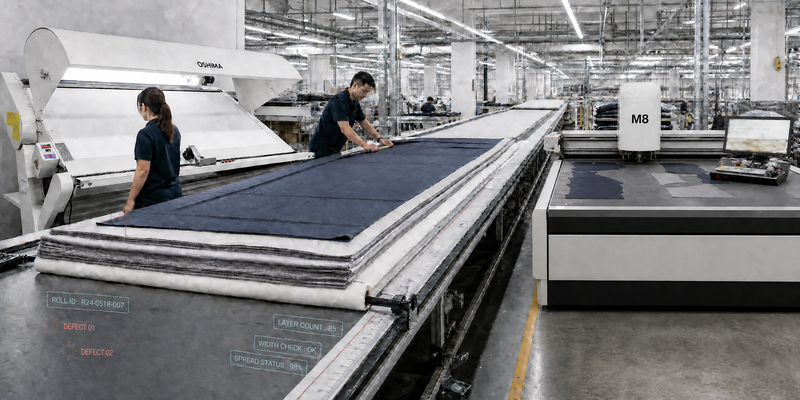
Fashion supply chains are being asked to move faster while paying more attention to material use, production records and environmental impact. Inside a garment factory, these expectations quickly become familiar production issues. A fabric defect discovered after cutting, an unstable lay that creates unusable parts, repeated rework at final inspection or incomplete production records all affect cost and delivery long before they appear in a sustainability report.
Shorter order cycles make these problems harder to absorb. Factories are handling more styles, smaller quantities and frequent production changes, while customers increasingly expect clearer information about materials, quality and production conditions. When something goes wrong late in the process, there is also less time to recover without affecting shipment.
Many sustainability issues already sit inside everyday production. How fabric is used, how early quality problems are handled, how consistently each process runs, and whether production information remains usable downstream are all part of normal factory management.
Faster Fashion Cycles Leave Less Room for Late Problems
Fast fashion has shortened the time between product development, production and market delivery. E-commerce and social media have added to that pace, while smaller and more varied orders have made production planning more fragmented.
From the factory side, speed is only part of the difficulty. Frequent style changes mean more fabric lots, markers, machine settings and quality requirements moving through the same production floor. A defect that escapes fabric inspection may later become a defective cut part. Poor spreading can affect cutting accuracy, while a quality problem discovered close to shipment may require rework when the schedule has the least room for it.
The scale of textile waste also puts these production losses into perspective. UNEP has cited an estimate of around 92 million tonnes of textile waste generated globally each year. Not all of this comes from garment manufacturing, but waste does not begin only after clothing is discarded. Fabric rejection, unnecessary cutting loss, damaged cut parts, rework and finished garments that cannot be shipped are already part of the same material problem.
When a problem is found late, cutting, sewing, labour and production time have often already been added to the affected material. Seeing the fabric condition earlier gives the factory more room to avoid recutting, rework or rejection later in production.
Longer Product Life Also Changes What Suppliers Need to Control
Slow fashion is usually discussed from the consumer side through buying fewer garments, choosing better products and wearing them longer. From a manufacturing perspective, longer product life also depends on what happens much earlier in the supply chain.
Brands that place more emphasis on durability need stable fabric performance, consistent garment construction and production that can repeatedly meet specification. As traceability requirements develop, information about materials and production history may also become part of what suppliers are expected to provide.
Patagonia's Worn Wear program encourages repair, trade-in and continued use of existing garments. EILEEN FISHER's Renew program takes back used clothing for resale, donation or remaking. These programs operate after manufacturing, but they reflect a broader shift toward looking at a garment beyond its first sale.
None of this means factories are expected to slow production in a literal sense. Delivery and price remain basic commercial requirements. What changes is the value placed on stable quality, lower material loss and reliable production records alongside those traditional expectations.
Material Waste Often Starts Before the Cutting Machine
Fabric represents a major share of garment production cost, so late defect discovery becomes expensive quickly. A problem missed during inspection may not become obvious until the fabric has already been spread, cut or even sewn. At that point, the loss includes far more than the original piece of fabric.
Earlier fabric visibility gives the cutting room more information to work with. Inspection records that include defect position, defect type and image data are easier to retain and review than handwritten marks or operator memory alone.
AI-assisted fabric inspection can help record these conditions in a more structured way. Human judgement still matters because defect acceptance depends on the fabric, garment position and customer standard. The practical value of the system is in making fabric information more consistent and easier to carry into the next production stage.
An inspection result has limited value when it stays at the inspection machine. Once the cutting room can review known fabric conditions before spreading and cutting, the information begins to affect an actual production decision.
The Cutting Room Turns Material Control into Actual Yield
The cutting room is where fabric utilization becomes visible. Marker efficiency is part of the calculation, but actual material loss can also come from unstable spreading, layer movement, inconsistent fabric handling and cutting deviation.
Automatic spreading and cutting equipment can reduce some of this variation by handling repetitive operations under more consistent conditions. Speed may improve as well, but for many factories the larger production value is repeatability. A stable lay and consistent cut parts reduce the number of corrections that need to be dealt with later.
The result at the cutting table also depends on what happened before the fabric arrived there. Inspection, relaxing and shrinkage control can influence spreading conditions. Spreading affects cutting, and cutting accuracy continues into sewing. A problem seen in one department may have started one or two processes earlier.
Production records make these relationships easier to review. Actual fabric consumption, fabric batches, production settings and abnormal events can help managers see whether a loss is occasional or whether the same process keeps creating it.
Those numbers are useful because they connect sustainability with normal production management. Instead of treating material waste as a broad environmental figure, the factory can see where fabric is actually being consumed and where avoidable loss keeps appearing.
Transparency Has to Be Created During Production
Supply-chain transparency is often discussed as a reporting or audit requirement. In practice, those reports still depend on information that was recorded while production was taking place.
When fabric information, inspection results, production quantities and quality records are spread across paper forms, spreadsheets and individual machines, compiling them later takes time. It also becomes more difficult to confirm which record belongs to a particular fabric roll, batch or order when a customer asks about a specific issue.
Equipment with data output and production dashboards can help factories retain more of this information at the point where it is generated. Depending on the production system, records may include fabric inspection results, material usage, machine status, production progress, abnormal events and final quality information.
Having more data does not automatically improve production. A record becomes useful when somebody can act on it. Fabric inspection information should help the next stage understand the condition of the material. An abnormal production record should help management identify where repeated delay or loss is occurring. Final inspection records should make the quality status of an order easier to trace.
Fabric moves from inspection through preparation, spreading and cutting. The information describing that fabric is more useful when it can move with it rather than stopping at each individual machine.
Longer Garment Life Still Depends on Manufacturing Quality
Consumers also influence fashion's environmental impact. Wearing garments longer, repairing them and keeping usable clothing in circulation can reduce the need for replacement products.
Research has estimated that extending the average active life of clothing by nine months could reduce its carbon, water and waste footprints by up to 20%. How long a garment actually remains in use, however, is partly determined before it leaves the factory. Fabric performance, dimensional stability, sewing quality and finishing all affect its usable life.
Poor fabric performance, unstable measurements, weak sewing or finishing problems limit how long a garment can realistically remain in use. Discussions about longer product life eventually come back to familiar manufacturing disciplines: suitable materials, process stability and consistent quality.
Factories cannot determine how long every consumer keeps a garment, and consumers cannot determine how efficiently every factory produces it. They influence different parts of the same product life cycle.
Bringing Sustainability Back to Daily Production
Inside the factory, sustainability becomes easier to manage when it is connected to losses that can actually be seen. Fabric rejected after several processes have already been completed, repeated recutting, unstable spreading, unnecessary quality handling and missing production records are all measurable production problems.
Within these processes, OSHIMA's related solutions include EagleAi® AI fabric inspection for recording fabric defects, SPro smart spreading equipment for spreading and production-data management, automatic cutting equipment, and equipment used in later quality-control and data-management processes. Each sits at a different point in the workflow and addresses a different production requirement.
The machinery itself does not determine whether production is sustainable. What matters is whether the factory can use material more consistently, identify problems before more processing cost is added, and keep useful information available as production moves forward.
Waste does not appear in the same place in every factory. In one plant, defect information may stop after fabric inspection. In another, material loss may repeatedly appear during spreading and cutting. Elsewhere, production records may simply fail to follow the order into the next process. These are already normal production-management issues, and they are also the places where sustainability becomes measurable inside the factory.


Article Classification
Recent Articles
- Why Are Garment Factories Struggling to Recruit Young Workers?
- What Does the World Cup Have in Common with Apparel Sourcing?
- Why Garment Factories Need Process Stability in a Slower Market?
- Why Scale and Low Cost Are No Longer Enough for Bangladesh Apparel Manufacturing?
- Why Extreme Heat Is Becoming a New Risk for Apparel Supply Chains?