
 0
0



- Home
- Blog
- Industry Insights
- When Workers Are Harder to Find, Where Should Garment Factories Change First?
When Workers Are Harder to Find, Where Should Garment Factories Change First?
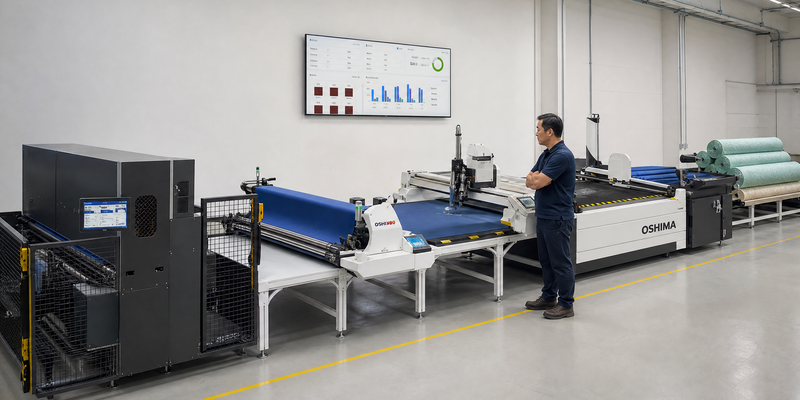
In many garment factories, labor pressure does not first show up as an empty position on an organization chart. It shows up when spreading cannot keep up with cutting, experienced operators are moved around to cover different jobs, inspection work starts to pile up, or supervisors spend more time arranging manpower than managing production.
This has become increasingly common in garment manufacturing. Factories in China and Vietnam are still producing for major global brands, but the labor conditions behind that production have changed. Wages are higher, workers have more choices, turnover is harder to control, and adding people during a busy period is no longer as easy as it once was.
For factories, the question is therefore no longer simply how to recruit more workers. It is how to keep production stable when labor itself is becoming less stable.
More Orders Do Not Always Mean More Workers
Vietnam remains an important apparel production base, and factories continue to receive opportunities as brands adjust and diversify their sourcing. But when orders increase, factories may not be able to increase manpower at the same speed.
Garment manufacturers are competing with electronics, services and other industries for workers. At the same time, employees are looking beyond wages at working conditions, commuting, management and longer-term job opportunities.
The difficulty becomes more obvious when order volumes change quickly. During peak periods, factories may need additional capacity within a short time. When orders slow again, the same factory has to manage idle lines and fixed labor costs. Using headcount as the main way to adjust capacity therefore becomes less flexible and more expensive.
China is moving in a similar direction, although the reasons are not exactly the same. Rising wages, demographic changes and competition from other manufacturing sectors have gradually reduced the advantage of production models built around large numbers of relatively low-cost workers.
Chinese garment factories still benefit from strong supply chains, production experience and manufacturing infrastructure. What is changing is where competitiveness comes from. Stable quality, fabric utilization, faster style changes, smaller order quantities and better production visibility now matter much more alongside labor cost.
When Labor Changes, Production Changes With It
The cost of unstable manpower goes beyond recruitment.
A new operator needs time before reaching the same speed and quality level as an experienced worker. When turnover is high, experienced employees also spend more time training, correcting and covering other positions. A factory may technically have enough people on the payroll but still feel short of manpower because too much skilled labor is being used to support repetitive work.
This becomes especially visible in fabric handling, inspection, spreading, packing and manual production recording. None of these activities looks like a major labor problem when viewed separately. Across an entire factory, however, they can consume a considerable amount of manpower every day.
Once labor becomes harder to replace, factories naturally start looking at which jobs actually require operator judgement and which jobs are still being done manually simply because that has always been the process.
This is where automation becomes relevant. The practical objective is not to remove people from the factory, but to reduce dependence on repetitive work in areas where manpower variation can affect the rest of production.
The Cutting Room Often Shows the Problem First
Spreading and cutting are one of the clearest examples because any instability here moves directly into the next production stage.
When spreading cannot keep up, cutting waits. When fabric tension, edge alignment or ply preparation varies, the result appears later in the cut parts. By the time those differences reach sewing, factories may be dealing with matching problems, inconsistent dimensions or additional correction even though the original problem began much earlier.
Automatic spreading reduces repeated fabric handling and makes tension, edge alignment, spreading length and ply count less dependent on individual operator technique. This becomes particularly useful when the same cutting room needs to handle different fabrics, frequent style changes or fluctuating production volumes.
Automatic cutting continues the same process. Working with marker and CAD/CAM information, it helps maintain more consistent cut parts and reduces the amount of manual correction required before sewing.
The important point is not simply how many operators one machine can replace. A more stable spreading and cutting process gives the sewing line a more predictable input. That is often where the larger production benefit appears.
Finding a Fabric Defect Is Only the First Step
Fabric inspection has a similar problem.
Finding a defect is useful, but the value becomes limited when its location remains on a paper report or only in the inspector's experience. The more important question is what happens to that information when the fabric moves into spreading and cutting.
Manual inspection still has an important role because fabric quality often requires experienced judgement. At the same time, inspecting large volumes for long periods can be affected by fatigue, inspection speed and differences between operators.
AI fabric inspection adds another layer by recording defect images, positions and inspection results in a form that can be stored and reused. This makes the inspection result more than a pass-or-fail decision at one machine.
The larger benefit appears when that information continues downstream.
Defect locations can support decisions on fabric-roll use, spreading and cutting before defective areas become defective cut parts. Factories have a better chance to avoid unnecessary fabric loss or recutting when the cutting room knows where the problem is before the fabric is laid and cut.
This is also where information flow becomes as important as material flow. A factory may automate fabric movement successfully and still lose time when inspection records, machine status and production progress continue to move through paper, verbal handovers and separate spreadsheets.
When Manpower Is Limited, Visibility Matters More
As factories operate with tighter manpower, supervisors often have to manage more equipment and more production at the same time.
Machine status, spreading progress, downtime and inspection information may already exist somewhere on the factory floor. The difficulty is that management often sees the information only after someone collects and reports it.
IoT-connected equipment and production dashboards shorten this gap. Machine operation, production progress and abnormal conditions can be seen earlier, making it easier to understand where production is slowing or where attention is required.
This becomes more relevant for manufacturers operating several factories or managing production across different countries. Relying on phone calls, messages and end-of-day reports makes it difficult to understand what is happening at each location at the same time.
Data does not solve a production problem by itself. Its value is that the factory can see the problem sooner and respond before a small delay becomes a larger production issue.
The Work People Do Will Change as Well
Automation changes where people are needed rather than making experience less important.
Garment factories will continue to need operators who understand fabric, quality and production. But more of these roles will involve equipment operation, checking system results, handling abnormalities, reading production information and performing basic machine management.
An experienced employee who spends less time moving fabric or repeatedly entering the same information can spend more time on quality decisions, troubleshooting and supervising equipment.
This can also make production less sensitive to individual operators. When a process depends entirely on one person's experience, every absence or resignation creates risk. Equipment and digital records can preserve more of the process condition and production information, making it easier for the next person to continue the work.
The objective is not a factory without people. It is a factory where experienced people are not spending most of their time on work that can be handled more consistently by equipment.
Buying Equipment Should Solve a Production Problem
Labor pressure can make automation attractive, but adding machines without looking at the whole process can simply create a different bottleneck.
A lower-priced machine provides little advantage when frequent downtime, difficult spare-parts supply, poor compatibility with the factory's main fabrics or slow service begins affecting delivery. The same applies to equipment that works well by itself but cannot exchange useful information with the rest of the production process.
Factories therefore need to look beyond the purchase price and consider how the equipment fits into actual production.
Can spreading keep up with cutting? Can inspection information be used later? Can production data be accessed without another person recording it manually? Can operators handle different fabric types and styles without creating another complicated process?
These are more useful questions than simply asking how many workers a machine can save.
OSHIMA's related solutions currently include EagleAi AI fabric inspection, smart spreading, automatic cutting, needle detection, and equipment and production-data integration. Beyond individual machines, fabric-defect locations and quality data generated during inspection can also be carried forward into spreading and cutting, with projection and marking used to support later production stages.
For factories, automation is not only about adding equipment. It also depends on how well machines and production data connect with the existing workflow, reducing repeated recording, manual handovers, and information gaps between processes.
Where Should a Factory Start?
Labor conditions in China and Vietnam are different, but the production challenge is becoming similar. Adding more people is no longer the easiest answer every time capacity becomes tight.
That does not mean every factory needs to automate everything.
A more practical starting point is the process where manpower dependence is already creating a visible production consequence: spreading that cannot keep up with cutting, inspection records that never reach the cutting room, repetitive manual recording, too much fabric handling, or a process whose output changes significantly depending on who is operating it.
Once that part becomes more stable, the benefit usually continues downstream.
For garment factories facing labor pressure, the goal is not simply to use fewer people. It is to make production less dependent on manpower changing from one day, one order or one season to the next.


Article Classification
Recent Articles
- Why Are Garment Factories Struggling to Recruit Young Workers?
- What Does the World Cup Have in Common with Apparel Sourcing?
- Why Garment Factories Need Process Stability in a Slower Market?
- Why Scale and Low Cost Are No Longer Enough for Bangladesh Apparel Manufacturing?
- Why Extreme Heat Is Becoming a New Risk for Apparel Supply Chains?