
 0
0



- Home
- Blog
- Smart Manufacturing
- From Paper Reports to Digital Command Centers: The Future of Factory Management
From Paper Reports to Digital Command Centers: The Future of Factory Management
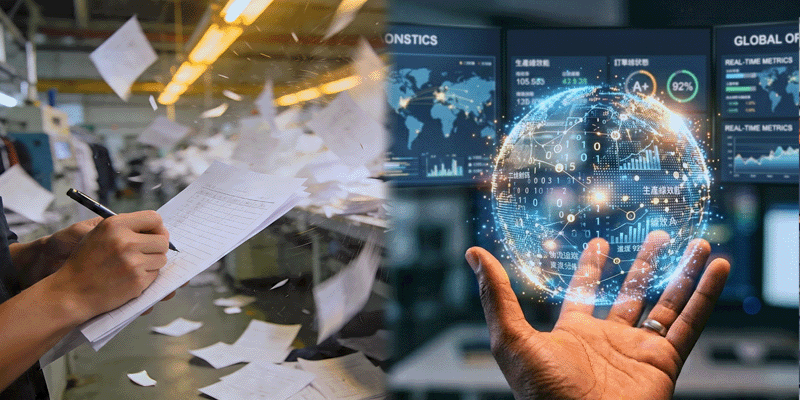
In the digital industrial era, data dashboards have become an important tool for factory management. They are also often called digital dashboards, data command centers, or factory control rooms.
In the past, many factories relied on paper records, Excel files, or verbal updates from production staff to understand production status.
These methods can still work, but as machines increase, orders become more complex, lead times become shorter, and quality requirements become stricter, manual data collection can easily create delays, errors, and information gaps.
The value of a data dashboard is that it brings information from different machines, processes, and departments into one visual interface.
Managers can see what is happening in the factory in real time.
For garment and textile factories, data dashboards are not only management tools. They are becoming a foundation for improving efficiency, reducing waste, improving quality, and responding to sustainability requirements.
What Is a Data Dashboard?
A data dashboard is a management interface that visualizes production data.
It uses charts, numbers, alerts, trend lines, and status indicators to turn complex data into information that is easy to understand.
In manufacturing, a dashboard can show:
Machine status.
Production progress.
Output data.
Downtime.
Quality abnormalities.
Energy use.
Inventory status.
Order progress.
Maintenance records.
Key performance indicators.
A good dashboard does not put every piece of data on the screen. It helps managers see the most important information quickly and respond when abnormalities occur.
Dashboard vs. Report: What Is the Difference?
Many factories already have reports, but reports and dashboards serve different purposes.
Reports are usually used for after-the-fact analysis. They provide detailed data, explanations, and statistics for a specific period. They are suitable for monthly meetings, audits, improvement plans, and management reviews.
Dashboards are better for real-time management. They show current or recent production conditions and help supervisors decide whether to adjust labor, machines, schedules, or materials.
In simple terms:
Reports answer: What happened in the past?
Dashboards answer: What is happening now?
If a factory relies only on reports, problems may be discovered too late.
With real-time dashboards, managers can detect abnormalities earlier and respond before problems grow.
Core Values of Data Dashboards in Manufacturing
1. Real-Time Production Visibility
One of the most common problems in manufacturing is that managers cannot see the true production status in real time.
How long has a machine been stopped?
Is a work order behind schedule?
Is one shift producing below target?
Is one process creating a waiting queue?
A dashboard can show this information in real time.
Managers no longer need to wait until the end of the day to review reports.
This is especially important for factories with multiple machines, production lines, or locations.
2. Identifying Production Bottlenecks
Low factory efficiency does not always mean every process is slow.
Often, one bottleneck affects the entire production line.
Dashboards help managers compare performance between machines and processes.
For example:
Is fabric inspection slowing down spreading?
Is fabric waiting after spreading before cutting?
Are cut panels accumulating after cutting?
Are needle detection and packing slowing shipment?
When data becomes visual, bottlenecks become easier to see.
This helps factories move from experience-based management to data-based improvement.
3. Improving Quality Response Speed
Quality problems become more expensive when they are discovered late.
Dashboards can integrate fabric inspection, needle detection, checkweighing, scanning, defect records, and abnormal alerts to help factories respond faster.
For example, if an AI fabric inspection machine finds a higher defect rate in one fabric batch, the dashboard can alert management.
If a needle detector records an abnormal event, quality control staff can track it more quickly.
Quality management is not only about inspection. It is about detecting, recording, and handling problems early.
4. Improving Resource and Energy Use
Factories consume many resources during production, including fabric, electricity, steam, compressed air, fuel, and labor.
Without data, it is difficult to know where waste happens.
Dashboards help factories track machine running time, downtime, energy use, and output.
If one machine consumes a lot of energy but produces little output, the factory can further check machine condition, scheduling, or maintenance.
For factories facing rising energy costs and green supply chain requirements, energy and resource visibility is an important step toward sustainable management.
5. Supporting Inventory and Material Management
Manufacturing problems are not only about production speed.
They also include material shortages, inaccurate inventory, and unclear material use.
If dashboards can connect with ERP, inventory systems, or scanning systems, managers can track raw materials, work-in-progress, and finished goods more clearly.
In garment factories, this can apply to fabric batches, cutting progress, needle detection results, packing quantities, and shipment status.
When inventory and production data become more transparent, factories can reduce waiting, mismatch, and repeated manual confirmation.
Why Garment Factories Need Data Dashboards
Garment production has long workflows, many machines, many people, and a large amount of data that is often manually reported.
From fabric inspection, relaxation, spreading, cutting, sewing, ironing, needle detection, and packing, every process can create an information gap.
If each machine works separately, managers cannot easily understand overall production status.
Even if one machine is efficient, the entire production line may still suffer from waiting, rework, or errors caused by poor data visibility.
Data dashboards help garment factories gradually connect different processes and build a clearer management structure.
For example:
AI fabric inspection data can show fabric defect status.
Smart spreading machine data can show spreading length, layer count, and progress.
Automatic cutting machine data can help track cutting status.
Needle detection data can support final safety records.
Scanning and packing data can reduce shipment errors.
When these data points are shown in one place, factories can decide more quickly which process needs adjustment.
How to Start Dashboard Integration
Many factories worry that digital dashboards are difficult to integrate, especially when they use many machine brands or do not have enough IT resources.
These concerns are reasonable.
For this reason, factories should not begin by trying to build a complete control room at once. They should start from the clearest pain point.
1. Define the Management Goal First
Factories should first ask: What problem do we want the dashboard to solve?
Is production progress unclear?
Is downtime hard to track?
Are quality records incomplete?
Is energy cost too high?
Are inventory and shipment errors common?
Different goals require different data.
Factories should not try to put every data point on the dashboard from the beginning.
2. Start with Key Machines
For garment factories, it is practical to start with machines that strongly affect output or quality.
Examples include AI fabric inspection machines, smart spreading machines, automatic cutting machines, needle detectors, or scanning and packing systems.
Once key machine data is clear, the factory can gradually expand to more processes.
3. Choose Equipment with Long-Term Integration Capability
If a factory wants to digitalize gradually, machine data output, system compatibility, and supplier support should be part of purchasing evaluation.
When buying machines, factories should not look only at mechanical functions.
They should also consider data capability.
4. Make the Dashboard Easy for People to Use
If the dashboard is too complicated, people will not use it.
A good dashboard should be designed by role.
Owners need an overview.
Factory managers need output and abnormality data.
Line supervisors need machine status and work order progress.
Quality control staff need defect and inspection records.
Layered information is more important than showing everything at once.
How Dashboards Support Sustainable Manufacturing
The connection between dashboards and sustainability is not only about making nice reports.
Dashboards help factories see waste.
For example:
Long machine downtime means capacity and energy waste.
High fabric defect rates may lead to rework and rejection.
High cutting waste means fabric utilization needs improvement.
Abnormal energy use may indicate machine efficiency issues.
Excess inventory may create material and capital waste.
When waste becomes visible, factories can improve it.
This is why dashboards are not only digital tools. They can also become a management foundation for sustainable and greener manufacturing.
How OSHIMA Helps Factories Build Data Dashboards
OSHIMA has long supported the garment and textile industry and understands the practical challenges factories face during digitalization.
Many garment factories use equipment from different brands and have fragmented workflows. Integrating all machine data independently can require time, labor, and technical resources.
For this reason, OSHIMA continues to develop smart equipment and digital functions that are easier to connect and manage.
For example, SPro smart spreading machines can return spreading data and machine status. AI fabric inspection machines can provide defect data and quality reports. Other machines with data output capability can also gradually be included in digital dashboards.
For factories, the most practical approach is not to complete all integration at once.
It is to begin with the most critical processes and gradually turn machine data into useful management information.
OSHIMA’s direction is to help customers not only purchase equipment, but also build clearer, faster, and more efficient factory management systems.
Conclusion
Data dashboards have become an important tool in manufacturing digitalization.
They help factories visualize production, machine, quality, energy, and inventory data in one place so managers can understand factory conditions and make decisions faster.
For garment and textile factories, dashboards do more than improve management efficiency.
They help reduce waste, improve quality, optimize resources, and support sustainable manufacturing.
Dashboard implementation does not need to happen all at once.
Factories can begin with clear management pain points such as production progress, downtime, quality inspection, or energy use, then gradually connect more machines and processes.
Successful digitalization is not about having more data.
It is about making data clearer, faster, and more useful for decision-making.
If your factory is planning digital transformation, a data dashboard is a practical and important starting point.


Article Classification
Recent Articles
- If Every Machine Is Running, Why Does the Factory Still Feel Stuck?
- AI Fabric Inspection: Turning Fabric Defects into Cutting Room Decisions
- Where Does a Garment Factory Lose Energy During Production?
- What Changes When Garment Factory Data Becomes Connected?
- How Garment Factories Can Boost Fabric Utilization and Cut Waste?