
 0
0



- Home
- Blog
- Smart Manufacturing
- What Changes When Garment Factory Data Becomes Connected?
What Changes When Garment Factory Data Becomes Connected?
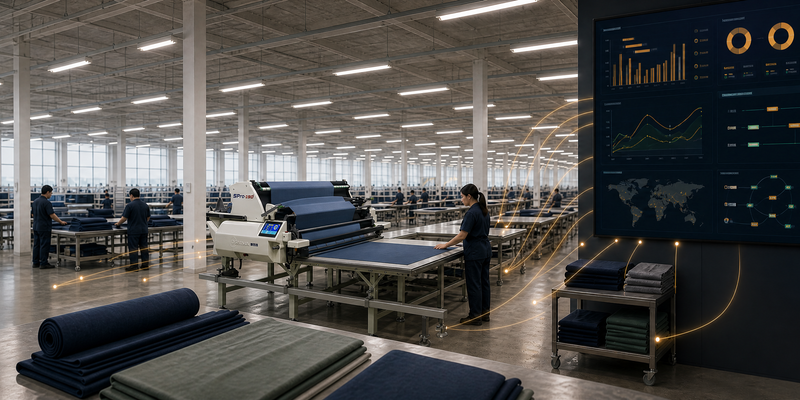
Garment factories have always depended on production information. What has changed is how quickly that information can move. Spreading records, inspection results, machine status, output and abnormal events that once remained on paper or inside individual departments can now appear on a dashboard while production is still running.
For factory management, this shorter information delay is useful. A production manager can see that a process has stopped or fallen behind without waiting for an end-of-shift report. Groups operating several factories can also review production conditions without relying entirely on information passed through several levels of management.
Once this information begins moving between machines, factory networks and cloud systems, however, it becomes part of the factory's digital infrastructure. Production visibility and data security therefore need to be considered within the same operating process.
Production Visibility Changes the Value of Factory Data
The same information used for faster decisions can also reveal capacity, quality, schedules and customer activity
In a conventional workflow, spreading length, ply count, downtime, inspection results and output may be recorded manually. The information still has value, but it often remains fragmented until somebody collects and summarizes it.
Connected equipment changes the timing. Machine status and production records can be collected automatically and presented through a digital dashboard while the work is taking place.
In the cutting room, for example, spreading equipment may provide spreading length, layer count, machine status and production records, while an AI fabric inspection system produces defect-location and inspection data. Bringing these records into a common view gives management a clearer picture of what is happening before cutting and how the fabric-preparation process is progressing.
This reduces dependence on handwritten reporting and can help management respond earlier to delays or capacity constraints.
The information also becomes more commercially meaningful once it is gathered together. Order quantities, production capacity, customer information, quality records, machine utilization and schedules can reveal much more about factory operations collectively than any single machine record does on its own.
That is why data security starts to matter as production visibility improves.
Access Control Becomes Part of Daily Factory Management
Production, quality, customer and support information should not be equally visible to every user
A factory dashboard rarely has only one type of user. Management may need a group-level view. Production supervisors need information for their own lines or departments. Operators may need machine-level functions, while maintenance staff and outside technical support require different access again.
Giving all of these users the same permissions creates unnecessary exposure.
Factories therefore need to decide who can see, change, download or export different types of information. Accounts belonging to employees who have left the company also need to be disabled rather than remaining available simply because nobody reviewed the user list.
The same principle applies when customer and production information is involved. An OEM or ODM factory may hold order details, brand information, quality records and production schedules that should not automatically be available to every system user.
Role-based access becomes part of operating discipline in the same way that physical production areas have different responsibilities. The people operating a machine, supervising a process, maintaining equipment and reviewing group performance do not require identical access simply because they use the same digital platform.
Secure login practices support this control. Password information should be handled using appropriate irreversible protection methods rather than stored as readable text, and multi-factor authentication can be considered for important accounts.
Remote Maintenance Adds Another Access Point to the Factory
A service connection should have a defined purpose, approval process, access period and record
Connected equipment can make remote technical support more practical. A supplier may be able to assist with system problems or updates without immediately sending a technician to the factory.
From an operating perspective, however, remote maintenance means allowing someone outside the production site to connect to part of the factory's system.
This should be managed deliberately.
Factories should confirm how suppliers establish remote connections and whether methods such as VPNs, encrypted communication, multi-factor authentication, firewalls, allowlists and connection logs are being used where appropriate.
The operating procedure around the connection is equally important. A factory should know who approves remote access, when the connection begins, what the service team is permitted to access and when the session is closed.
Leaving permanent or uncontrolled remote access available for convenience creates a different risk from allowing temporary access for a defined service task.
As more equipment becomes connected, supplier evaluation therefore extends beyond mechanical reliability and technical support. Factories also need to understand how outside service personnel enter the digital side of the production environment.
Backup Planning Is Part of Production Continuity
Stored production data has operational value only when the factory can recover it after a failure
Paper records have obvious limitations, but factories know where the paper is. As production information moves into digital dashboards and cloud systems, another set of questions becomes necessary.
How often is the information backed up? Where is the backup stored? How far back can records be recovered? Who is responsible for recovery? How long would restoration take after a problem?
Hardware failures and system errors can interrupt access to production data. Natural disasters and cybersecurity incidents can create the same problem.
For this reason, backup should be planned according to the business importance of the information. Customer orders, production reports, machine records and quality information may require different backup frequencies or retention periods.
Keeping another copy of the data is only part of the work. Recovery procedures also need to be tested. A backup that has never been restored provides less certainty than it appears to provide on a checklist.
For factories increasingly using digital information for scheduling and management decisions, data recovery is part of keeping production management functioning when the normal system is unavailable.
Daily User Behavior Still Determines How Secure a System Remains
New connected tools need clear operating rules for accounts, passwords, files and removable devices
Many factory security problems do not begin with a highly sophisticated attack. They can begin with familiar behavior: shared passwords, accounts used by several employees, suspicious email links, unauthorized USB devices, passwords written where others can see them or production information forwarded through personal messaging accounts.
Technical controls cannot fully compensate for unclear working practices.
When a factory introduces a dashboard or connected machine, user training should therefore include more than operating the software. Employees need to know what information is considered sensitive, whether accounts may be shared, how passwords should be handled, what files may be exported and whom they should inform when they notice unusual system behavior.
This does not require every garment factory to establish a large cybersecurity department before installing connected equipment.
It does require ownership.
Someone needs responsibility for account creation and removal, access changes, abnormal events and basic security rules. As with machine operation, a process becomes more stable when responsibilities are understood rather than assumed.
Data Ownership Needs to Be Clear Before Connected Systems Expand
Factories should know where information is stored, who controls it and what customers or local requirements expect
Cloud-based production systems introduce questions that do not arise when information remains entirely inside one machine.
Factories should understand which information belongs to the factory, which information is managed by the equipment or software supplier, what customers can view and what remains restricted to internal users.
Before expanding a connected system, management should also understand where data is stored, how it is backed up, who can access or export it and how information can be deleted when required.
These questions become more important for manufacturers operating across several countries or handling customer, employee and supplier information across borders.
Applicable requirements can differ by country, customer and contractual relationship. For export-oriented garment factories, data management may therefore enter buyer requirements, audits and commercial responsibilities alongside the technical considerations.
The practical approach is to settle these points while the connected environment is still manageable rather than after machines, sites and user accounts have multiplied.
Connected Production Needs the Same Discipline as Physical Production
OSHIMA Smart Factory Platform connects production visibility with the responsibility to manage how factory data is used
As more production information moves beyond individual machines, factories need to think about the system around that data as carefully as the equipment generating it. Account permissions, remote access, backup procedures and day-to-day user practices all affect whether connected production remains manageable over time.
This is also where the OSHIMA Smart Factory Platform fits into the production flow. OSHIMA's smart spreading equipment, AI fabric inspection and related connected systems can generate production information at different stages, while the platform provides a digital environment for bringing factory data into production management.
Within OSHIMA's cloud system design, sensitive information such as account passwords and personal information is handled using hash functions and irreversible password processing. Cloud data is also desensitized where appropriate, while user data and transaction data are separated through a layered architecture to reduce the impact of data exposure.
For the factory, however, system design is only one part of the picture. Before connecting another machine or expanding the use of a production dashboard, management should still confirm who needs access, how remote service will be controlled, how important records will be recovered and who is responsible for maintaining these rules.
Connected equipment can shorten the time between what happens on the production floor and what management can see. The tools have changed, but the underlying manufacturing principle has not: a production system remains reliable when responsibilities are clear, processes are controlled and there is a practical way to recover when something goes wrong.


Article Classification
Recent Articles
- If Every Machine Is Running, Why Does the Factory Still Feel Stuck?
- AI Fabric Inspection: Turning Fabric Defects into Cutting Room Decisions
- Where Does a Garment Factory Lose Energy During Production?
- What Changes When Garment Factory Data Becomes Connected?
- How Garment Factories Can Boost Fabric Utilization and Cut Waste?