
 0
0



- Home
- Blog
- Smart Manufacturing
- AI Fabric Inspection: Turning Fabric Defects into Cutting Room Decisions
AI Fabric Inspection: Turning Fabric Defects into Cutting Room Decisions
Many garment factories do not question the need for fabric inspection. They question whether AI fabric inspection is worth the investment when experienced inspectors are already doing the job.
That hesitation is understandable. For most factories, automation is not attractive just because it looks advanced. It only matters when it solves a real production problem. If AI fabric inspection is compared with manual inspection only by speed, headcount, or inspection cost, the discussion quickly becomes a cost calculation.
But for the cutting room, the bigger issue is not only whether defects are found. It is whether defect information can still be used when the fabric moves into spreading and cutting.
The stronger value of AI fabric inspection is not simply that it detects defects. It is that defect information can become usable production data. When defect location, defect type, image records, and roll information are saved in a structured way, fabric inspection no longer ends with a report. It becomes a data source for spreading, cutting, and quality management.
That is why AI fabric inspection should not be treated only as a replacement for manual inspection. A better way to understand it is this: AI gives the cutting room a way to use fabric information before cutting decisions are made.
Manual Inspection Still Matters, but It Does Not Always Leave Usable Data
Manual fabric inspection has clear strengths. Experienced inspectors understand fabric hand feel, surface condition, shade variation, texture changes, and the quality standards of different customers. Some defects still need human judgment, especially when the fabric is complicated, the customer standard is specific, or the defect requires on-site review.
The issue is not that experienced inspectors are less valuable. The issue is that their judgment often stays with the person instead of becoming information the whole process can use.
Long hours of visual checking can lead to fatigue, and judgment may change with time, workload, and operator experience. Different inspectors may also classify the same defect differently. In a factory environment, this is not unusual.
The bigger issue often appears after the defect is found. If the defect position is written on paper, marked manually on the fabric edge, or passed to the next process through verbal communication, the information can become unclear before spreading or cutting starts. A mark can be missed. A position can be misunderstood. A report can stay in a folder while the fabric has already moved forward.
So the better comparison is not only whether AI or people can find defects faster. The more useful question is whether defect information can be saved, transferred, traced, and used in the next production decision.
Low Labor Cost Can Still Hide Real Cost
In some regions, labor cost still looks relatively manageable, so the investment in AI fabric inspection may seem less urgent. But the real cost of manual inspection is not only the salary of one inspector.
One hidden cost is quality stability. Different people may judge defects differently, and the same person may perform differently across a long shift. If defects are missed, grading becomes inconsistent, or fabric problems are discovered only after cutting, the factory may face rework, claims, returns, or damage to customer trust.
Another hidden cost is the data gap. An inspector may see holes, oil stains, snags, shade marks, or crease-related defects. But if this information is not digitalized, spreading and cutting teams cannot easily use it. For brands that increasingly care about transparency and quality tracking, quality information that was seen but not recorded is still difficult to manage.
There is also a communication cost. When defect positions are transferred manually between inspection, spreading, and cutting, errors can happen through unclear marking, wrong positioning, missing information, or misreading on the floor. These problems may not happen every day, but when they happen on a high-value order, the loss can be significant.
This is where AI fabric inspection becomes more relevant. Its value is not to remove people from the factory. It is to reduce the parts of the process that are most likely to create errors, hardest to trace, and hardest to standardize.
The Core Value Is a Digital Defect Map
Traditional fabric inspection often stops at two outputs: defects are found, and a report is created. For the cutting room, that is not enough. The more important questions are where the defect is, whether it affects marker planning, whether it should be avoided during spreading, and whether it needs to be reviewed again before cutting.
AI fabric inspection can record defect location, defect type, and image data during inspection, creating a digital defect map for each fabric roll. When this information is connected to later processes, the factory can understand the condition of each roll before cutting begins.
For example, if a roll contains oil stains, holes, shade marks, snags, or other defects, the system does not only say that the roll has a problem. It records where the defect appears, what type of defect it is, what the image shows, and whether the defect should be avoided or checked again later.
This changes how the cutting room works. Managers can review fabric quality with clearer records instead of relying mainly on verbal updates. Spreading and cutting operators can see defect positions earlier, reducing last-minute judgment pressure. If a customer requests quality evidence, the factory can provide more complete digital records instead of trying to explain the situation after the fact.
The important part of AI inspection is not only that defects are visible. It is that defect data becomes usable.
The Real Question Is What Happens After Detection
When factories evaluate AI fabric inspection, they often focus on whether AI can detect a certain defect. That is important, but it is not the full question. A more practical question is what the factory does after AI finds the defect.
If AI fabric inspection only creates a report, and that report remains separate from production, its value for the cutting room is limited. The value becomes much stronger when defect data can move into spreading, projection-assisted review, and cutting. This is the logic behind a smart cutting room.
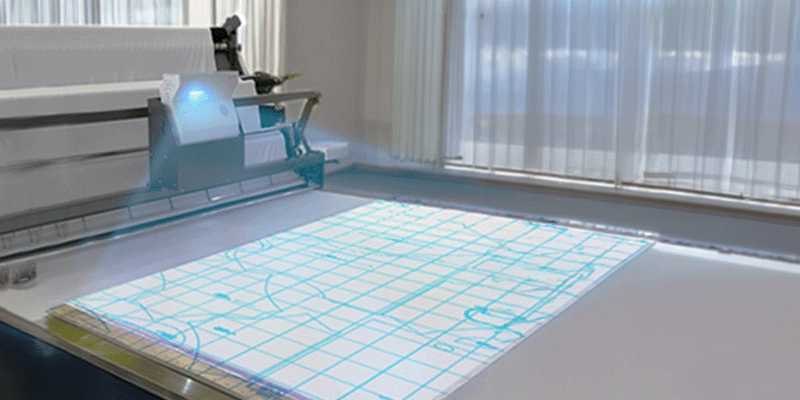
AI fabric inspection converts fabric defects into structured data. Smart spreading can use roll and defect information to help operators understand fabric conditions before and during spreading. A projection system can then display defect positions on the laid fabric, so workers can confirm them on site.
In this setup, AI is not making every decision by itself. It is giving people better information before they make decisions.
That matters for factories with higher quality requirements. Human experience is still needed for judgment, especially for difficult fabrics or customer-specific standards. Projection assistance connects AI’s data-recording ability with the operator’s on-site judgment. This is a more realistic form of human-machine collaboration than simply asking whether AI will replace people.
AI Fabric Inspection Can Support Fabric Utilization
As material costs rise and sustainability expectations become stronger, fabric waste is no longer only a production cost. It is also part of how brands evaluate supply chain performance.
AI fabric inspection helps factories understand defect positions earlier, giving spreading and cutting teams a better chance to plan how fabric should be used. When defect data enters the cutting room, the factory can reduce wrong cutting, rework, or rejection caused by unclear information.
This should not be exaggerated into a fixed saving percentage. The actual result depends on fabric type, defect rate, marker planning, cutting workflow, and factory management. A factory with frequent defects and poor data transfer may see a different result from a factory that already has strong inspection discipline.
Still, the direction is clear. When defect information is earlier, clearer, and easier for later processes to use, the factory has a better chance to improve material use through data. The sustainability value of AI fabric inspection is therefore not only faster inspection. It is that quality information can become part of production decisions, helping reduce waste that could have been avoided.
Human Value Changes Instead of Disappearing
For garment factories, the most realistic transformation is not removing all workers. It is changing where human experience is used.
Experienced fabric inspectors can move toward higher-value work, such as building defect standards, helping calibrate AI judgment, reviewing special fabrics, managing customer quality rules, or analyzing recurring defect sources. These are tasks where experience matters more than simply watching fabric pass for long hours.
AI can handle long-hour inspection support, data recording, defect location organization, and information transfer to later processes. This division of work is more practical than a simple “AI versus people” discussion.
A future smart cutting room will not depend only on AI, and it will not return fully to manual work either. It will depend on AI, machinery, and people working together: AI records and organizes, equipment carries the data into the process, and people make judgments, manage exceptions, and improve standards.
Human value does not disappear. It moves closer to decision-making and process control.
Bring Defect Data into the Cutting Process
Whether AI fabric inspection is worth the investment should not be judged only by whether it can replace manual inspection. The key question is whether it can bring defect data into later production processes.
If AI fabric inspection stops at producing reports, its value will be limited. But if AI inspection data connects with smart spreading, projection assistance, and the cutting process, it can help factories reduce manual transfer errors, improve fabric utilization, strengthen quality tracking, and move the cutting room closer to data-based management.
For garment factories facing labor shortages, cost pressure, quality demands, and sustainability expectations, AI fabric inspection is not only an equipment purchase. It can become the starting point for cutting room digitalization.
This is also why OSHIMA looks at AI fabric inspection as part of a broader smart cutting room workflow. The goal is not only to inspect fabric, but to connect defect records with spreading, on-site review, and cutting decisions. When inspection data can move forward with the fabric, factories are no longer leaving quality information inside a report. They are bringing it into the process where cost, quality, and delivery are directly affected.
That is the real value of AI fabric inspection. It does not stop at finding defects. It helps the factory understand where the defects are, how they should be handled, how they can be traced, and how that information can support the cutting process.


Article Classification
Recent Articles
- If Every Machine Is Running, Why Does the Factory Still Feel Stuck?
- AI Fabric Inspection: Turning Fabric Defects into Cutting Room Decisions
- Where Does a Garment Factory Lose Energy During Production?
- What Changes When Garment Factory Data Becomes Connected?
- How Garment Factories Can Boost Fabric Utilization and Cut Waste?