
 0
0



- Home
- Blog
- Equipment Knowledge
- Why Garment Factories Need Better Pressing Tables for a Cleaner Final Finish?
Why Garment Factories Need Better Pressing Tables for a Cleaner Final Finish?
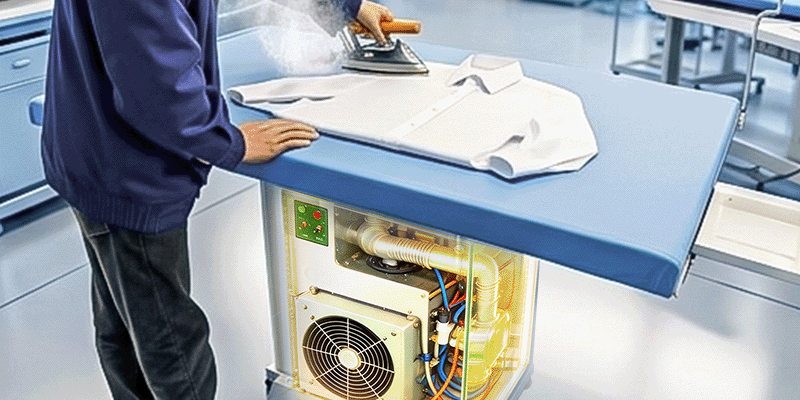
In garment production, pressing is not only about removing wrinkles. For factories, pressing is part of the finishing process and affects garment appearance, dimensional stability, crease formation and final shipment quality. A household iron is usually used for daily clothing care, mainly to make garments look neat. An industrial ironing table, however, is designed for long hours, high frequency and high-volume production. It is not only a flat surface for placing garments. It works together with steam, pressure, vacuum suction and up-air functions to help operators finish garments more consistently.
For garment factories, the difference between simple ironing and professional finishing lies in the ability to control fabric condition. Steam helps fibres become easier to shape. Pressure helps form a flat surface or crease. Vacuum suction removes moisture and heat so the fabric cools and stabilizes faster. When these conditions are controlled well, the pressing result becomes more consistent. When factories rely only on manual skill and a basic table, the result can be affected by workers, fabric behaviour and the production environment.
What Conditions Matter in Professional Pressing?
Garment finishing usually involves several conditions at the same time: heat, moisture, pressure and cooling.
Heat
Heat temporarily makes fibres easier to shape and helps remove wrinkles or create the required form. Different fabrics tolerate different temperatures, so pressing temperature should be adjusted according to the material.
Moisture
Steam helps fibres swell and become easier to handle. For cotton, linen, wool and some blended fabrics, proper steam can improve pressing results. However, too much moisture or insufficient drying may cause moisture rebound, pressure marks or wrinkles after cooling.
Pressure
Pressure helps fabric form a smooth surface or crease in specific positions, such as trouser creases, shirt plackets, pockets, cuffs or jacket parts. Too little pressure may not give enough shape. Too much pressure may cause marks or unwanted shine.
Vacuum suction
Vacuum suction is one of the key differences between an industrial ironing table and a basic ironing surface. Suction helps hold the garment in place and removes steam, moisture and heat from the fabric. This helps the garment stabilize more quickly after pressing and reduces the chance of wrinkles returning after cooling.
Why Vacuum Suction Matters
One common issue in factory pressing is that a garment looks smooth immediately after ironing, but wrinkles return after it cools. This is often related to remaining moisture, heat and insufficient setting. A vacuum ironing table pulls steam and moisture downward through the fabric during pressing. This helps the garment dry faster and stay more stable on the table. It is especially useful for shirts, trousers, uniforms, jackets and garments that require clear creases. Vacuum suction also helps operators hold fabric panels more easily during pressing, reducing garment movement. In mass production, this affects not only the appearance of one garment, but also the stability of the whole finishing line.
When Is the Up-Air Function Useful?
In addition to suction, some industrial ironing tables include an up-air function. Up-air creates airflow from the table surface, allowing the fabric to float slightly and reducing the effect of direct pressure from the iron.
This is useful for delicate fabrics that are more likely to develop pressure marks or shine, such as some silk-like fabrics, knits, pile surfaces or sensitive synthetic materials. When a fabric should not be pressed too heavily, up-air allows operators to finish the surface more gently.
How Industrial Ironing Tables Support Long-Hour Production
Garment factory pressing is rarely a small or short operation. Finishing lines may need to process large quantities of garments continuously, so equipment stability and operator comfort both matter. Industrial ironing tables usually place more emphasis on table flatness, heat resistance, suction efficiency and structural strength than ordinary ironing boards. If the table surface deforms or suction becomes unstable, pressing quality may be affected during long production hours.
Table height and operator posture also influence work stability. Pressing requires workers to stand for long periods, move garments and operate irons repeatedly. If the table height is unsuitable, operators may become tired more quickly, and consistency may decline. Adjustable height or designs that match factory operating habits can make finishing work smoother. For factories, an industrial ironing table is not only about making one garment look good. It must support large-scale, repetitive and consistent pressing work every day.
How Professional Pressing Affects Garment Quality
Pressing is an important process before shipment. After sewing, many garments still require pressing to make the final appearance cleaner and to define seams, plackets, collars, cuffs, trouser creases or pocket positions.
For shirts, pressing affects collar, cuff and placket sharpness.
For trousers, pressing affects creases, waistbands and hems.
For jackets, pressing affects shoulder lines, front panels and overall shape.
For uniforms and formal garments, pressing directly affects the first impression when the product arrives.
If pressing is unstable, garments may show returning wrinkles, pressure marks, unwanted shine, inconsistent creases or untidy appearance after shipment. These issues do not always come from sewing. They can also come from an unstable finishing process. This is why an industrial ironing table is valuable to garment factories. It is not only about appearance. It helps make the final finishing process more stable.
Start Improving Pressing from Finishing Stability
For garment factories, choosing a professional ironing table should begin with the actual product and production conditions. Does the factory handle shirts, trousers, jackets, uniforms, knits, delicate fabrics or silk-like materials? How many garments need to be pressed each day? Does the finishing line often face returning wrinkles, pressure marks, fabric shine or operator fatigue?
OSHIMA provides compact and adjustable industrial ironing tables with vacuum suction and up-air functions, helping factories adjust pressing methods according to garment type and fabric condition. For garment factories that press for long hours, table stability, suction performance and operator comfort all affect finishing quality and workflow efficiency.
An industrial ironing table is not a minor accessory in the finishing line. When a factory wants to improve garment appearance, reduce wrinkles after pressing or support more stable operator performance during long production hours, a professional ironing table is worth considering in the next finishing process review.


Article Classification
Recent Articles
- The 30-90-180 Day Rule for Industrial Boiler Maintenance
- How Garment Machinery Supports Safety, Compliance and Environmental Management?
- What Happens Before Fabric Goes to the Cutting Table?
- Industrial Iron & Vacuum Table Care: How to Extend Their Lifespan
- Cutting Floor ROI: How the M8s and TAC Save $100K Annually