
 0
0



- Home
- Blog
- Equipment Knowledge
- What Happens Before Fabric Goes to the Cutting Table?
What Happens Before Fabric Goes to the Cutting Table?
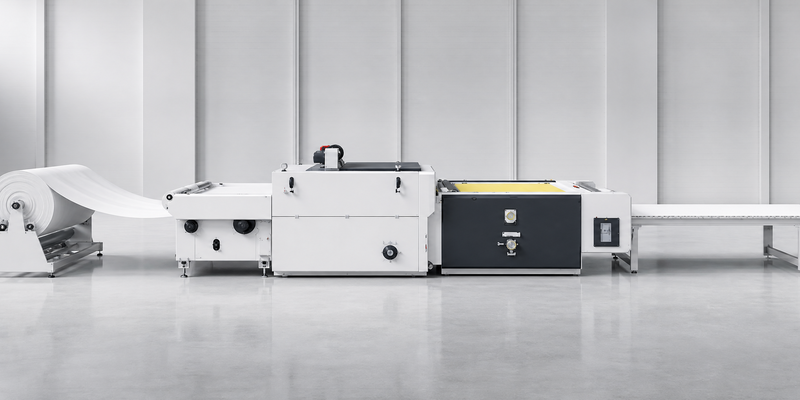
In garment production, fabric is rarely in exactly the same condition when it reaches the cutting room as when it left the mill.
During knitting or weaving, dyeing, finishing, rolling and transportation, the material goes through different levels of tension, pressure, heat and moisture. Once the roll is opened, some of that tension begins to release, and the fabric may continue to change slightly in width, length or alignment before it settles.
For the cutting room, this timing matters. A fabric roll may look flat and ready to use but still need time to relax or additional treatment before spreading and cutting. Depending on the material, this could mean natural resting, mechanical relaxation, steam treatment or pre-shrinking.
These processes are often grouped together, but they do not address exactly the same type of dimensional change. Understanding what the fabric needs before cutting makes it easier to choose the appropriate treatment without adding unnecessary steps to production.
Fabric Has Already Been Through a Lot Before Cutting
By the time fabric arrives at a garment factory, it has already passed through several processes that can affect its condition. Knitting or weaving, dyeing, finishing, heat treatment and rolling can all introduce stretching, compression or tension.
Rolling the fabric tightly for storage and transportation does not necessarily remove that tension. Some of it can remain in the roll and begin to release only after the fabric is opened.
Different materials respond differently. Knitted and stretch fabrics are generally more sensitive to tension, while cotton, wool, viscose and certain blended materials may also react to temperature and moisture.
When fabric is spread and cut before it has settled, the panels may initially look correct but change slightly during storage, sewing, pressing or washing. This may show up as small differences in size, alignment or skewing later in production.
The purpose of fabric preparation is therefore to allow as much of this movement as possible to happen before the first panels are cut.
Not Every Fabric Needs the Same Relaxation Process
There is no fixed relaxation method or resting time that works for every fabric.
Some materials may stabilize relatively quickly, while others can require 12 to 48 hours depending on the structure, fibre content, elasticity, roll tension and factory conditions. The way the fabric is opened and handled during this period also affects the result.
For some fabrics, natural resting is sufficient. The material can be opened and placed flat or hung without tension, giving it time to recover without additional mechanical treatment. This approach is simple and gentle, although it requires both time and storage space.
As production volume increases, keeping large quantities of fabric resting for long periods can become difficult to manage. Mechanical fabric relaxing machines provide another option by opening and feeding the fabric under more controlled conditions. They can be particularly useful for knitted, stretch or lightweight fabrics that are easily affected by pulling during manual handling.
Steam may also be used when the material responds to heat and moisture. Cotton, wool, viscose and certain blends can react differently under controlled steam, and fabrics with strong roll marks or compressed creases may also benefit from this type of treatment.
The important point is not to use the strongest or fastest method available. Feeding speed, vibration, temperature and moisture should suit the fabric so that the treatment releases tension rather than introducing new tension.
Relaxation and Pre-Shrinking Are Similar, but Not the Same
Relaxation and pre-shrinking are often discussed together because both take place before or around the early stages of production. Their purposes, however, are different.
Fabric relaxation mainly deals with mechanical tension created during manufacturing, finishing, rolling and transportation. The objective is to allow the material to return to a more stable condition before spreading and cutting.
Pre-shrinking focuses more on dimensional change caused by heat, moisture or washing. By exposing the fabric to controlled conditions before production, part of the expected change can take place earlier instead of appearing later in the finished garment.
This means a fabric can be properly relaxed and still have a measurable wash shrinkage rate. It can also meet a required shrinkage tolerance and still need relaxation before cutting.
For some materials, relaxation is enough. Others may need pre-shrinking, while certain products require both.
When Shrinkage Needs to Be Controlled Before Production
Pre-shrinking can be carried out in several ways depending on the fabric and finished-product requirement.
For larger production volumes, continuous shrinking equipment provides controlled treatment as the fabric passes through the machine. Depending on the configuration, this may involve heat, steam, drying or cooling. The advantage is that treatment conditions can be repeated more consistently across larger quantities of fabric.
Other products use washing and drying as part of their dimensional control. Denim, casualwear, knitwear and towels are common examples where washing may also contribute to the required colour, texture or hand feel.
Hot-water soaking offers another approach for fabrics that need moisture treatment without strong mechanical action, although soaking time, water conditions and drying still need to remain consistent.
Chemical stabilization may be used for specific easy-care or shrink-resistant materials, usually in coordination with the fabric mill or finishing supplier. In these cases, product requirements, chemical restrictions and environmental controls also become part of the process.
There is no reason for every fabric to go through the same pre-shrinking method. The treatment should follow the actual material and the finished-garment requirement.
The Shrinkage Result Still Needs to Be Checked
Experience can help a production team recognize fabrics that may require more relaxation or shrinkage control, but measurement provides a clearer basis for deciding whether the treatment is sufficient.
A practical internal check can be carried out by marking a measured fabric sample in the warp and weft directions, washing and drying it under the required conditions, and comparing the dimensions before and after treatment.
Small samples are useful for quick internal screening, while formal testing should follow the buyer's required method. AATCC TM135, ISO 3759, ISO 5077 and ISO 6330 are commonly referenced when evaluating dimensional change after washing and drying.
The test result helps the factory confirm whether the current treatment is suitable for the material rather than applying the same setting simply because it worked on a previous fabric.
Different Fabrics Need Different Machine Configurations
Once a factory moves from passive resting to machine-assisted treatment, the equipment also needs to match the type of fabric being processed.
Some factories mainly need a fabric relaxing machine to reduce the time and floor space required for natural resting. Others need a fabric shrinking machine with controlled heating, while materials that respond more strongly to moisture may require steam as part of the treatment.
OSHIMA offers fabric relaxing machines and different configurations of fabric shrinking machines for these production requirements. Shrinking machines are available with steam or without steam. Steam models can also use open treatment compartments or fully enclosed chambers, while selected configurations provide individual temperature settings for different heating zones.
These variations allow factories to choose a treatment setup according to the fabric, shrinkage requirement and production conditions rather than using the same process for every material.
Fabric preparation before cutting does not need to become a complicated additional process. The practical point is to determine whether the material needs relaxation, pre-shrinking or both, then apply the treatment that fits the fabric before it moves into spreading and cutting.


Article Classification
Recent Articles
- The 30-90-180 Day Rule for Industrial Boiler Maintenance
- How Garment Machinery Supports Safety, Compliance and Environmental Management?
- What Happens Before Fabric Goes to the Cutting Table?
- Industrial Iron & Vacuum Table Care: How to Extend Their Lifespan
- Cutting Floor ROI: How the M8s and TAC Save $100K Annually