
 0
0



- Home
- Blog
- Equipment Knowledge
- How Pants Are Made: From Fabric Preparation to Final Packing
How Pants Are Made: From Fabric Preparation to Final Packing
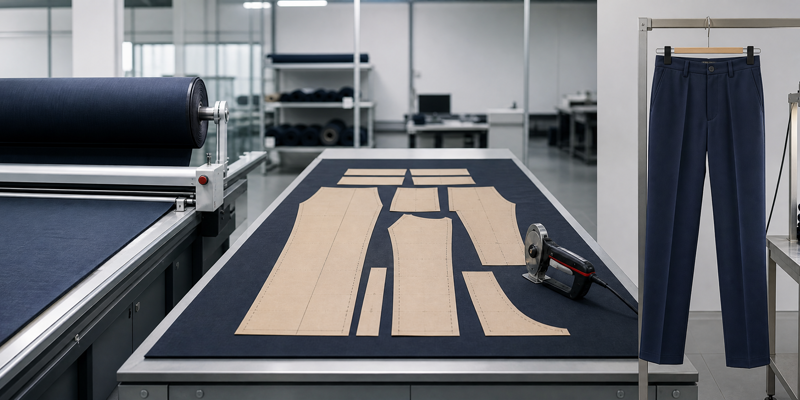
A pair of pants may look simple, but consistency depends on many details, including fabric stability, cutting accuracy, seam strength, waistband symmetry, pocket position, zipper function and final inspection. When one of these areas is not controlled, the result is usually more rework, slower production and greater difficulty meeting the buyer’s standard.
In many factories, a sewing issue may actually begin during spreading or cutting, while a size problem may come from fabric tension or shrinkage before the fabric even reaches the cutting table. This is why pants production cannot be viewed as a series of separate operations. Each stage affects the next.
Work pants, jeans, casual trousers and sports pants may use different fabrics and constructions, but they still follow the same basic production flow: design development, fabric preparation, spreading and cutting, sewing, finishing, inspection and packing.
1. Production Starts with a Clear Design and an Approved Sample
Before fabric reaches the cutting table, the factory must clearly understand what it is expected to produce.
The brand or design team normally provides the style, size specifications, fabric information, sewing methods, pocket positions, waistband construction, zipper or button details and other requirements. These instructions are usually organized in a tech pack so the factory can follow the same production standard throughout sampling and bulk production.
Pattern makers then develop the pattern and use CAD software for size grading and marker planning. CAD is not only used to digitize patterns. It also helps the factory arrange pattern pieces more efficiently, improve fabric utilization and prepare accurate cutting data.
Once the pattern is ready, the factory produces a sample to check fit, waist and hip measurements, pants length, leg width, pocket position and sewing construction. This stage is important because correcting a pattern before bulk production is much easier than correcting hundreds or thousands of finished garments.
Bulk production should begin only after the sample, measurements and construction details have been approved.
2. Fabric Must Be Stable Before Cutting
Fabric condition has a direct effect on finished garment size.
During rolling, transportation and storage, fabric can retain tension, develop wrinkles or contain potential shrinkage. If it is cut before these conditions are controlled, the cut parts may change size later, creating problems during sewing or after washing.
Pants are made from many types of materials, including denim, twill, cotton, stretch fabrics, functional fabrics and blended materials. Stretch pants, sports pants and close-fitting styles require particular attention because fabric tension and recovery can affect both fit and dimensional stability.
Fabric preparation normally includes two main areas.
Fabric Inspection
The fabric should be checked for shade variation, oil stains, holes, uneven texture, foreign fibres and other visible defects before spreading begins.
Traditional fabric inspection depends heavily on the operator’s experience and concentration. Factories using AI fabric inspection equipment can also record defect positions, defect types and distribution data, making it easier to review fabric quality and trace recurring problems.
The purpose is not only to find defects. Early inspection also helps the factory decide where defective areas should be marked, removed or avoided during marker planning.
Fabric Relaxing or Preshrinking
Knitted, stretch and dimension-sensitive fabrics may need time or equipment to release tension before cutting. Depending on the material, the factory may use relaxing or preshrinking equipment to bring the fabric into a more stable condition.
For example, if stretch fabric is spread under excessive tension and cut immediately, the panels may contract after cutting. This can cause size differences, uneven sewing alignment or finished garments that do not match the approved measurements.
The more clearly the factory understands and controls the fabric condition at this stage, the easier it becomes to maintain consistency later.
3. Spreading and Cutting Set the Standard for Sewing
Accurate sewing is difficult when the cut parts are already inconsistent.
During spreading, fabric is laid onto the cutting table according to the required length, ply height and marker plan. The fabric must remain flat, aligned and under suitable tension. If the edges shift, the layers are uneven or the material is stretched during spreading, the cut pieces may not match each other.
Automatic spreading machines help maintain more consistent fabric alignment and tension while reducing variation caused by manual handling. In high-volume pants production, this can improve both cutting efficiency and cut-part consistency.
The marker normally includes components such as:
-
front and back panels;
-
waistbands;
-
pocket bags;
-
fly and zipper pieces;
-
patch pockets;
-
belt loops;
-
yokes, facings or reinforcement pieces.
The cutting method must also match the fabric. Heavy denim and workwear materials place different demands on the cutting system than lightweight casual or sports fabrics. Blade condition, cutting speed, ply height and vacuum suction all need to be reviewed according to the actual material.
Automatic cutting machines can improve repeatability and reduce dependence on manual cutting, especially when the factory handles larger orders or repeated styles. However, the equipment can only follow the data it receives. Accurate patterns, suitable markers and stable fabric preparation are still necessary.
4. Sewing Requires Alignment, Reinforcement and Operator Skill
Sewing is one of the most labour- and skill-dependent stages in pants production.
A pair of pants contains multiple components that must be positioned, joined and reinforced correctly. A small difference in pocket placement, waistband alignment or left-right symmetry can be immediately visible on the finished garment.
Common sewing operations include:
-
pocket making and attachment;
-
joining front and back panels;
-
fly or zipper installation;
-
inseam and outseam sewing;
-
crotch seam sewing;
-
waistband attachment;
-
belt-loop attachment;
-
hemming;
-
button, rivet and accessory installation.
Pants are worn frequently and must withstand sitting, walking, stretching and repeated washing. For this reason, high-stress areas such as the crotch, pocket openings, belt loops, zipper area and hem require stable sewing and suitable reinforcement.
Depending on the product, factories may use double-needle stitching, bartacking or additional reinforcement stitches to improve durability. The correct solution depends on the fabric thickness, stretch, garment construction and buyer’s standard.
Although sewing automation continues to develop, pants assembly still relies heavily on skilled operators in real production environments. Denim, stretch fabric and lightweight functional materials behave differently under the sewing machine. Equipment settings and handling methods must therefore be adjusted according to the actual fabric, rather than using the same approach for every style.
5. Pressing and Finishing Create the Final Form
After sewing, pants normally go through pressing and other finishing processes.
Pressing removes wrinkles created during handling and sewing, but its purpose goes beyond appearance. It also helps shape the waistband, seams, pockets, hems and overall garment form.
Different products require different results. Dress pants may need a flat appearance and a clear crease. Jeans may require washing, fading, whiskering, brushing or other surface treatments. Sports pants and casual trousers may include heat-transfer logos, decorative patches or branding details.
When logos or graphics are required, heat-transfer equipment can apply them at the specified position under controlled temperature, pressure and time. Functional pants may also require bonding, seam pressing or other specialised finishing processes.
These details may appear secondary compared with cutting and sewing, but they strongly affect how the customer sees and handles the product. Inconsistent logo placement, poor pressing or uneven finishing can make an otherwise well-sewn garment look unacceptable.
6. Final Inspection Must Check More Than Appearance
Final inspection is the last opportunity to identify problems before the order leaves the factory.
Inspectors normally check measurements, appearance, stitching, symmetry, fabric condition, accessories and product safety. Important measurement points include the waist, hip, inseam, outseam, total length and leg opening.
They also review:
-
pocket position and left-right symmetry;
-
waistband shape and flatness;
-
skipped stitches or broken threads;
-
loose threads and unfinished seams;
-
stains, holes and fabric defects;
-
zipper movement and fly construction;
-
button, snap and rivet attachment;
-
belt-loop strength;
-
hem consistency.
Inspection should not focus only on whether the pants look acceptable on a table. The product must also function correctly. Zippers should move smoothly, buttons should remain secure and reinforced areas should withstand normal use.
For factories producing export orders or working with international brands, needle detection is often an important part of final quality control. Needle detection equipment helps identify broken needle fragments or magnetic metal contamination in finished garments or packed products, reducing product-safety risks.
Some factories also connect needle detection with weight checking, barcode reading, sorting, folding and packing systems. This allows the final production data to be checked in a more organized way and can reduce missed items, incorrect quantities and packing errors.
7. Packing Is Part of Product Quality
After inspection, the pants move into folding, bagging, carton packing and shipment.
Packing is not only about presenting the garment neatly. It protects the finished product during storage and transportation and ensures that the customer receives the correct style, colour, size and quantity.
Depending on order volume and packing requirements, factories may use manual folding or automatic folding and packing equipment. Automated systems are more suitable when products have standard dimensions, repeated folding methods and stable packing specifications.
Carton sealing equipment can also improve consistency for bulk shipments, but the factory still needs to check polybags, hangtags, barcodes, size labels, carton markings and quantities.
Once an order leaves the factory, a packing mistake can create problems for the buyer’s warehouse, distribution centre or retail operation. Packing should therefore be treated as part of shipment quality, not as a minor task after production is completed.
Conclusion
Pants may be everyday garments, but producing them consistently requires control throughout the process. Pattern accuracy, fabric stability, spreading, cutting, sewing, finishing, inspection and packing all affect the final fit, appearance and durability.
When reviewing a pants production line, factories should look beyond the stage where a defect is discovered and identify where the variation first begins. A sewing problem may originate in cutting, while a size problem may begin with fabric tension or shrinkage before spreading.
OSHIMA provides equipment for fabric inspection, relaxing, spreading, automatic cutting, heat transfer, needle detection, weight checking and packing. These systems can be introduced according to the factory’s product requirements and existing production setup.
More stable processes make quality, production flow and shipment control easier to manage. Effective improvement begins with a clear understanding of where inconsistency enters the production line.


Article Classification
Recent Articles
- The 30-90-180 Day Rule for Industrial Boiler Maintenance
- How Garment Machinery Supports Safety, Compliance and Environmental Management?
- What Happens Before Fabric Goes to the Cutting Table?
- Industrial Iron & Vacuum Table Care: How to Extend Their Lifespan
- Cutting Floor ROI: How the M8s and TAC Save $100K Annually