
 0
0



- Home
- Blog
- Equipment Knowledge
- How Do Garment Factories Handle Multiple Care Labels?
How Do Garment Factories Handle Multiple Care Labels?
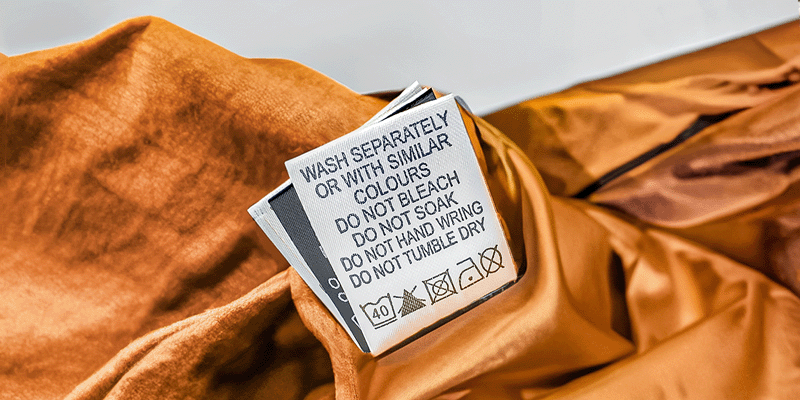
Wash care labels occupy very little space on a garment, but the work around them can become surprisingly complicated once an order enters volume production. Depending on the customer and destination market, one garment may need care instructions, fibre composition, size, country of origin, brand information or several language versions. Sometimes this information is combined on one label. In other orders, several separate labels have to be prepared and attached together.
For a factory, the work does not begin when the sewing operator receives the garment. Labels may first need to be cut, separated, arranged in the correct sequence, checked for direction and aligned with the other layers. Depending on how the labels are supplied, some of this work may already be completed by the label supplier, while other factories receive roll labels and handle more of the preparation internally.
This makes wash care labeling a small production flow of its own. Before deciding whether a machine is needed, it is useful to look at where that flow currently begins, how many times the labels are handled and where mistakes are usually found.
The Label Process Starts Before Sewing
Factories Do Not All Receive Labels in the Same Form
Sewing is still a common way to attach wash care labels, but there can be several operations before the label reaches the sewing station.
Some factories receive individual labels that have already been printed, cut and folded. Others work with labels supplied in rolls and carry out part of the cutting or separation themselves. Depending on the product, the label may also require folding before attachment.
This distinction matters because “wash care label automation” does not describe one single process. For one factory, the repetitive work may be cutting. For another, it may be arranging five or six labels in the correct order. Another factory may be looking for a system that prepares the labels and then completes the sewing operation.
The starting point should therefore be the factory's existing label flow rather than the machine category.
Heat-transfer care information is another option for some garments, particularly where a conventional physical label is undesirable. Its use still depends on fabric construction, required information, durability and customer specifications. Where several physical labels are required, however, the preparation process remains.
Several Labels Change a Simple Operation
Order Direction and Missing Labels All Need to Be Controlled
One wash care label is relatively easy to handle. The situation changes when a garment requires several labels containing different information.
The labels may need to follow a fixed sequence. One can carry composition information, another care instructions, another country-of-origin information, while additional versions may be required for different languages or markets.
With manual preparation, an operator has to pick up the correct labels, keep them facing the right direction and align the layers before they move forward.
Alignment is the most visible difference, but it is not always the most serious one. A label set can look acceptable and still be incomplete because one layer is missing. When several labels are used together, detecting an absent label before the set reaches the garment becomes part of process control.
The same applies to direction and sequence. A securely sewn label set still has to be removed or corrected when one layer has been placed backwards or in the wrong order.
In volume production, these are not isolated mistakes. The same checking process is repeated across the whole order.
Cutting Is More Than Setting the Correct Length
The Label Material Also Affects the Cutting Method
Automatic cutting is often discussed simply as a way to produce labels at a consistent length. In practice, the cut edge matters as well.
Different label materials can respond differently to cutting. This is why care-label equipment may use different cutting methods, including hot or cold cutting, depending on the material and required result.
Some label-processing equipment also combines cutting with folding. Center folding, end folding and other label forms are commonly handled before the label reaches garment assembly.
Not every garment factory needs to perform these operations internally. A label supplier may already deliver fully prepared pieces. But when roll labels enter the factory directly, cutting becomes part of the production process rather than a separate supplier operation.
For factories considering automation, this is an important distinction. The equipment needs to match the condition in which the label actually arrives.
Loose Layers Create Repeated Handling
Holding the Label Set Together Can Simplify What Happens Next
When several loose labels are manually arranged into one stack, each additional handling step creates another opportunity for them to shift.
An operator may align the layers correctly, pass them to another station and find that they need to be adjusted again before sewing. The individual correction takes only a moment, but the same work is repeated across every garment.
Ultrasonic bonding provides one way to hold suitable label materials together at selected points before the set reaches the next operation. Once the layers have been fixed, the prepared set can be handled as one unit instead of several loose pieces.
This does not mean that ultrasonic bonding automatically replaces sewing. In many production arrangements, its role is to stabilise the multi-label set before another process takes place.
Material remains an important condition. Ultrasonic bonding depends on the construction of the label, and equipment designed for this process must be used with compatible materials. Bonding position, strength and wash performance also need to be confirmed against the actual product requirement.
The useful production question is therefore not simply whether ultrasonic bonding is faster than sewing. It is whether keeping the label stack together removes repeated preparation work from the next operation.
Different Factories Automate Different Parts of the Label Process
Cutting Assembly and Sewing Do Not Always Have to Be Automated Together
There is no single standard configuration for wash care label automation.
Some equipment focuses mainly on preparing the individual label. This may include cutting, separating or folding roll labels before they reach garment production.
Another type of system focuses on multi-label assembly. Several labels enter from separate stations, are arranged in the required sequence and fixed together so that the factory receives one prepared set for the following operation.
Other systems extend further and combine label preparation with sewing, allowing several labels to be cut, arranged and then attached directly to the garment.
These machines solve different production problems.
A factory already receiving pre-cut labels may have little reason to invest in additional cutting. A factory working with multiple roll labels may need both cutting and assembly. Another production line may be less concerned about preparation and more interested in removing repeated manual handling between label preparation and final sewing.
This is why the process should be mapped before comparing machine specifications.
Automation Makes More Sense When the Same Work Keeps Coming Back
Label Count Changeovers and Error Handling Matter More Than Speed Alone
Samples, small orders and frequently changing styles can still be handled efficiently by experienced operators. Manual preparation remains flexible, particularly when the label combination changes constantly.
Automation becomes more relevant when the work is repetitive.
Factories should look at several practical questions:
- How many physical labels are used on each garment?
- Are labels supplied individually or in rolls?
- Does the factory need cutting, folding, assembly or sewing?
- How often does the label combination change?
- How much time is spent arranging and realigning labels?
- Are missing, reversed or incorrectly ordered labels a recurring problem?
- At which stage are these mistakes normally discovered?
The answers are more useful than cycle time alone.
A machine that completes one label set quickly may still provide limited value when every order requires a different setup. Conversely, a few seconds of manual work can become a large labour requirement when the same multi-label combination is repeated tens of thousands of times.
The objective is the same as in other garment processes: reduce repeated handling where repetition has become predictable enough to control.
Where OSHIMA Equipment Fits Into This Process
WLS-302 Handles Labels From Feeding Through Bonding
OSHIMA's WLS-302 is designed for production where several wash care labels need to be prepared as one set.
The machine has six label stations, allowing different numbers of labels to be used according to the production requirement. The process combines automatic feeding and cutting with label preparation, ultrasonic bonding, pick-up and collection.
Hot and cold cutting modes are available so the cutting method can be selected according to the label material.
The machine also includes missing-label detection. When an expected label is not supplied, the process can stop rather than allowing an incomplete stack to continue to the following operation. This becomes more relevant as the number of labels in each set increases.
After the layers are arranged, ultrasonic bonding fixes them together at selected points. The label material used for ultrasonic bonding needs to be suitable for this process, including the required chemical-fibre content.
The WLS-302 completes the bonding process in approximately six seconds. Where the production flow also requires sewing after preparation, the WLS-302S adds a sewing function.
WLA-720 Focuses More Directly on Multi-Label Assembly
Not every factory needs cutting to be part of the same process.
For production where the primary requirement is assembling several labels, OSHIMA's WLA-720 is designed around multi-label preparation. It can handle two to six labels and uses laser alignment together with ultrasonic bonding to prepare the label set.
This illustrates why two factories producing similar garments may still require different equipment. The decision depends partly on how the labels arrive at the machine and how much work has already been completed upstream.
One factory may need feeding, cutting and bonding in one sequence. Another may already have prepared labels and mainly needs consistent multi-label assembly.
Look at the Whole Label Path Before Changing the Machine
Wash care labels are small, but the process around them can include several separate operations before the finished set reaches the garment.
Cutting, folding, sequence, orientation, missing-label checking, alignment, bonding and sewing do not necessarily happen in the same place or on the same machine. Some work may already be completed by the label supplier. Other factories may carry out most of it internally.
For low volumes, keeping these steps manual can still make sense. Once the same label combination is repeated at scale, however, it becomes worth measuring how many times the label set is handled before attachment and where operators spend time correcting it.
Before choosing a wash care label machine, start with the actual path of the label through the factory. Knowing whether the bottleneck begins at cutting, multi-label assembly, checking or final sewing will usually tell you much more than comparing machine speed alone.


Article Classification
Recent Articles
- The 30-90-180 Day Rule for Industrial Boiler Maintenance
- How Garment Machinery Supports Safety, Compliance and Environmental Management?
- What Happens Before Fabric Goes to the Cutting Table?
- Industrial Iron & Vacuum Table Care: How to Extend Their Lifespan
- Cutting Floor ROI: How the M8s and TAC Save $100K Annually