
 0
0



- Home
- Blog
- Industry Insights
- What a USD 1.32 Trillion Textile Market Means for Factories?
What a USD 1.32 Trillion Textile Market Means for Factories?
The textile market is still growing, but the factories that benefit will not simply be the ones that produce more. They will be the ones that can handle more materials, applications and customer requirements without losing control of quality or delivery.
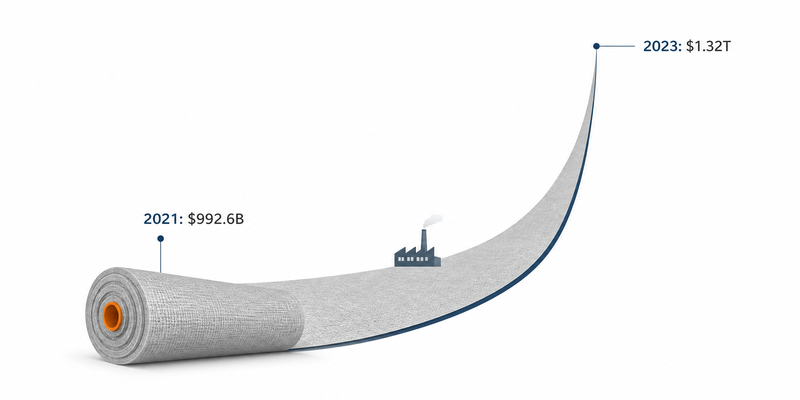
According to market research published around 2021, the global textile market was valued at approximately USD 992.6 billion in 2021 and was projected to reach around USD 1.32 trillion by 2030, with an estimated compound annual growth rate of 3.9% from 2022 to 2030.
For textile mills and garment factories, the important point is not the size of the market alone. Demand is becoming more varied, and factories are being asked to produce different materials, smaller batches, more product types and higher-quality results within increasingly demanding delivery schedules.
Market growth creates opportunities, but it also makes production more complex.
Apparel Remains the Largest Market, but Production Requirements Are Changing
Fashion and clothing remain the main source of textile demand. In 2021, the fashion application segment represented more than 73% of global textile market revenue.
Everyday clothing, sportswear, shirts, suits, functional garments, seamless knitwear, dyed fabrics and printed fabrics continue to support demand across the textile industry. Growing populations, urbanisation and purchasing power in markets such as India, Bangladesh, Vietnam and Brazil also contribute to long-term apparel consumption.
However, the opportunity is not simply about producing more garments. Brands are releasing products more frequently, while consumers expect better comfort, function, appearance and material choices.
For factories, this means handling more fabric characteristics and production conditions. A lightweight stretch fabric cannot be spread, cut or pressed in the same way as a stable woven fabric. A functional garment may also require more careful control of bonding temperature, fabric movement and final inspection.
The apparel market remains large, but factories need greater process stability to compete within it.
Home and Technical Textiles Create More Production Opportunities
Apparel is not the only area supporting textile market growth. Home textiles—including bedsheets, curtains, carpets, sofa fabrics, towels and kitchen textiles—continue to expand through changing lifestyles, interior design demand and online sales.
These products often require different production considerations from garments. Wider fabric widths, heavier materials, dimensional stability, durability, colour consistency and batch control may become more important.
A factory entering the home-textile market may therefore need to review whether its current inspection, preshrinking, fabric handling, cutting and packing processes are suitable for the new materials.
Technical textiles create another group of opportunities. These include materials used in medical products, protective clothing, filtration, automotive interiors, transportation, construction and industrial applications.
In these markets, appearance is only one part of quality. Material performance, cleanliness, dimensional stability, abrasion resistance, flame resistance and production records may be equally important.
For example, a medical-material producer may focus on barrier performance and process cleanliness, while an automotive supplier may place more importance on consistency, durability and traceable quality records.
Moving into these applications may require better control of machinery settings, material movement and production data. It is therefore not simply a matter of using the same equipment to make a different product.
Different Fibres Require Different Production Control
Natural fibres accounted for more than 44.5% of global textile market revenue in 2021. Cotton alone represented more than 39%, showing that cotton, wool, silk and linen remain important to both the textile and apparel industries.
Natural fibres are valued for their hand feel, comfort and breathability, but they also create practical production challenges. Shrinkage, wrinkles, shade variation and differences between fabric batches can affect inspection, relaxing, preshrinking, spreading, cutting and finishing.
As demand for natural and more sustainable materials grows, factories need to consider whether their processes can manage these variations consistently. A material may be attractive to the buyer, but it still needs to move through production without creating excessive waste, rework or quality problems.
Man-made fibres such as polyester, nylon, polypropylene and polyethylene are also widely used in apparel, home textiles and industrial products because of their strength, durability and processing flexibility.
They are common in sportswear, outdoor clothing, workwear, coated fabrics, filtration materials and composite products. However, different fibres react differently to heat, tension, stretching and finishing conditions.
This affects practical production decisions. A fabric that stretches during spreading may create inaccurate cutting. A heat-sensitive material may require tighter control during bonding or pressing. Factories therefore need to understand how the fabric behaves rather than relying on one standard machine setting for every product.
Asia Remains the Centre of Production, but Low Cost Is Not Enough
Asia Pacific accounted for more than 48% of global textile market revenue in 2021. China, India, Bangladesh, Vietnam, Pakistan and other Asian countries remain central to the global textile and garment supply chain.
The region’s strength comes from more than production capacity. It also has established suppliers, raw-material access, manufacturing experience, labour resources and export infrastructure.
At the same time, competition within the region continues to increase. Factories that depend only on lower prices may find it difficult to maintain their advantage as wages, material costs and customer expectations rise.
Delivery performance, quality stability, process control, production records and the ability to manage different product types are becoming more important. Asia will remain a major production centre, but buyers are increasingly comparing factories based on reliability rather than cost alone.
Buyers Are Looking at the Factory Behind the Product
In Europe, sustainability requirements, material sourcing, quality documentation and supply-chain transparency have become increasingly important considerations for export factories.
In North and South America, demand remains strong across sportswear, outdoor products, home textiles and functional materials. Buyers in these markets may have different product priorities, but they share several common expectations: consistent quality, dependable delivery and clearer production information.
Large apparel brands such as Zara, H&M and Uniqlo influence the industry through broad product ranges, fast product cycles and global supply chains. For manufacturers, however, the important lesson is not about following individual brands.
It is about understanding the production capability these supply chains require.
Factories must be able to handle material changes, style changes and different delivery schedules while maintaining batch consistency and quality records. A competitive price may help a factory receive an enquiry, but stable production is what helps it maintain the business.
What Textile Market Growth Means for Factory Planning
A growing market does not guarantee that every factory will grow with it. Factories still need to decide which products they want to produce and what capabilities those products require.
Four areas deserve particular attention.
Material handling
Natural fibres, synthetic fibres, stretch fabrics, functional materials and composites do not behave in the same way. Equipment settings and production methods should reflect the actual fabric.
Fabric preparation and cutting
Problems created during inspection, relaxing, preshrinking, spreading or cutting usually continue into later production. Stable preparation reduces fabric waste, cutting errors and unnecessary rework.
Quality and production records
Buyers increasingly want clearer information about materials, quality results and production conditions. Records that are easy to understand and trace can support both internal management and customer communication.
Equipment selection
Apparel, home textiles and technical textiles do not require exactly the same production setup. Equipment should be selected according to the product, fabric width, material behaviour, output target and quality requirement—not simply according to maximum speed or machine specifications.
Start with the Product Direction, Not the Equipment List
At OSHIMA, we see equipment planning as part of factory process planning. Fabric preparation, spreading, cutting, pressing, bonding and quality-control equipment should support the type of product the factory wants to make and the production problem it needs to solve.
A garment factory may need to improve fabric preparation, cutting accuracy or final quality control. A home-textile producer may need to focus more on fabric width, dimensional stability and batch consistency. A factory entering technical textiles may require closer control of material behaviour, process parameters and quality records.
This does not mean every process must be upgraded at the same time. A practical approach is to identify where the current production flow loses the most time, material or quality, and then improve that area first.
The textile market continues to offer room for growth, but the opportunity is becoming more specialised. Factories that understand their product direction, control their processes and choose equipment around actual production needs will be in a stronger position to respond.
The next step is to review the materials and products your factory expects to handle over the next three to five years, then compare those requirements with the limits of your current production process.



Article Classification
Recent Articles
- Why Are Garment Factories Struggling to Recruit Young Workers?
- What Does the World Cup Have in Common with Apparel Sourcing?
- Why Garment Factories Need Process Stability in a Slower Market?
- Why Scale and Low Cost Are No Longer Enough for Bangladesh Apparel Manufacturing?
- Why Extreme Heat Is Becoming a New Risk for Apparel Supply Chains?