
 0
0



- Home
- Blog
- Smart Manufacturing
- What Automation Really Means for Workers in Garment Factories?
What Automation Really Means for Workers in Garment Factories?
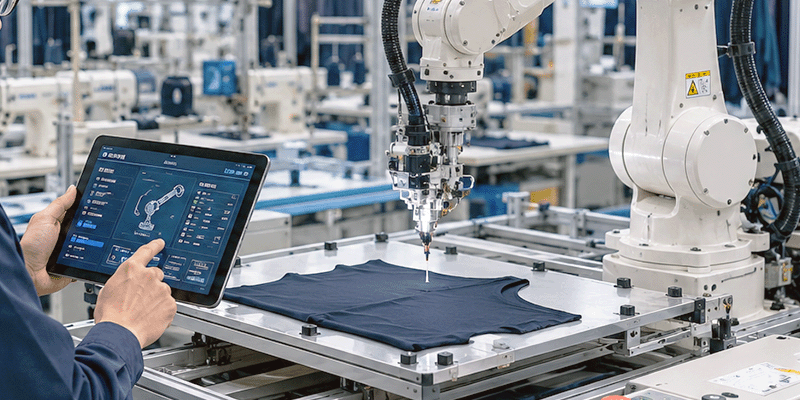
In recent years, digital transformation, automation, AI and smart manufacturing have become common topics in the textile and garment industry. For management teams, automation means efficiency, stable quality and better data management. For factory workers, automation can also create concern. Some surveys have reported that around 27% of employees worry that their jobs may be replaced by machines. This concern is understandable. When machines begin to handle fabric inspection, spreading, cutting, needle detection, packing or data entry, the work people used to perform will change.
But changing work does not mean people lose their value.
Other survey data also suggests that around 81% of factory workers believe automation and AI can improve job performance, while around 61% believe AI can help improve productivity. This shows that workers do not only see automation as a threat. They may also see its ability to reduce repetitive work and improve efficiency.
From a broader economic perspective, PwC has estimated that AI could contribute up to USD 15.7 trillion to the global economy by 2030. This is not a garment-specific figure, but it shows that AI and automation are not limited to one industry. They are changing how work and production are organized globally.
For garment factories, the real question is not whether automation will replace everyone. The better question is which tasks should be handled by equipment, which tasks still require human judgement, and how factories can redistribute work between people and machines.
Are Automation and Workers in Conflict?
Garment manufacturing is labour-intensive, and many processes still depend heavily on shop-floor experience and human judgement. Fabric changes shape, styles change, sewing and pressing require skill, and quality control still requires decision-making. In garment factories, automation does not simply remove people from production. It changes how people and machines share the work.
Automation is more suitable for processes that are clear, repetitive and standardizable. These include spreading fabric to a set length, cutting according to CAD data, detecting metal contamination under set conditions, recording machine status or organizing inspection results. When equipment handles these tasks, factories can reduce fatigue and variation in manual operation.
Workers then move toward machine operation, parameter setting, abnormal handling, quality judgement and process improvement. This is not a conflict between labour and automation. It is a redistribution of work.
Automation Reduces the Pressure of Repetitive Work
Garment factories include many highly repetitive tasks. Fabric inspection requires workers to look at fabric for long periods. Spreading requires repeated fabric handling, laying and edge alignment. Cutting requires strong concentration. Needle detection and packing before shipment also require stable execution. These tasks are important, but they are easily affected by fatigue, experience differences and worker turnover.
Fabric inspection is a clear example. Data from Taiwan’s Ministry of Economic Affairs has described traditional manual fabric inspection as operating at around 10 yards per minute with about 70% defect detection accuracy. This does not mean manual inspection has no value. It shows that long visual inspection is affected by fatigue, experience and attention.
The value of AI or AOI fabric inspection is that it helps factories record defect positions, defect types and inspection results while reducing the pressure of long manual visual inspection. Some AI inspection cases around 2022 also reported a 96.4% defect detection rate at 20 meters per minute under specific conditions. However, this should be understood as a specific case result, not a guarantee for every AI fabric inspection system. Actual performance still depends on fabric type, defect data, camera setup, labelling quality and the factory environment.
AI fabric inspection is therefore not a plug-and-play solution. It needs shop-floor experience, data labelling and continuous calibration.
The Role of AI and AOI in Garment Factories
AI and AOI are often discussed together, but their roles in garment factories are not exactly the same. AOI usually uses optical images and preset rules to identify abnormalities. It is suitable for inspection situations where conditions are relatively stable and clearly defined. AI fabric inspection relies on defect images, labelled data and model training, allowing the system to learn fabric defect features over time.
For factories, the value of AI or AOI is not that they completely replace experienced inspectors. Their value is that inspection results become easier to record, compare and trace. Manual fabric inspection depends heavily on experience and attention. Different inspectors may judge the same defect differently. If a system helps record defect positions, defect types and inspection results, later cutting, quality control and customer communication have a stronger basis.
However, AI is not a magic solution. The performance of AI fabric inspection still depends on fabric type, defect classification, image quality, labelling standards and on-site training data. If the early data is unclear, the model will also be affected. The key question is not only whether a factory has AI. It is whether the factory can combine AI inspection results with shop-floor experience.
From Equipment Automation to Data-Driven Management
Automation equipment is only the first step. If machines still operate separately and data cannot be connected, the factory is only partially automated. Garment production includes many processes, from fabric inspection, relaxing, spreading and cutting to sewing, pressing, needle detection and packing. Each process can generate data. If the data remains scattered across machines, reports and individual workers, managers still cannot understand the whole situation clearly. This is why data-driven management becomes more important.
Can fabric inspection data show defect positions? Can spreading equipment record fabric usage and output? Can cutting progress be tracked? Can needle detection and weight checking leave inspection records? When this information can gradually be organized, factories can see problems earlier and understand line status more clearly. Automation makes work more stable. Data makes management clearer. Together, they create the foundation of a smart factory.
Worker Skills Become Critical in Transformation
After automation is introduced, the skills factories need also change. In the past, shop-floor workers may have focused mainly on operation skills. In the future, they will also need to understand machine settings, read basic data, judge abnormal situations and communicate with engineering, quality or management teams.
For example, AI fabric inspection is not only about pressing the start button. Factories need people who understand defect classification, confirm labelling standards, judge which results require rechecking and work with equipment suppliers to adjust models and parameters.
The same applies to spreading, cutting, needle detection and packing equipment. The more equipment a factory uses, the more it needs people who can operate, maintain, judge abnormalities and improve processes. This means automation is not only an equipment investment. It is also a worker capability upgrade. If a factory only buys machines but does not develop people who can use, manage and improve them, the transformation will have limited impact.
Automation Does Not Remove Human Value
For garment factories, the best direction for automation is not to remove people from production. It is to free people from repetitive, fatigue-prone and low-judgement work. When equipment handles repeated inspection, standard cutting, data recording and final safety checks, workers can spend more time on more valuable tasks: judging fabric conditions, handling abnormalities, improving processes, confirming quality standards, training new workers and helping managers make faster production decisions.
This change is meaningful for both factories and workers. Factories gain more stable processes. Workers have the chance to move from simple operation toward work with more technical and management value.
Where Should Factories Start Redistributing Work?
Garment factories do not need to introduce a fully automated line from the beginning. A more practical approach is to identify which processes are most repetitive, most affected by fatigue or most in need of recording and tracking.
If fabric inspection depends heavily on manual work, the factory can begin with fabric inspection or AI fabric inspection data. If the front end of cutting needs more stability, spreading and cutting equipment may be the starting point. If final quality control needs clearer records, needle detection, weight checking, barcode reading and sorting can be improved first.
OSHIMA provides AI fabric inspection, spreading, cutting, needle detection, weight checking and final quality control-related equipment to help garment factories improve repetitive work and production records step by step according to their actual processes.
Automation does not remove all human value. When equipment, worker experience and production data work together more effectively, garment factories can place people in roles that require more judgement and create more value for quality and efficiency.


Article Classification
Recent Articles
- If Every Machine Is Running, Why Does the Factory Still Feel Stuck?
- AI Fabric Inspection: Turning Fabric Defects into Cutting Room Decisions
- Where Does a Garment Factory Lose Energy During Production?
- What Changes When Garment Factory Data Becomes Connected?
- How Garment Factories Can Boost Fabric Utilization and Cut Waste?