
 0
0



- Home
- Blog
- Smart Manufacturing
- How Garment Manufacturing Adapts to the Data-Driven Era?
How Garment Manufacturing Adapts to the Data-Driven Era?
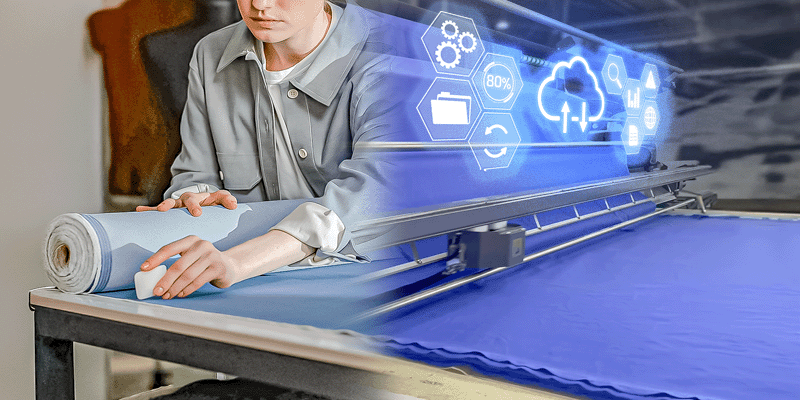
The garment industry has a long history. In earlier times, clothing was mostly made by hand, and each piece required time, skill and careful work. After the Industrial Revolution, sewing machines, cutting equipment and factory production changed the way garments were made, moving clothing from individual hand production toward mass production.
By around 2022, garment manufacturing had entered another turning point. The global apparel retail market had already reached trillion-dollar scale, with the 2022 market estimated at around USD 1.84 trillion and the 2023 market expected to reach around USD 1.95 trillion. This shows that apparel is not only an everyday consumer product, but also a highly globalized, competitive and large-scale industry.
Globalization also means garment production is no longer concentrated in one market. In the 1960s, a very high proportion of apparel worn by American consumers was made domestically. Today, production has largely moved overseas. India, China, Vietnam, Cambodia, Bangladesh and other regions play important roles in the global textile and apparel supply chain. In India, earlier data showed that textiles and apparel accounted for slightly more than 30% of export earnings, making the industry an important source of industrial activity and employment.
These numbers reflect one reality: garment manufacturing is no longer a simple business handled by one country or one factory. Brands, fabrics, trims, production sites and sales markets are often spread across different countries. Factories must manage not only production, but also delivery, quality, cost, materials, shipment and customer communication.
At the same time, consumers buy clothing faster, and brands launch new products and replenishment orders more frequently. Many retailers no longer introduce new products only by season. They update more often to respond to market changes. As a result, factory orders are shifting from more stable high-volume production toward more styles, shorter lead times and greater flexibility.
In this market, garment factories can no longer depend only on traditional experience and after-the-fact reporting. The real challenge is not to replace every worker with machines. It is how factories can record, track and use production information to improve their processes.
This is the issue garment manufacturing must face in the data-driven era.
Globalization Creates Higher Management Pressure for Garment Factories
In the past, garment production and sales were more concentrated in local markets. Today, design, sourcing, production and sales often take place across different countries. A brand may be based in Europe or North America, fabric may come from different parts of Asia, production may take place in Vietnam, Cambodia, Indonesia, China or other regions, and the finished goods may be shipped worldwide.
This global division of work gives the garment supply chain more flexibility, but it also makes management more complex. Factories must handle not only production, but also delivery, quality, cost, material flow, shipment and customer communication.
If all information depends on manual reporting, managers often see the situation only after problems have already happened. Whether fabric inspection is complete, whether cutting is on schedule, whether machines are stopped, whether inspection results are abnormal and whether shipment is ready all become harder to control without timely information. The value of data-driven management is not showing more reports. It is helping managers see the factory floor earlier.
From Manual Experience to Recordable Production Processes
Garment manufacturing has always depended heavily on experience. Skilled workers know how different fabrics should be relaxed, spread, cut and pressed. Quality control staff understand which defects affect the final garment. Production supervisors know which line is suitable for which type of order. This experience is valuable. But if it exists only in people’s memory, factories face several challenges. New workers take longer to train. Worker turnover may create knowledge gaps. Different people may also judge the same situation differently.
The goal of the data-driven era is not to replace experience with data. It is to turn important experience into information that can be saved and compared. For example, fabric relaxing time, spreading settings, cutting layers, pressing conditions, defect types and inspection results can gradually become part of the factory’s own process records. When experience can be recorded, factories do not need to start from zero every time they meet a similar problem.
Automation Is Not the Goal; Stable Processes Are
When factories talk about digitalization, many immediately think of automation equipment. Automation can help factories handle repetitive, time-consuming and fatigue-prone work, such as fabric inspection, spreading, cutting, needle detection, weight checking, barcode reading and packing.
But automation is not the final goal. For garment factories, the more important question is whether the process becomes more stable.
If spreading equipment can record fabric usage and output, managers can better understand front-end production status.
If AI fabric inspection records defect positions, fabric condition before cutting no longer depends only on paper records.
If needle detection and weight checking leave inspection records, final quality control becomes easier to trace.
If barcode and sorting processes connect with packing, factories can reduce the risk of wrong shipments, missing items or abnormal products entering the shipment flow.
The point is not to make the factory look more advanced. It is to make each key process easier to manage.
Data Brings Management Closer to the Factory Floor
Traditional factory management often depends on daily reports, meetings and manual updates. These methods still have value, but if information appears too late, managers can only react after the fact. The value of data-driven production is that key information becomes closer to real time. When machine status, output, fabric usage, downtime, inspection results and abnormal records can be seen earlier, managers can judge sooner whether schedules, materials or machine conditions need adjustment.
This is especially important for cross-border factories. Headquarters cannot be physically present in every overseas factory every day. If management relies only on manual updates, information gaps can easily occur. When key machines and processes begin to provide data, headquarters can understand production capacity and shop-floor conditions across different sites more quickly. Data-driven management does not replace factory management. It brings management closer to the real production floor.
Flexibility Will Define Future Garment Factories
The modern apparel market changes quickly. Brands need to test styles, replenish orders and adjust products faster. This means garment factories cannot rely only on one product type or one large-volume production model. Future competitiveness will depend on flexibility. This does not only mean flexible workers. Equipment and processes also need to support different products, fabrics and order rhythms.
For example, fabric preparation equipment helps factories handle different material conditions. AI fabric inspection and data records allow factories to understand fabric quality earlier. Automatic spreading and cutting equipment can support front-end production for different orders. Needle detection, weight checking and barcode systems make final inspection more stable. A factory’s ability to respond to the market is not only about production capacity. It is also about whether the process is clear, whether equipment supports the workflow and whether people can make correct decisions based on available information.
Worker Roles Change, but People Do Not Disappear
Digitalization and automation are often misunderstood as reducing the need for people. In garment manufacturing, people remain essential. Fabric changes shape. Styles change. Sewing and pressing still require experience. Quality decisions still need the involvement of people on the production floor. Equipment can help stabilize repetitive processes, but it cannot completely replace human judgement of fabric, process and garment quality.
What changes in the data-driven era is the role of workers. In the past, much time was spent on repetitive operations, manual records and after-the-fact organization. In the future, more work will move toward machine operation, parameter setting, data interpretation, abnormal handling and process improvement. This shift matters because it allows workers to become more than production-line labour. They become on-site specialists who contribute to quality management and process improvement.
Where Should Data-Driven Manufacturing Begin?
A garment factory does not need to introduce a complete smart factory system at once. A more practical approach is to begin with the process that most needs visibility or most often affects efficiency and quality.
If the factory wants to improve fabric quality management, it can begin with fabric inspection and AI fabric inspection data.
If the factory wants to understand front-end production status, it can begin with spreading equipment data such as output, fabric usage and machine status.
If the factory wants to make final quality control more stable, it can begin with needle detection, weight checking, barcode reading and sorting.
OSHIMA provides fabric inspection, AI fabric inspection, relaxing, spreading, automatic cutting, heat transfer, needle detection, weight checking and packing-related equipment, helping garment factories gradually build a clearer data foundation according to their existing production flow.
A real data-driven upgrade does not mean replacing the entire factory at once. It means making key processes gradually recordable, visible and improvable. When equipment, worker experience and production data work together more effectively, garment factories are better prepared to adapt to a fast-changing market.


Article Classification
Recent Articles
- If Every Machine Is Running, Why Does the Factory Still Feel Stuck?
- AI Fabric Inspection: Turning Fabric Defects into Cutting Room Decisions
- Where Does a Garment Factory Lose Energy During Production?
- What Changes When Garment Factory Data Becomes Connected?
- How Garment Factories Can Boost Fabric Utilization and Cut Waste?