
 0
0



- Home
- Blog
- Equipment Knowledge
- How to Maintain an Automatic Fabric Spreading Machine
How to Maintain an Automatic Fabric Spreading Machine
In garment factories, the fabric spreading machine is the starting point of the cutting process.
Whether the fabric is laid flat, whether tension is stable, and whether edge alignment is accurate all directly affect cutting quality, fabric utilization, and overall production efficiency.
Many spreading machine problems are not caused by poor machine design. They are caused by insufficient daily maintenance.
Dust, fabric lint, improper chain tension, sensor misalignment, or lack of lubrication may look like small issues. However, over time, they can lead to unstable spreading, machine stoppage, and production delays in the cutting room.
Spreading machine maintenance is not only about repairing equipment. It is a basic management practice for keeping production stable.
Why Does a Fabric Spreading Machine Need Preventive Maintenance?
A spreading machine lays fabric layer by layer on the cutting table before cutting. If this step is unstable, even the most accurate cutting machine may still face problems caused by uneven layers, unstable tension, or poor edge alignment.
Preventive maintenance helps factories solve problems before they become machine failures. Its main benefits include:
Reducing unexpected downtime.
Maintaining fabric spreading quality.
Extending machine service life.
Improving operator safety.
For garment factories, downtime is not only a repair issue. It affects work order progress, labor arrangement, cutting room rhythm, and delivery stability. This is why regular maintenance is more cost-effective than emergency repair after failure.
Common Spreading Machine Problems Often Come from Poor Maintenance
1. Poor Edge Alignment
If sensors are covered with dust, misaligned, or slow to respond, the machine may detect fabric edges incorrectly.
This can lead to uneven fabric layers, affecting cutting accuracy and fabric utilization.
2. Uneven Fabric Tension
Loose chains, tight chains, or worn transmission components may affect spreading stability.
For woven fabrics, stretch fabrics, or sensitive materials, unstable tension can cause wrinkles, stretching, or fabric distortion.
3. Unexpected Machine Stoppage
If fabric lint, thread, paper, or other foreign objects are caught in the rail, walking wheels, or moving platform, the machine may jam, create abnormal noise, or stop during operation.
4. Increased Fabric Waste
Unstable spreading can create cutting errors.
When cut panels shift or sizes become inaccurate, factories may need to recut, replace material, or reject pieces.
This increases material waste.
5. Lower Cutting Room Efficiency
Small problems can gradually affect the entire production rhythm.
If the spreading machine slows down, stops more often, or produces unstable layers, downstream cutting and production scheduling will be affected.
5 Key Maintenance Points for Fabric Spreading Machines
1. Daily Cleaning and Dust Removal
Fabric spreading machines contact large amounts of fabric every day. Fabric lint, dust, and threads can quickly build up on the moving platform, rails, walking wheels, and contact surfaces. Operators should complete the following checks every day:
Remove lint and dust from the moving platform.
Clean rails and walking wheel contact surfaces.
Check for threads, paper, or foreign objects.
Confirm that the machine travel path is clear before startup.
Daily cleaning may look simple, but it is the most basic step for preventing jamming and abnormal stoppage.
2. Weekly Sensor Inspection
Sensors are critical for automatic operation and safety control. If sensor surfaces are dirty, positions shift, or response becomes unstable, edge alignment, stop protection, or safety detection may be affected. Weekly inspection should include:
Cleaning sensor surfaces.
Checking sensor position.
Testing response accuracy.
Checking whether cables or connectors are loose.
Sensor problems may not stop the machine immediately, but they can reduce spreading accuracy. This is why regular checks are necessary.
3. Weekly Transmission System Inspection
The transmission system directly affects machine stability. If chains, gears, walking wheels, or related components are worn, loose, or noisy, they should be handled early. Weekly inspection should include:
Checking whether chains are loose or worn.
Confirming that gears run smoothly.
Checking whether walking wheels are blocked by foreign objects.
Listening for abnormal noise during operation.
Checking whether transmission components are loose or misaligned.
If operators notice that the machine sounds different from usual, they should report it to the supervisor or technician immediately. They should not wait until the machine stops.
4. Monthly Chain Tension Check
Chain tension affects machine movement stability.
If the chain is too loose, it may cause unstable movement, positioning error, or delayed transmission. If the chain is too tight, it increases resistance, wear, and mechanical load.
Technicians should check chain tension monthly and adjust it according to machine condition. This maintenance step is important for maintaining spreading accuracy and reducing mechanical wear.
5. Monthly Lubrication Maintenance
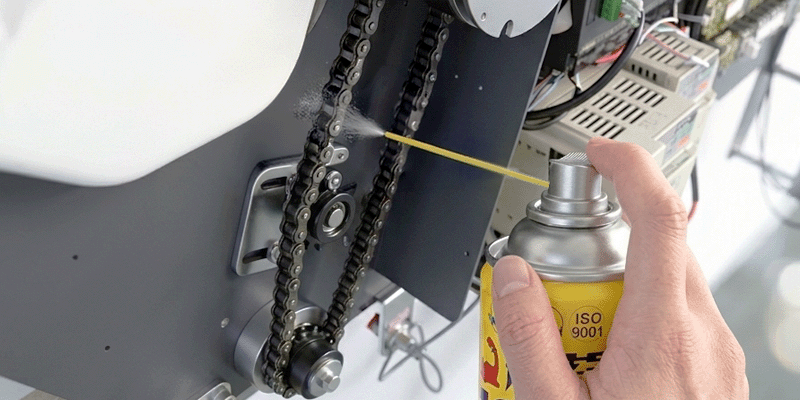
Proper lubrication reduces friction and extends the life of chains, sprockets, and related transmission parts. Chains, sprockets, and designated lubrication points should be maintained at least once a month.
During lubrication, factories should:
Remove old grease and dust first.
Use suitable lubricant for the equipment.
Avoid excessive oiling that attracts lint and dust.
Confirm smooth operation after lubrication.
Lubrication is not simply adding more oil. Too much grease may collect dust and fabric fibers, causing dirt buildup.
Maintenance Responsibility: Who Should Do What?
Effective maintenance should not depend only on technicians. Operators should also take part.
Operators: Daily Frontline Checks
Operators use the machine every day and are most likely to notice abnormalities. Daily cleaning, pre-start checks, travel path confirmation, and abnormal noise reporting should be part of operator responsibility.
Supervisors or Technicians: Weekly Checks
Sensors, transmission systems, gears, walking wheels, and abnormal noise should be checked weekly by supervisors or technicians.
Technicians: Monthly Maintenance
Chain tension, lubrication, part wear, and necessary adjustments should be handled by technicians and recorded properly.
Suggested Maintenance Frequency
Daily maintenance: Clean the platform, rails, and walking wheels, and confirm no foreign objects are blocking movement.
Weekly maintenance: Check sensors, transmission system, chains, gears, and walking wheels.
Monthly maintenance: Check chain tension, lubricate chains and sprockets, and confirm part wear.
Semi-annual or annual maintenance: Arrange more complete inspection and calibration by the original supplier or professional technicians.
Factories can adjust the schedule based on production volume, fabric type, and machine usage.
If the factory produces heavy lint, runs machines for long hours, or handles heavy materials, maintenance frequency should be increased.
Why Maintenance Records Matter
Maintenance should not end after the task is completed. It should be recorded. Factories should create a simple maintenance checklist that records date, inspection item, responsible person, abnormality, and action taken. This provides three benefits:
First, it helps track whether machine condition is getting worse over time.
Second, it confirms whether maintenance has actually been performed.
Third, if a failure occurs, technicians can identify the cause faster.
For factories using multiple spreading machines or multiple shifts, maintenance records are a basic tool for managing equipment stability.
OSHIMA’s Recommendation
The spreading machine is a core machine in the front end of the cutting room. If spreading is unstable, cutting, sewing, and quality control will all be affected. OSHIMA recommends that factories should not wait until a machine stops before taking action.
Instead, they should establish daily, weekly, and monthly maintenance routines. Moving platforms, rails, walking wheels, sensors, chains, and lubrication points should be included in regular inspection.
For automatic spreading machines, smart spreading machines, or IoT-enabled spreading machines, factories should also check sensors, cables, and data transmission status to keep both machine operation and production data stable.
Conclusion
Spreading machine maintenance is not an extra burden. It is a necessary practice for stable garment production. Through daily cleaning, weekly sensor and transmission checks, monthly chain tension checks, and lubrication maintenance, factories can reduce downtime risk, maintain spreading accuracy, reduce fabric waste, and extend machine service life.
Stable production depends not only on good equipment, but also on consistent and correct maintenance management.


Article Classification
Recent Articles
- The 30-90-180 Day Rule for Industrial Boiler Maintenance
- How Garment Machinery Supports Safety, Compliance and Environmental Management?
- What Happens Before Fabric Goes to the Cutting Table?
- Industrial Iron & Vacuum Table Care: How to Extend Their Lifespan
- Cutting Floor ROI: How the M8s and TAC Save $100K Annually