
 0
0



- Home
- Blog
- Equipment Knowledge
- Needle Detection in the Garment Industry: How Needle Detector Machines Are Used
Needle Detection in the Garment Industry: How Needle Detector Machines Are Used
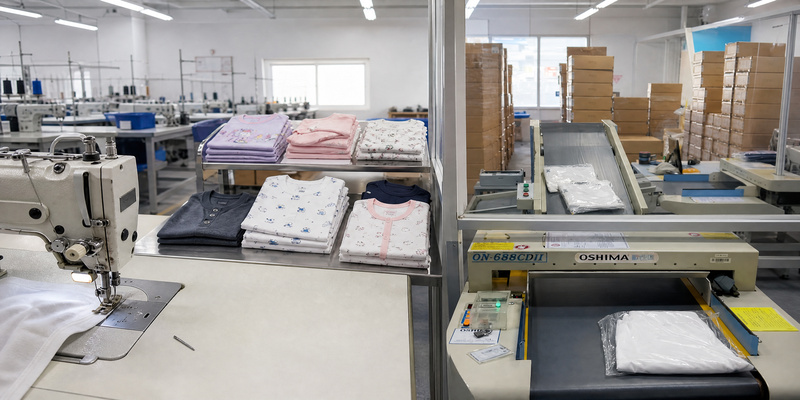
Needle detection is a quality-control process used in garment and textile manufacturing to identify broken sewing needles and other ferromagnetic metal contamination before products are packed or shipped.
In factories handling large production volumes, a conveyor needle detector allows garments or textile products to pass continuously through a defined detection area. If metal above the selected detection level is identified, the machine can alert the operator and stop or reverse the conveyor so that the affected product can be removed and investigated.
However, final needle detection is only one part of metal control. If a sewing needle breaks during production, the factory should first recover the fragments, isolate affected products when necessary and follow its established broken-needle procedure. A needle detector provides another inspection point before shipment; it does not replace proper control on the sewing floor.
What Is a Needle Detector?
A needle detector is equipment designed to detect ferromagnetic metal contamination in garments, textiles and other products.
In garment manufacturing, the primary concern is often a broken sewing needle or needle tip that may remain inside a garment after sewing. Other ferrous metal fragments may also be detected depending on their size, position, the product and the sensitivity setting.
Most garment conveyor needle detectors use magnetic induction. Products move through the detection opening on a conveyor. When the detector identifies a ferromagnetic object above the selected detection level, it generates an alarm and interrupts the normal inspection flow.
This makes needle detection different from normal visual quality inspection.
A quality inspector can check sewing quality, stains, measurements, labels, trims and appearance. A needle detector is used specifically to check for metal contamination that may be difficult to see or locate manually.
What Is a Needle Detector Machine Used For?
Needle detector machines are commonly used in garment and textile factories for several purposes:
- checking finished garments for broken sewing needles or ferrous fragments;
- providing a defined inspection step before packing or shipment;
- supporting factory and buyer metal-control procedures;
- separating products that require further investigation;
- improving consistency when large production volumes must be inspected;
- recording inspection quantities and rejected products when the equipment provides data functions.
Applications may include children's wear, underwear, shirts, trousers, jackets, home textiles and other sewn products.
The actual inspection requirement depends on the product, factory procedure and customer specification. Not every garment factory requires exactly the same sensitivity, inspection arrangement or documentation.
How Does Needle Detection Work?
A typical conveyor needle-detection process is straightforward.
1. The product enters the detector
The operator places the garment or textile product on the conveyor according to the established inspection method.
2. The product passes through the detection area
As the product travels through the detector, the sensing system checks for ferromagnetic metal contamination.
3. The detector identifies an abnormal signal
If an object exceeds the selected detection threshold, the equipment generates an alarm.
Depending on the machine configuration, the conveyor may stop or reverse so that the affected product does not continue with accepted products.
4. The rejected product is removed
Detection does not automatically explain what the metal object is.
The operator still needs to remove the rejected product from the normal flow and investigate the cause.
5. The contaminant is located and investigated
A handheld needle detector may be useful at this stage because it allows the operator to examine a smaller area and locate the metal more precisely.
The factory can then determine whether the object is a broken sewing needle, another metal fragment, a product component or another source of interference.
6. The product is handled according to the factory procedure
The rejected garment should only return to the normal production or packing flow after the issue has been resolved according to the applicable quality procedure.
This is why a needle detector should be considered part of a quality-control process rather than simply a machine placed at the end of a production line.
Where Is Needle Detection Used in Garment Production?
A simplified garment workflow may look like this:
Sewing → Finishing → Quality Inspection → Needle Detection → Packing → Shipment
The exact location varies by factory and product.
For many applications, needle detection is performed after the relevant production operations have been completed and before final packing or shipment.
The purpose is to establish a final inspection point before products leave the factory.
For higher-volume production, conveyor needle detection is generally more practical than checking every garment manually with a handheld detector. A conveyor system creates a repeatable inspection route and allows products to pass continuously through the detection area.
A handheld detector serves a different role and is more suitable for localized checking, smaller products and investigation after a conveyor detector has identified an abnormal product.
What Happens When a Sewing Needle Breaks?
Needle detection should not begin only at final inspection.
When a sewing needle breaks, the first response should take place at the sewing workstation.
The operator should stop sewing and recover the broken pieces. The recovered fragments can then be checked to determine whether the complete needle has been accounted for.
If all pieces are recovered, the incident can be recorded and handled according to the factory's established procedure.
If part of the needle cannot be found, the affected garment and other potentially affected products should not simply continue through normal production.
A practical process may include:
- stopping the sewing operation;
- collecting all visible needle fragments;
- checking whether the complete needle has been recovered;
- isolating potentially affected products if a fragment is missing;
- searching the workstation, machine and product;
- documenting the incident according to factory or buyer requirements;
- completing the required inspection before the affected product is released.
The exact procedure varies between factories and customers.
The important distinction is that broken-needle control and final needle detection are related but different processes.
Why Final Needle Detection Does Not Replace Broken-Needle Control
It can be tempting to assume that every garment will eventually pass through a detector, so a missing needle fragment can simply be found later.
That is not a sound production-control approach.
A broken needle is a known production incident. The factory already knows approximately when and where the problem occurred, so the issue should be controlled at that point.
Final needle detection provides another opportunity to identify contamination that remains in the finished product.
The two controls therefore work together:
Broken-needle procedure
Controls a known incident during production.
Final needle detection
Checks products for metal contamination before packing or shipment.
A reliable quality system should not depend on final detection as a substitute for controlling the original incident.
Types of Needle Detection Systems Used in Garment Factories
Different equipment serves different inspection purposes.
Conveyor Needle Detector
A conveyor needle detector is designed for continuous inspection.
Garments are placed on a conveyor and pass through the detection opening. If the system detects ferromagnetic metal above the selected sensitivity, an alarm is triggered and the product is removed for investigation.
This type of system is suitable for higher production volumes and standardized final inspection.
OSHIMA's ON-688CD6S / ON-688CDD6S, for example, uses magnetic induction with a 10-point sensor probe system and supports ΦFe 0.8 / 1.0 / 1.2 mm test modes. The system can stop or reverse the conveyor after detection.
Handheld Needle Detector
A handheld needle detector is designed for localized inspection.
It can be useful for:
- small pieces;
- thin products;
- spot checking;
- locating metal after a conveyor detector rejects a product;
- products that are difficult to return to a conveyor line.
A handheld detector normally supplements continuous conveyor inspection rather than replacing it in high-volume garment production.
OSHIMA ON-30, for example, is designed for small-area inspection and locating ferromagnetic metal after a conveyor detector identifies an abnormal product.
X-Ray Inspection
Needle detectors based on magnetic induction are intended primarily for ferromagnetic metal detection.
Where a factory needs to inspect for different types of foreign objects or materials that cannot be reliably handled through conventional needle detection, another inspection technology such as X-ray may need to be evaluated according to the product and inspection requirement.
This is why factories should first define what they need to detect before deciding which inspection technology to purchase.
How Should a Needle Detector Be Checked Before Production?
Machine specifications alone do not guarantee consistent inspection.
Daily operating procedures are equally important.
Before or during production, factories may need to verify detector performance using the specified test piece according to their own quality procedure or customer requirement.
Verification should confirm that the detector responds correctly and that the alarm, conveyor stop or reverse function operates as expected.
The inspection area should also remain suitable for operation. Metal objects close to the machine, unsuitable product handling or inconsistent testing practices can affect the inspection process.
Factories operating several shifts should establish a procedure that operators can follow consistently.
The objective is not to create the most complicated verification procedure. It is to create one that is clear, repeatable and appropriate for the customer requirement.
What Sensitivity Should a Garment Needle Detector Use?
There is no single sensitivity setting that is automatically correct for every garment factory.
The appropriate setting depends on factors such as:
- customer or brand requirements;
- product type;
- product thickness;
- detection opening;
- inspection method;
- detector design.
A higher sensitivity number or smaller test piece does not by itself mean that a machine is more suitable for every production situation.
Factories should confirm that the selected detection level can be applied consistently to the products they actually manufacture.
Product handling and detection stability are as important as the specification printed on the machine brochure.
Does Product Size Affect Needle Detection?
Yes. Product dimensions and thickness affect how a product can be inspected.
Thin garments such as underwear or children's clothing may require relatively little detection-channel clearance.
Thicker products such as jackets, bedding, shoes or folded textile products may require a larger opening.
Factories should therefore consider both:
- detection sensitivity; and
- usable channel width and height.
Selecting a detector only because it offers high sensitivity is not useful if normal products cannot pass through the machine conveniently.
The way products are folded and placed on the conveyor should also be considered when planning the inspection process.
What Can Affect Needle Detection in Daily Production?
Several operating conditions can influence the inspection process.
Metal components in the product
Garments containing metal trims, accessories or other ferrous components may require a different inspection method or procedure.
Metal around the detector
Metal objects or equipment close to the inspection area may interfere with stable operation depending on the installation environment.
Product placement
Products should pass through the detector according to the defined inspection method rather than being placed inconsistently.
Product thickness
Detection conditions may change when products become thicker or are folded differently.
Sensitivity setting
The setting should correspond to the product and applicable requirement. Simply operating at the highest possible sensitivity is not always the correct approach.
Verification practices
Operators should follow a consistent verification process instead of changing methods between shifts.
These operational factors are why factories should evaluate the complete inspection process rather than comparing specifications alone.
Inspection Records and Traceability
Some factories only need a reliable inspection station.
Others also need inspection records for:
- buyer audits;
- internal quality management;
- shipment documentation;
- production tracking;
- investigation of rejected products.
Where records are required, automatic counting and data functions can reduce dependence on manual paperwork.
OSHIMA ON-688CD6S / ON-688CDD6S includes pass, reject and total counters together with printing capability.
However, data recording is not necessarily required for every factory.
The equipment configuration should follow the actual production and customer requirements rather than adding functions that will not be used.
Can Needle Detection Be Integrated With Other Equipment?
Yes.
A needle detector can operate as an independent inspection station, but it can also form part of a larger final quality-control and packing line.
Depending on the application, additional equipment can include:
- product turning;
- barcode reading;
- RFID reading;
- automatic rejection;
- sorting;
- carton checking;
- packing equipment.
For example, OSHIMA's ON-688P can turn products 180 degrees between inspection stages and can be connected with needle detection, barcode, RFID or sorting equipment.
The broader OSHIMA quality-control range also includes X-ray inspection, carton needle and weight checking, barcode reading, RFID, sorting and packing equipment.
Integration should be considered when it improves the factory's actual workflow. It is not a requirement for every needle-detection application.
What to Consider When Selecting a Needle Detector Machine
Factories comparing needle detector machines should begin with the application rather than only comparing technical specifications.
1. Detection requirement
Confirm the applicable buyer, product and factory requirements.
2. Product size
Check whether the detection channel can accommodate the products in their normal inspection condition.
3. Sensitivity
Confirm that the required detection level can be maintained for the relevant products.
4. Production capacity
The conveyor system should be suitable for the expected daily production volume.
5. Rejection method
Check what happens after detection.
Depending on the system, the conveyor may stop, reverse or connect to another rejection process.
6. Verification and calibration
Operators should be able to verify machine performance according to the factory's established procedure.
7. Inspection records
Determine whether pass, reject, total quantities or printed records are required.
8. Future integration
Factories planning additional automation may want to consider compatibility with scanning, RFID, sorting and packing systems.
A machine should ultimately fit the factory's products, customer requirements and daily operating process.
Conclusion
Needle detection is an important part of garment quality control, but the machine is only one component of the process.
Factories need to consider how broken needles are controlled during sewing, where final detection takes place, how rejected products are investigated, how detector performance is verified and whether inspection records are required.
For high-volume production, a conveyor needle detector provides a repeatable inspection point before packing or shipment. Handheld detection can support localized investigation, while additional inspection technologies may be used when the product requires a different type of foreign-object detection.
Selecting the right system therefore depends not only on sensitivity, but also on product dimensions, production volume, customer requirements, inspection records and the factory's overall quality-control workflow.
Frequently Asked Questions About Needle Detection
What is needle detection in the garment industry?
Needle detection is a quality-control process used to check garments or textile products for broken sewing needles and other ferromagnetic metal contamination. It is commonly carried out before packing or shipment when required by the product, factory or customer.
What is a needle detector machine used for?
A needle detector machine is used to identify ferromagnetic metal contamination in garments and textiles. Conveyor-type machines are commonly used for continuous inspection of finished products before packing or shipment.
Can a needle detector detect every type of metal?
Conventional garment needle detectors using magnetic induction are primarily intended for ferromagnetic metal detection. If the inspection requirement involves other types of foreign objects, another technology such as X-ray inspection may need to be considered.
Can a handheld needle detector replace a conveyor needle detector?
A handheld detector is useful for localized checking and locating metal in rejected products. For higher-volume continuous garment inspection, it normally supplements rather than replaces a conveyor needle detector.
What happens if a garment fails needle detection?
The affected product should be removed from the normal flow and investigated. The operator needs to locate the source of the metal signal and handle the garment according to the factory's quality procedure before it is released.
Where should needle detection take place in garment manufacturing?
For products requiring final needle detection, the inspection point is commonly positioned after relevant production processes and before final packing or shipment. The exact location depends on the factory's production and customer requirements.
What sensitivity should a garment needle detector use?
There is no single setting that applies to every factory. Sensitivity should follow the relevant buyer specification, product characteristics, machine configuration and inspection procedure.
Does final needle detection replace a broken-needle procedure?
No. When a needle breaks during sewing, the incident should be controlled at the production stage. Final needle detection provides an additional inspection before products are packed or shipped.



Article Classification
Recent Articles
- The 30-90-180 Day Rule for Industrial Boiler Maintenance
- How Garment Machinery Supports Safety, Compliance and Environmental Management?
- What Happens Before Fabric Goes to the Cutting Table?
- Industrial Iron & Vacuum Table Care: How to Extend Their Lifespan
- Cutting Floor ROI: How the M8s and TAC Save $100K Annually