
 0
0



- Home
- Blog
- Equipment Knowledge
- Fabric Cutting Machine Selection Guide for Garment and Textile Factories
Fabric Cutting Machine Selection Guide for Garment and Textile Factories
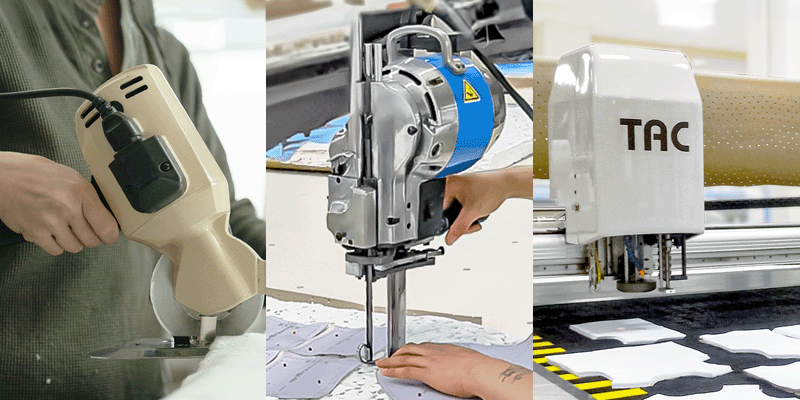
Fabric cutting is one of the most important steps in garment and textile manufacturing. It directly affects production efficiency, material cost, cutting accuracy, and final product consistency.
For many factories, cutting is also where hidden costs appear. Even a small percentage of fabric waste can become a significant cost when production volume is high. Manual cutting may be too slow for large orders. Inconsistent cutting quality can lead to size variation, rework, or rejected pieces. In some factories, cutting equipment also operates separately from CAD, nesting, or production systems, making the overall workflow less efficient.
Choosing the right fabric cutting machine is therefore not only about buying equipment. It is about selecting a cutting solution that matches your fabric type, order volume, production workflow, and long-term factory direction.
Why Fabric Cutting Machine Selection Matters
The cutting process comes after fabric preparation and before sewing or further assembly. If this step is not stable, the following production stages will be affected.
When cutting is slow, production may fall behind schedule. When cutting is inaccurate, factories may face rework, material waste, or quality complaints. When cutting depends too much on manual skill, production consistency may vary between operators.
The right fabric cutting machine can help factories improve cutting speed, reduce manual dependency, improve material utilization, and maintain more consistent cutting results.
However, there is no single machine that is suitable for every factory. A sampling room, a small-batch custom production line, a garment mass production factory, and an automotive textile supplier may all need different cutting solutions.
Common Types of Fabric Cutting Machines
Fabric cutting machines can generally be divided into manual cutting tools, semi-automatic cutting machines, and automatic cutting systems. Each type has its own suitable production scenario.
Manual Cutting Tools: Flexible but Labor-Dependent
Manual cutting tools include scissors, rotary cutters, and electric hand cutters. These tools are commonly used in sampling, small-batch production, custom orders, and special fabric handling.
They are flexible, easy to operate, and require relatively low initial investment. For factories or workshops that produce small quantities, frequent style changes, or customized garments, manual tools can still be practical.
However, manual cutting is highly dependent on operator skill. It is usually slower and may create more variation in cutting accuracy. When order volume increases, manual cutting may become a bottleneck. It may also increase labor intensity and make production scheduling less stable.
Manual cutting is suitable when flexibility is more important than high-volume output.
Semi-Automatic Cutting Machines: A Practical Step Toward Higher Efficiency
Semi-automatic cutting machines usually include straight knife cutting machines and round knife cutting machines. They are commonly used in garment factories, furniture fabric processing, and some technical textile applications.
Compared with manual tools, semi-automatic machines can improve cutting speed and reduce part of the manual error. They are suitable for factories that already have regular production needs but may not yet require a full automatic cutting system.
These machines still require operators to guide the cutting process, so they do not fully remove manual dependency. Production capacity is also limited compared with automatic cutting systems.
Semi-automatic cutting machines are suitable for factories that need better efficiency than manual cutting, but still require flexibility and moderate investment.
Automatic Fabric Cutting Machines: Designed for Scale, Consistency, and Material Utilization
Automatic fabric cutting machines are commonly used in garment mass production, automotive interiors, home textiles, aerospace materials, and technical textile manufacturing.
These machines are usually integrated with CAD software and marker planning systems. The purpose is to improve cutting accuracy, reduce fabric waste, lower labor dependency, and support higher production volume.
Automatic cutting systems are especially useful when factories need to process large orders, maintain consistent quality, or improve fabric utilization. By combining digital pattern files, nesting, and controlled cutting paths, factories can reduce manual variation and make cutting room operations more predictable.
The main consideration is the initial investment. Automatic cutting machines usually require a higher budget, operator training, maintenance planning, and system compatibility review. However, for factories with stable production volume, the value can come from labor savings, better material utilization, fewer cutting errors, and improved production flow.
Automatic cutting is suitable when the factory needs scalability, consistency, and long-term process control.
Choose by Cutting Layers: Single-Ply, Low-Ply, and Multi-Ply Cutting
A single-ply cutting machine cuts one layer at a time. It is suitable for sampling, customized orders, technical textiles, leather, printed materials, and applications where accuracy and flexibility are more important than mass volume. It is also commonly used when the material cannot be stacked easily.
A low-ply cutting machine is suitable for lower layer counts. It can be used for automotive interiors, furniture fabrics, industrial fabrics, leather-like materials, and thicker or more rigid materials. This type of machine provides a balance between flexibility and productivity, especially when the fabric or material is not suitable for high-ply cutting.
A multi-ply cutting machine is widely used in garment mass production. It can cut multiple fabric layers at once, helping factories increase output and reduce production time. This is suitable for large orders and repeated styles where production efficiency is the main priority.
The best choice depends on the material, order quantity, cutting accuracy requirements, and whether the fabric can be stacked without distortion.
Fabric Type Also Affects Cutting Machine Selection
Different materials behave differently during cutting. This is why fabric type should be evaluated before selecting a machine.
For woven fabrics, factories often focus on cutting speed, layer consistency, and material utilization. These fabrics are commonly used in mass garment production and can often be processed with multi-ply cutting systems.
For knitted or elastic fabrics, stretch and recovery must be considered. If fabric tension is not controlled properly during preparation and cutting, the final pieces may have size variation.
For leather, synthetic leather, automotive interior materials, or technical textiles, the material may be thicker, more expensive, or less suitable for stacking. In these cases, single-ply or low-ply cutting may provide better control.
For printed fabrics, patterned fabrics, or materials with direction, cutting accuracy and layout planning become more important. Factories may need stronger CAD support and careful marker planning to reduce waste and avoid pattern misalignment.
The more expensive or specialized the material is, the more important it becomes to choose a machine that can reduce cutting error and material loss.
CAD, Nesting, and System Compatibility
Automatic cutting machines are often used with CAD software and nesting systems. These tools help factories arrange pattern pieces efficiently before cutting, improving material utilization and reducing waste.
However, system compatibility should be reviewed before purchasing equipment. Not all machine brands, CAD systems, and factory software environments work together in the same way.
Before choosing a machine, factories should check whether the cutting system can work with existing CAD files, pattern-making software, production management systems, or internal workflows. If the factory plans to connect cutting data with ERP, MES, or other production systems, this should also be discussed early.
A good cutting machine should not only cut fabric well. It should also fit into the factory’s actual production process.
Key Questions Before Choosing a Fabric Cutting Machine
Before investing in a fabric cutting machine, factories should review several practical questions.
What type of fabric or material do you mainly cut?
Is your production mostly sampling, small-batch, mixed orders, or mass production?
How many layers do you need to cut at one time?
Do your materials stretch, slip, curl, or deform easily?
Is fabric waste currently a serious cost issue?
How much of the cutting process depends on skilled operators?
Do you need CAD, nesting, or digital pattern integration?
Will the machine need to connect with ERP, MES, or other production systems in the future?
How much space is available in the cutting room?
These questions help factories avoid choosing a machine only by price or speed. The right machine should match the actual production conditions.
Conclusion: The Best Cutting Machine Is the One That Fits Your Production Line
Choosing a fabric cutting machine is not about choosing the most expensive model. It is about choosing the machine that fits your production line.
Manual cutting may still be suitable for sampling, custom orders, and small production. Semi-automatic cutting machines can help factories improve efficiency while keeping flexibility. Automatic cutting systems are suitable for factories that need higher output, better consistency, lower labor dependency, and improved material utilization.
For factories facing growing order volume, rising labor cost, fabric waste, or unstable cutting quality, upgrading cutting equipment can become an important step toward a more efficient cutting room.
Before making a decision, factories should evaluate fabric type, production volume, cutting layers, material cost, labor dependency, CAD integration, and future system needs.
OSHIMA can support garment, textile, automotive, home textile, and technical material manufacturers with fabric cutting solutions based on production needs, material type, and cutting room workflow.


Article Classification
Recent Articles
- The 30-90-180 Day Rule for Industrial Boiler Maintenance
- How Garment Machinery Supports Safety, Compliance and Environmental Management?
- What Happens Before Fabric Goes to the Cutting Table?
- Industrial Iron & Vacuum Table Care: How to Extend Their Lifespan
- Cutting Floor ROI: How the M8s and TAC Save $100K Annually