
 0
0



- Home
- Blog
- Equipment Knowledge
- Choosing a Heat Press: Commercial Small-Run vs. Industrial Mass Production
Choosing a Heat Press: Commercial Small-Run vs. Industrial Mass Production
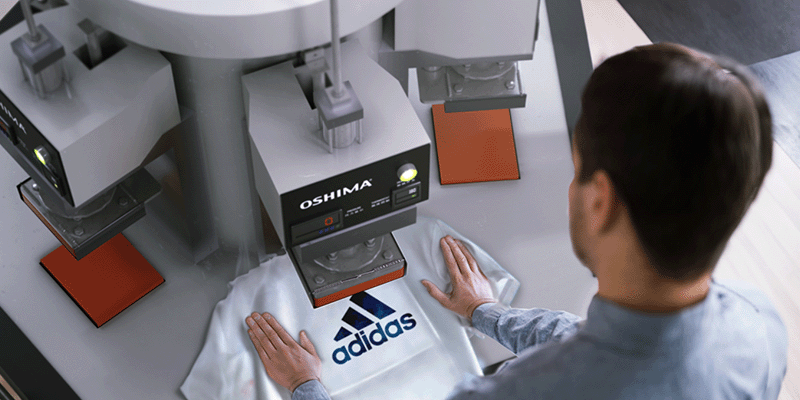
In garment printing and finishing, heat transfer technology has become a common decoration and application method. It is widely used for sportswear, uniforms, teamwear, brand logos, number labels, care labels, reflective materials, and functional transfers.
For small brands, a desktop or commercial heat press may be enough. But for medium and large garment factories, the real question is not only whether the machine can press.
The more important questions are:
Can it support long production hours?
Can it reduce waiting time?
Can it lower operator fatigue?
Can it reduce consumable waste?
Can it maintain consistent transfer quality across every piece?
This is where industrial heat press machines differ from commercial heat presses.
Industrial Heat Press vs. Commercial Heat Press
Commercial heat press machines are usually suitable for small studios, custom shops, startup brands, small-batch printing, and personalized products.
They are usually compact, easy to operate, and more affordable. They are commonly used for T-shirts, tote bags, caps, pillows, and small customized items.
Industrial heat press machines are designed for high-volume production.
They focus on long operating hours, pressure stability, temperature consistency, platen size, automation level, safety, cycle efficiency, and operator arrangement.
For garment factories, the value of an industrial heat press is not only completing the transfer. It is making the production flow smoother.
If a factory needs to process large volumes of sportswear, uniforms, badges, reflective materials, or functional transfers every day, small single-station machines may create waiting time, repeated loading and unloading, and operator fatigue.
When production volume grows, these small delays become a serious bottleneck.
For this reason, medium and large factories should evaluate heat press machines based on output, station design, operator safety, pressure control, cooling efficiency, and long-term consumable cost.
Common Types of Heat Press Machines
1. Clamshell Heat Press
A clamshell heat press opens upward like a clamshell. It is simple, compact, and easy to use. It is often suitable for T-shirts, small studios, and entry-level commercial use.
Its advantages are easy operation, lower space requirement, and relatively accessible pricing.
However, the working area is more limited. Operators must place garments and transfer materials under the heated platen. For thicker, larger, or more precise positioning applications, this may reduce convenience.
If a factory only handles small-batch printing or sampling, a clamshell heat press may be enough. For long-hour production, efficiency and safety need further evaluation.
2. Swing-Away Heat Press
A swing-away heat press allows the upper heat platen to swing to the side, leaving the lower worktable fully open.
This gives operators more space and better visibility when placing garments and transfer materials.
The advantage is better positioning and reduced need to work directly under a heated platen. It is more suitable for thicker materials, complex placement, or applications that require better operator access.
The trade-off is that swing-away machines usually require more space, involve more operating steps, and cost more than clamshell models.
3. Drawer Heat Press
A drawer heat press has a lower worktable that slides out like a drawer. Operators can place garments and transfer paper outside the heat platen area, then slide the table in for pressing.
This design improves safety and supports continuous operation.
For production lines with frequent loading and unloading, a drawer design helps reduce the need to reach under the heated platen.
However, for thicker products or materials that move easily, factories still need to pay attention to positioning stability during table movement.
4. Sublimation Heat Press
A sublimation heat press is used for sublimation printing. In this process, special ink and transfer paper are heated so that the ink turns into gas and bonds with polyester fibers or specially coated surfaces.
Sublimation is commonly used for polyester sportswear, flags, pillows, mugs, panels, and other suitable substrates.
Its advantages include strong color performance and a lighter feel because the image bonds with the material rather than sitting as a thick layer on top.
However, sublimation requires compatible materials. It is not suitable for every fabric. If the factory mainly processes cotton T-shirts, heat transfer vinyl, labels, or functional transfer materials, equipment should be selected based on actual application needs.
Common Heat Press Brands and Market Positioning
There are many heat press brands in the market, and each has its own positioning.
Cricut is widely known among personal creators, hobby users, and small businesses. Its heat press products focus on ease of use and customization. Cricut describes its heat presses as tools for applying heat transfer designs onto fabric, wood, and other surfaces.
Stahls’ and Hotronix are well-known in commercial and professional heat transfer markets, offering different types of heat press equipment.
Geo Knight offers a variety of heat presses, including clamshell, swing-away, and multipurpose machines for garments, mugs, caps, and other applications.
VEIT, Macpi, and Hashima also have their own positions in garment equipment, pressing, or professional heat application markets.
However, many common market brands focus on single-platen, desktop, commercial, or specific-use heat press machines.
For garment factories that require high-volume production, continuous operation, multi-station configuration, and higher cycle efficiency, equipment selection should not depend only on brand awareness. It should return to the real production workflow.
Why Do Medium and Large Factories Need Industrial Multi-Station Heat Press Machines?
When heat transfer moves from small customization to mass production, the biggest issue is usually not whether one transfer can be done successfully. The issue is whether the whole workflow can remain smooth.
High-volume production often faces several problems:
Long loading and unloading time.
Cooling time after pressing.
Different materials requiring different pressure settings.
Operator fatigue from repetitive work.
Single-station machines limiting production output.
Consumable usage affecting long-term cost.
The value of a multi-station heat press is that loading, pressing, cooling, and unloading can be separated into a smoother continuous process.
For medium and large garment manufacturers, a five-station rotary design can improve cycle stability and help operators follow a more consistent workflow.
Three Key Advantages of OSHIMA’s Five-Station Rotary Heat Press
1. Five-Station Rotary Design for Continuous Production
OSHIMA’s five-station rotary heat press is designed for high-volume garment production.
Unlike single-station or small commercial heat presses, the multi-station structure allows multiple worktables to move through different production stages.
For sportswear, uniforms, teamwear, brand badges, and large heat transfer orders, the five-station design helps reduce waiting time and creates a smoother process for loading, positioning, pressing, and unloading.
This type of machine is especially suitable for medium and large factories that require stable output and long-hour production efficiency.
2. Independent Pressure Control for Better Material Flexibility
Heat transfer quality depends on temperature, time, and pressure.
Different fabrics, transfer films, garment thicknesses, and functional materials may require different pressure settings.
One important feature of OSHIMA’s five-station heat press is independent pressure operation and display for each worktable.
This is useful for factories with changing production conditions.
If different orders, fabrics, or transfer materials require pressure adjustment, independent pressure control makes operation more intuitive and flexible.
Compared with unified pressure control, independent control is more suitable for factories that handle varied products and materials.
3. Cooling Design and Mechanical Label Removal to Reduce Waiting and Consumable Cost
Cooling and unloading can affect the overall production cycle.
If operators must wait for materials to cool down after heat pressing, the production rhythm slows down. OSHIMA’s five-station heat press can be customized with cooling design to help reduce waiting time and improve continuous production.
Another important feature is mechanical label removal, which helps reduce the need for tape or similar consumables.
For high-volume production, consumables may look inexpensive per piece, but the annual cost can become significant.
A machine that reduces consumable use can lower cost, reduce manual steps, and reduce material waste.
What Should Factories Evaluate When Choosing an Industrial Heat Press?
1. Production Volume and Daily Working Hours
If the factory handles only small-batch customization, a commercial heat press may be enough.
If the factory needs long-hour and high-volume production, industrial-grade and multi-station designs should be evaluated.
2. Product Type and Material
Different fabrics and transfer materials require different temperature, pressure, time, and cooling conditions.
Sportswear, functional garments, reflective materials, logo badges, and thick materials may all require different settings.
3. Operator Safety and Working Space
Machine design should allow operators to load, position, and unload safely.
For long-hour production, worktable height, platen position, loading method, and anti-burn design all affect operator safety and efficiency.
4. Pressure Control Method
Factories with varied products should choose machines with more intuitive and flexible pressure adjustment.
Independent pressure control is especially useful for multi-style and multi-material production.
5. Cooling and Post-Press Handling
Heat transfer does not end after pressing.
Cooling, peeling, unloading, inspection, and stacking affect the full cycle time.
Machines that integrate cooling and label removal are more suitable for mass production.
6. Long-Term Consumable and Maintenance Cost
Factories should not evaluate only the machine purchase price.
Consumables, maintenance, downtime, and after-sales service should also be included.
For high-volume production, long-term total cost is more important than initial price alone.
Why OSHIMA Is Suitable for Industrial Heat Transfer Solutions
OSHIMA has long supported the garment and textile industry and understands the production needs of garment factories, including high output, consistent quality, delivery pressure, and cost control.
The value of OSHIMA’s five-station rotary heat press is not only that it is another equipment option. It is designed for the workflow of medium and large factories.
Through multi-station structure, independent pressure control, cooling design, and mechanical label removal, the machine helps factories improve efficiency, reduce waiting time, and reduce consumable dependency.
For factories that need stable high-volume heat transfer production, equipment selection should not focus only on single-press performance. It should focus on whether the overall workflow is smooth, safe, stable, and cost-effective over long-term operation.
Conclusion
Heat transfer technology has become an important process in garment printing and finishing. From small customization to industrial mass production, different factories need different levels of equipment.
Clamshell, swing-away, drawer, and sublimation heat presses each have suitable applications. Small studios may focus on ease of use and cost. Medium and large garment factories should focus more on output, stability, pressure control, cooling efficiency, operator safety, and long-term consumable cost.
OSHIMA’s five-station rotary heat press is designed for high-volume garment production. It provides a more efficient multi-station workflow, independent pressure control, cooling design, and consumable-saving mechanism.
For factories that want to increase heat transfer capacity, reduce waiting time, and maintain consistent quality, it is a heat transfer solution worth evaluating. Choosing the right equipment does not only improve one process. It makes the garment finishing workflow more stable, efficient, and suitable for long-term production needs.


Article Classification
Recent Articles
- The 30-90-180 Day Rule for Industrial Boiler Maintenance
- How Garment Machinery Supports Safety, Compliance and Environmental Management?
- What Happens Before Fabric Goes to the Cutting Table?
- Industrial Iron & Vacuum Table Care: How to Extend Their Lifespan
- Cutting Floor ROI: How the M8s and TAC Save $100K Annually