
 0
0



- Home
- Blog
- Smart Manufacturing
- How Is Industry 4.0 Changing Garment Machinery?
How Is Industry 4.0 Changing Garment Machinery?
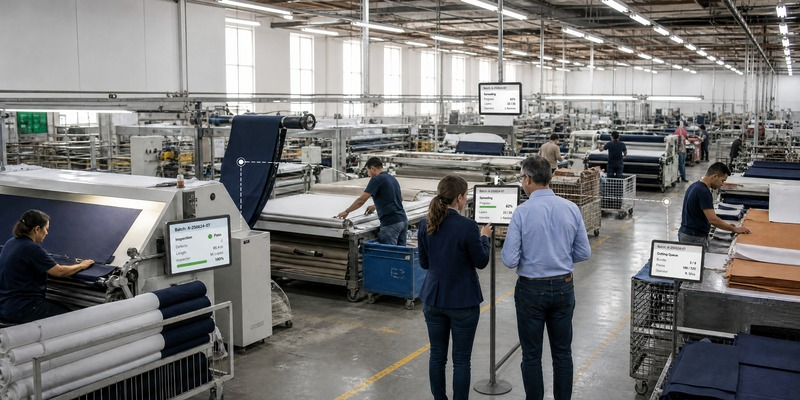
Garment equipment used to be evaluated largely by what it could do at one production stage. A fabric inspection machine inspected fabric, a spreading machine laid the material, and an automatic cutter handled cutting. For equipment suppliers, discussions naturally focused on capacity, accuracy, applicable materials, machine configuration and operating requirements.
That conversation is becoming broader. As factories introduce more automation and equipment begins to generate production data, the performance of one machine is increasingly connected to what happens before and after it. Fabric conditions identified during inspection can affect spreading and cutting. Spreading quality influences cutting consistency. Production information recorded at the machine may later be useful to supervisors or management.
From an equipment supplier's perspective, this is one of the more practical changes behind Industry 4.0. We still need machines that perform their own jobs reliably, but evaluating equipment increasingly requires us to understand the production flow around it: where the problem begins, what it affects downstream, what information should be retained and whether that information can remain useful in the next process.
A Machine Can No Longer Be Evaluated Only by Its Own Process
Garment manufacturing has always been a sequence of connected operations. Fabric inspection, relaxing, spreading, cutting, fusing, sewing, pressing, final inspection and packing may be managed by different departments, but problems rarely stay within one department.
A dimensional or fabric-condition issue discovered during sewing may have started before cutting. A damaged cut part may come from a defect that was already present in the roll. Poor spreading conditions may appear later as cutting inconsistency. In the same way, an inspection record has limited production value when the information stops at the inspection station.
This changes the discussion between equipment suppliers and factories.
When a factory evaluates an automatic spreading machine, for example, spreading speed is important, but it is not the only consideration. The supplier also needs to understand the fabric being handled, roll conditions, lay requirements, cutting-room workflow and how frequently production changes.
Automatic cutting is similar. Cutter capacity matters, but the cutting machine receives the result of everything that happened during material preparation and spreading. Evaluating the cutter without considering those conditions gives only part of the picture.
Industry 4.0 makes these connections more visible, but the underlying manufacturing principle is familiar: each process needs to provide stable conditions for the next one.
Automation Still Has to Fix the Production Process
Automation is often associated with higher output and lower labor requirements. Both can be relevant, particularly as factories face rising labor costs and difficulty retaining people for repetitive or physically demanding work. From an equipment perspective, however, automation also changes how much production variation depends on individual operators.
Automatic spreading can reduce repeated manual handling and maintain more consistent spreading conditions. Automatic cutting can reproduce programmed cutting work with less operator-dependent variation. Fusing machines control temperature, pressure and processing time where bonding conditions need to remain consistent. Pressing and heat-press equipment can reduce differences in repeated manual operations, while needle detection provides a controlled inspection process before shipment.
AI-assisted fabric inspection adds another dimension because the equipment can support defect detection while creating quality records for later review.
These applications are different, and they should not be treated as one general automation package. A machine that provides strong results in one factory may be poorly matched to another factory's fabric, production volume, style-change frequency or operating conditions.
This is why our discussion with a customer increasingly has to begin before the specification sheet. We need to understand what production problem the factory is actually trying to reduce.
Machine Data Becomes Useful Only When the Factory Can Use It
For many years, a machine could complete its work without creating much information beyond basic production figures. As IoT functions and digital controls become more common, equipment can increasingly record operating status, production quantities, settings or quality-related information.
Having the data does not automatically make the process smarter.
The production value appears when that information helps someone make a decision.
Fabric inspection is a clear example. When defects are detected and recorded during inspection, the information can remain as an inspection report, or it can become an input for later production planning. When spreading and cutting teams can refer to known fabric conditions before cutting begins, a problem identified upstream has a better chance of being handled before it becomes replacement work or material waste.
Spreading equipment can also record information such as spreading length, layer count, operation time and machine status. Depending on the factory's management system, some of this information can be brought into a dashboard rather than remaining only at the machine.
At later stages, inspection, needle-detection or barcode-related records may also support product and shipment tracking where required.
For an equipment supplier, this creates new questions. What information does the factory actually need? Who will use it? Does the next process need access to it? Does the existing equipment environment allow that information to be used?
Connecting everything simply because it can be connected creates complexity without necessarily improving production. Useful data should follow the production decision it is intended to support.
More Technology Does Not Automatically Mean a Better Equipment Choice
As automation becomes more sophisticated, equipment comparison can easily become a comparison of functions.
This is where factory conditions still matter.
A high-capacity machine may be suitable for stable, long production runs but less practical in an operation that changes styles continuously. Equipment developed for one fabric category may not perform the same way with stretch materials, heavy rolls or other materials the factory handles regularly. Machine dimensions, floor layout, material movement and utility requirements also need to fit the site.
Future data requirements add another consideration. A factory that plans to build production monitoring later may need to know what information a machine can output and how that information can be accessed. Existing machines from different generations or suppliers may also have very different levels of connectivity.
Choosing automation without considering these conditions can create new problems instead of removing old ones. The machine may have unused functions, operators may develop workarounds, or a process may become faster while creating another bottleneck downstream.
The equipment decision therefore still comes back to basic production questions: What material is being processed? Where does the current variation occur? What is limiting output? How often does the production condition change? What does the next process require?
Industry 4.0 has added more tools to the discussion, but it has not removed the need to understand the factory.
Installation Is Part of the Equipment Project
Another change in the equipment supplier's role becomes clear after the machine arrives.
Automated equipment still needs operators who understand settings, changeovers and abnormal handling. Maintenance personnel need to know routine maintenance and troubleshooting. Production managers need to understand which parameters should remain controlled and which machine information is useful for daily management.
Without this work, even capable equipment can gradually return to operator-dependent production.
A function that operators do not understand may be bypassed. A parameter that should remain standardized may slowly return to individual adjustment. Data may be recorded but never reviewed. When an abnormal condition occurs and technical support is difficult to obtain, the factory may build a manual workaround simply to keep production moving.
Installation, training, maintenance guidance, spare-part availability and technical support are therefore part of the equipment decision rather than separate issues that begin after purchase.
For suppliers, this also means understanding how the machine will actually be used after installation. Factory conditions, operator experience and local technical capability affect the long-term value of automation just as much as the machine specification itself.
Different Factories Will Enter Industry 4.0 from Different Processes
There is no single machine that marks the beginning of Industry 4.0, and there is no fixed sequence every garment factory needs to follow.
One factory may begin with fabric inspection because fabric defects are causing too much replacement work downstream. Another may first automate spreading and cutting because the cutting room has become the production bottleneck. A factory that already has substantial automation may have a different issue: its machines are productive, but production information remains scattered across separate systems.
This is also why equipment suppliers need to be careful about presenting smart manufacturing as a complete package that every factory should adopt at the same time.
In practice, factories tend to move process by process.
A repetitive or unstable operation is automated first. Once the equipment is running reliably, useful production information can begin to be collected. Dashboards become relevant when there is reliable data worth managing. Cross-process integration becomes useful when information from one stage can genuinely improve a decision in another.
The sequence depends on the customer's present production conditions, not on how many technologies can be placed under the Industry 4.0 label.
From Individual Equipment to a More Connected Production Flow
Within OSHIMA's garment-production equipment, this change can be seen across several stages of the process.
Related solutions include AI-assisted fabric inspection, IoT spreading equipment, automatic cutting machines, fusing equipment, pressing and heat-press machines, needle detection, and inspection and packing-related equipment.
Each machine still has its own production responsibility. At the same time, some information created in one process can increasingly become useful later in the workflow. Fabric inspection information, for example, can support later spreading and cutting decisions. Production information from connected spreading equipment can be used in management dashboards where required.
This does not mean that every machine in a garment factory has to become part of one large system. The useful connection is the one that helps the factory reduce a real production gap: a defect known earlier, a setting controlled more consistently, a production condition made visible or information reaching the next process before a decision has already been made.
For an equipment supplier, Industry 4.0 therefore changes the starting point of the conversation. We can no longer look only at what one machine does. We also need to understand what arrives at that machine, what leaves it, and what the factory needs to know in between.
The technology will continue to change. The manufacturing requirement remains familiar: stable processes, controlled quality, predictable production and equipment that fits the way the factory actually works.


Article Classification
Recent Articles
- If Every Machine Is Running, Why Does the Factory Still Feel Stuck?
- AI Fabric Inspection: Turning Fabric Defects into Cutting Room Decisions
- Where Does a Garment Factory Lose Energy During Production?
- What Changes When Garment Factory Data Becomes Connected?
- How Garment Factories Can Boost Fabric Utilization and Cut Waste?