
 0
0



- Home
- Blog
- Industry Insights
- Why Are Garment Factories Struggling to Recruit Young Workers?
Why Are Garment Factories Struggling to Recruit Young Workers?
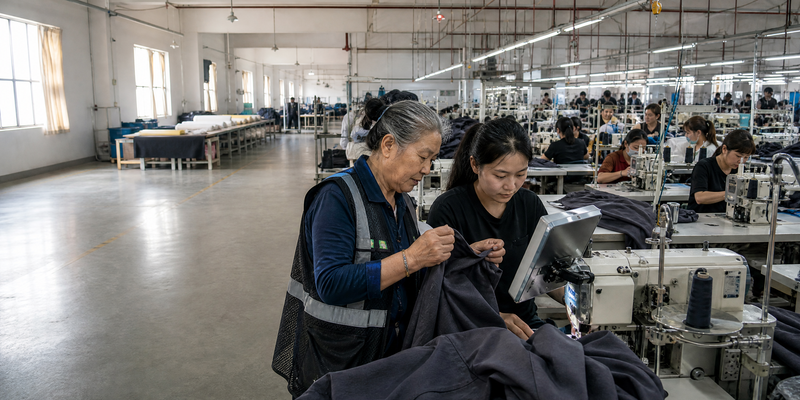
Over the past several years, many garment manufacturers have found production workers noticeably harder to recruit. Orders may be available and machines may still have capacity, but filling sewing, quality, fabric inspection, packing, warehouse and other shop-floor positions is often less straightforward than it used to be. Keeping people after they are hired is another challenge.
The change can already be seen in the workforce itself. A study found that workers aged 15–24 declined from 26% of the sector's workforce in 2012 to 14% in 2023. The share aged 25–34 also fell, from 37% to 32%. The report specifically points to difficulty attracting younger workers and stronger competition from industries such as electronics and service sectors such as tourism.
The pressure has continued. Industry reporting in July 2026 showed that labor shortages remained a major bottleneck as export orders recovered, with manufacturers competing for workers both within the sector and with other industries offering more attractive employment conditions.
This is not unique to garment manufacturing. Many labor-intensive manufacturing industries are dealing with similar issues: fewer young people entering traditional production jobs, more alternatives in the labor market, and experienced workers gradually approaching retirement. Garment manufacturing feels the change particularly quickly because so many processes still depend on a large shop-floor workforce.
Reducing the issue to “young people do not want to work in factories anymore” does not explain very much. Someone entering the workforce today simply has more choices than someone entering it 15 or 20 years ago. Electronics, technology manufacturing, logistics, warehousing, retail, hospitality and other services may all be recruiting from the same population.
When the difference in pay is not large enough to decide the choice on its own, working environment, hours, physical demands, management and what a person can learn from the job all become part of the comparison.
For garment factories, this eventually goes beyond recruitment numbers. When fewer new workers enter, experienced employees leave or retire, and production still depends heavily on accumulated knowledge, labor shortage can gradually become a skills and experience gap.
Young Workers Have More Choices Even When They Still Choose Factory Work
Garment factories are no longer competing only with the factory next door
In many garment-producing regions, factory work used to be one of the most obvious employment options for young people entering the workforce. Garment, footwear and textile factories were concentrated around industrial areas, and joining a factory to learn a production skill was a common career path.
The employment market is much broader today.
Electronics and technology manufacturing have expanded in Viet Nam, China and other Asian production bases. Logistics, warehousing and service industries have also grown. In some industrial areas, garment factories are now directly competing with large electronics manufacturers for the same entry-level workers.
The scale of this competition can be substantial. In Bac Ninh, Viet Nam, more than 330,000 workers were reportedly needed in March 2026, with some manufacturers increasing signing and referral bonuses to compete for labor.
For a worker, the differences between jobs can be quite practical.
Garment production remains highly labor-intensive. Sewing means spending long periods at a fixed workstation. Fabric inspection and quality work require sustained attention. Warehousing, material handling and other operations can involve physical work, while peak seasons may bring longer working hours in some factories.
Other manufacturing jobs may offer different working environments, more equipment-based roles or a clearer technical image. When compensation is relatively close, choosing one of those jobs instead of garment production is understandable.
Garment factories are therefore no longer competing only on the question of which factory nearby pays slightly more.
A young worker may instead be asking:
Why should I choose garment manufacturing when I can also work in another manufacturing or service industry?
That is a much wider competition for labor.
More Job Choices Mean More Things to Compare
Pay still matters, but workers can compare the whole job more easily than before
Different generations entered the workforce under different economic and social conditions.
For many workers from earlier generations, stable employment and regular income carried considerable weight. In manufacturing communities with fewer employment alternatives, getting a steady factory job could itself represent a good long-term opportunity.
Millennials entered a broader labor market, where job content, advancement and work-life arrangements became more visible considerations.
Gen Z enters an environment where information is even easier to obtain. Pay, workplace reviews, working conditions and alternative career paths can be compared quickly. Changing employers or moving between industries is also more common and more visible than it was for earlier generations.
That does not mean every Gen Z worker thinks alike, or that younger people are unwilling to work hard. The practical difference is that they have more information and more alternatives to compare.
A worker considering a position may look at monthly income, but also at daily responsibilities, overtime, management style, workplace conditions and whether two or three years in the job will build skills that can lead somewhere else.
When some garment-production jobs have changed relatively little while working environments, equipment and career paths in competing industries continue to develop, that difference becomes more noticeable during recruitment.
Experienced Workers Are Gradually Leaving While Replacements Are Harder to Build
Many shop-floor skills take years to develop
A surprising amount of garment-production knowledge looks simple until an experienced person leaves.
An experienced fabric inspector recognizes conditions that a new operator may need time to understand. Quality personnel can often look at a sewing or finished-garment problem and narrow down where it originated. Skilled sewing workers learn how different fabrics, stitch settings and machine conditions behave. Maintenance, machine operation and production management contain the same kind of accumulated knowledge.
Many factories today still depend heavily on employees who have built this experience over years.
A growing number of those workers are now in their fifties or sixties, approaching retirement or finding some physical production work harder to sustain.
When they leave, the factory does not lose only one headcount. It loses years of practical judgment.
Previously, the usual approach was relatively straightforward: an experienced worker trained the next person, and skills gradually passed from one group to another.
That becomes harder when the next group is more difficult to recruit and more likely to move between employers.
The result may not immediately appear as lower production output. It can begin with smaller dependencies: one person is always called when a particular machine stops, only a few people are comfortable judging a difficult material, or one senior employee knows a customer's quality requirements better than everyone else.
The machines are still there and the theoretical capacity is still there. The number of people who can deal with unusual situations becomes smaller.
High turnover makes factories repeat the same learning curve
Recruiting a replacement is only the beginning.
New employees need training, time to become familiar with the work and someone experienced enough to check mistakes. When the same position turns over repeatedly, senior employees and supervisors spend the same time teaching the same knowledge again.
This is particularly relevant in garment manufacturing because many production decisions cannot be completely captured in an SOP.
Different fabrics behave differently. Customer standards vary. Styles and orders change. Operators encounter situations that are similar but rarely identical.
Basic work can be standardized, but some capabilities still develop through repetition and experience.
A factory may therefore replace the same number of people it loses without fully replacing the capability that left with them.
Over several years, the larger problem is that experience can leave the factory faster than the next group can build it.
Automation Looks Different When Workers Are Harder to Replace
Some equipment investments are now driven by labor availability as much as labor cost
Factories have always calculated automation partly around labor savings and return on investment.
That calculation is beginning to change in some locations.
There are jobs where the problem is no longer simply that manual labor costs more. The problem is finding enough people willing to perform the work consistently and remain in the position.
Continuous visual observation, repeated material handling, repetitive machine movements, handwritten production records and routine reporting all consume labor every day. They do not necessarily require an experienced person to perform every step manually.
Equipment can take over the more repeatable portion while operators remain responsible for setup, confirmation, adjustment and abnormal conditions.
AI fabric inspection shows how the division of work can change
Fabric inspection is one example.
Conventional inspection depends heavily on an operator continuously watching the fabric and recording defects and their positions. AI-assisted fabric inspection can take over part of the continuous image detection and recording work.
People are still needed.
Customer acceptance standards, unusual fabrics, ambiguous defects and decisions about how an issue should be handled in production still require human judgment.
The operational change is therefore relatively practical: experienced inspectors can spend less of their time on continuous observation and repetitive recording, and more of it reviewing conditions that actually require their experience.
The same approach can be considered in other processes. Repetitive movements may be handled by equipment while people manage settings and abnormalities. Production information that was previously written down and consolidated manually can increasingly be recorded as part of machine operation.
The work remains. How people's time is used begins to change.
As Equipment Increases Factory Management Cannot Depend on More People Walking Around and Taking Notes
Connected machinery can reduce the time spent checking machines, copying numbers and rebuilding production reports
Automation creates another management issue.
As factories install more equipment, it is difficult to continue assigning more people simply to check machines, collect production figures and confirm what is happening across the floor.
When labor is readily available, work can be divided into very narrow responsibilities. One operator watches one station, production numbers are written down, supervisors collect the records, and machine problems are communicated by phone or messaging groups.
Across dozens of machines and multiple shifts, however, these small tasks add up.
Production operators enter quantities. Team leaders collect them. Supervisors reorganize the information. Someone calls to ask whether a machine is still stopped. Another person checks which order is currently running. Management may eventually receive information from the previous shift rather than the current condition.
Connected equipment changes part of this work.
Machine status, production quantities and operating records can be captured during production and viewed centrally where the system supports it. Supervisors can spend less time walking from machine to machine or waiting for individual reports before understanding current production conditions.
This does not automatically mean eliminating a position.
More often, it means allowing the same production and management team to supervise more equipment and information with less time spent on routine checking, copying and consolidation.
Single-machine automation reduces repetitive work within one operation. Connected equipment and centralized information reduce part of the management work required simply to understand what is happening across multiple machines.
For factories with a large equipment base, both can affect labor requirements.
From Individual Automation to an Equipment Ecosystem
OSHIMA provides one option for keeping related equipment and production data within the same environment
Factories can approach automation and equipment management in different ways. Some build around existing machines from several suppliers. Others prefer to keep related processes within a more unified equipment ecosystem.
Within garment production, OSHIMA's related equipment and systems include EagleAi® AI fabric inspection, automated spreading and cutting equipment, and the OSHIMA Smart Factory Platform.
The equipment covers different production processes, but within the same ecosystem there are two broad applications: automating repetitive machine-level work and retaining useful production information generated during operation.
EagleAi, for example, detects and records fabric defects and their locations during inspection. Spreading and cutting equipment perform their respective production operations according to production settings, while operators remain responsible for material conditions, setup, quality confirmation and abnormal situations.
This type of automation reduces some of the repetitive work surrounding individual processes without removing the need for people who understand production.
As the number of machines grows their information can also be managed together
The other part of the ecosystem is equipment information.
Supported connected equipment can retain operating and production records that can be viewed through the OSHIMA Smart Factory Platform. Where a factory operates multiple supported machines, processes or sites, production personnel can review relevant operating and production information through the same platform instead of relying entirely on separate machine checks and manually consolidated records.
For a factory with many machines, this is a different issue from automating one operation.
Adding automation should not require management work to grow at the same rate as the number of machines. Direct access to equipment information can reduce part of the checking, reporting and information-gathering work that otherwise grows with the equipment base.
Data created in one process can be reused where it is relevant downstream
An equipment ecosystem can also allow information created earlier in production to be used again where there is a practical reason to do so.
For example, defect-location data recorded during EagleAi fabric inspection can, within the relevant system configuration, be applied to spreading planning. Inspection information therefore does not have to remain only as a separate inspection report when it can support a later production decision.
Not every factory needs every connection, and keeping equipment within one ecosystem is not the only approach.
Existing machinery, IT architecture, investment cost, maintenance capability and the production problem the factory is trying to solve all need to be considered.
OSHIMA represents one option for factories that want related inspection, spreading, cutting and supported machine information within the same equipment environment. A factory can use individual machines where that is all it requires, or use the connected functions when centralized equipment management or continued use of production data is useful.
The boundaries are also clear. Equipment and software do not solve wages, working hours, workplace conditions, management quality or employee development.
What machinery can address is more specific: repetitive work that is increasingly difficult to staff consistently, together with the checking, recording and information-management workload that can grow as factories install more equipment.
Capacity Planning Also Needs to Account for Labor
The labor conditions facing garment factories are different from those of 10 or 20 years ago. Younger workers have more job options, while many experienced employees are approaching retirement. Capacity planning therefore needs to consider not only available machine hours, but also how many people a factory can realistically recruit and retain.
Many shop-floor tasks still require experience, while repetitive operation, machine checking, manual recording and routine reporting can be reviewed to see whether they still need to depend entirely on people. Automation and connected machinery are one option—not to remove people from production, but to reduce dependence on repetitive labor and allow operators to spend more time on setup, quality decisions and abnormal conditions.
Increasing capacity does not always have to mean adding more workers. Depending on the process, labor situation and investment priorities, factories can reconsider how work is divided between people and equipment so the available workforce can support production more consistently.

Article Classification
Recent Articles
- Why Are Garment Factories Struggling to Recruit Young Workers?
- What Does the World Cup Have in Common with Apparel Sourcing?
- Why Garment Factories Need Process Stability in a Slower Market?
- Why Scale and Low Cost Are No Longer Enough for Bangladesh Apparel Manufacturing?
- Why Extreme Heat Is Becoming a New Risk for Apparel Supply Chains?