
 0
0



- Home
- Blog
- Equipment Knowledge
- What Steam Equipment Does a Garment Factory Actually Need?
What Steam Equipment Does a Garment Factory Actually Need?
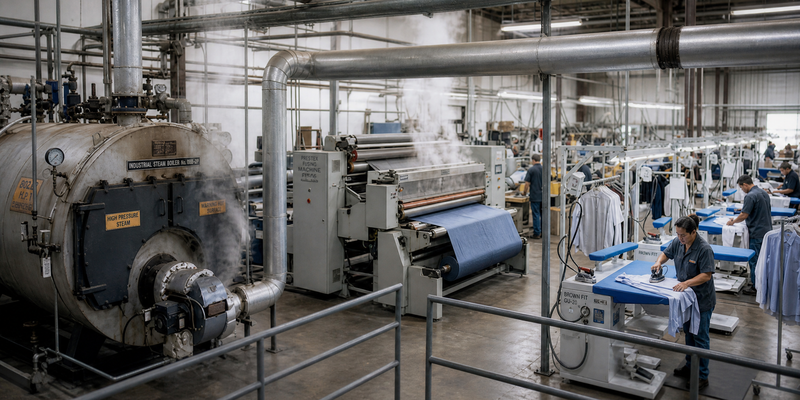
Steam is used in several parts of garment production, but the demand is rarely the same throughout the day. Fabric treatment may be running before cutting while pressing stations are operating at the other end of production. During busy periods, several steam-consuming machines may be working at the same time.
This is when steam capacity starts to affect production more directly. Fabric treatment can take longer, pressing stations may have to wait, or finishing conditions can become less consistent when the supply cannot keep up with simultaneous demand.
Choosing steam equipment is therefore less about finding one boiler specification and more about understanding how the factory actually uses steam. Production volume, operating hours, fabric and garment type, available energy, water quality and maintenance conditions all have a place in that decision.
Start with How Steam Is Used During Production
Before comparing boiler capacity, it helps to list the equipment that actually uses steam and when it normally operates.
In a garment factory, this may include industrial steam irons, vacuum ironing tables, garment pressing machines, fabric shrinking equipment and other finishing processes. Some machines operate for most of the working day, while others create heavier demand during certain production periods.
The combined load matters more than looking at each machine separately. A boiler may be sufficient for a pressing section on its own, for example, but the situation changes when fabric shrinking equipment and several pressing stations are operating at the same time.
Daily production patterns should also be considered. A factory using steam only at selected stages has a different requirement from a facility running a large finishing department continuously. Planned increases in capacity or additional steam-consuming equipment should be included before the system is finalized.
In practice, the useful figures are the steam quantity and pressure required by each machine, how many machines operate simultaneously, peak demand, daily operating hours and any likely future expansion.
Boiler Capacity Should Match Production Demand
A larger boiler is not automatically a safer choice.
Too little capacity can leave downstream equipment waiting for steam during peak periods. Excess capacity can increase initial investment and may create unnecessary operating costs depending on how the system is used.
The better starting point is the factory's actual production rhythm. The boiler needs enough capacity for normal simultaneous operation and reasonable peak demand without being sized only around the highest number available.
This becomes especially important when the same steam source supports more than one production area. Fabric preparation and garment finishing may be physically separated, but from the steam system's point of view they are drawing from the same supply.
Energy Choice Depends on Factory Condition
Once the steam demand is reasonably clear, the available energy options can be compared.
Electric, gas, oil-fired and biomass systems can all be used under different factory conditions. The practical choice depends on local energy supply, operating cost, infrastructure and the amount of daily steam required.
Electric systems may be suitable where electrical capacity is sufficient and on-site combustion is not preferred, particularly for relatively small steam loads. Electricity cost and available power still need to be checked carefully.
Gas can be practical where a stable supply is already available. Oil-fired equipment remains relevant in locations without convenient gas access, provided fuel delivery and storage can be managed. Biomass introduces another set of operating requirements, including fuel sourcing, storage, ash handling and emissions management.
Two boilers with similar steam output can therefore have very different implications once they are installed in different factories. Equipment price is only one part of that comparison.
Water Quality Affects Long-Term Steam System Operation
Water conditions are easy to overlook because their effect is usually gradual.
Hard water can create scale inside boilers and steam systems, reducing heat-transfer efficiency and increasing maintenance requirements. Corrosion can also shorten equipment life when water conditions are not properly managed.
For factories using steam every day, incoming water quality should be checked as part of the system design. Depending on local conditions, this may include water softening, regular testing, blowdown procedures and routine maintenance.
This is relevant to more than the boiler. The condition of the steam supply can also affect the long-term maintenance of pressing machines and other equipment connected to the system.
Shrinking and Pressing Have Different Steam Requirements
Fabric shrinking before cutting and final garment pressing may use the same steam source, but the production requirements are quite different.
Before cutting, shrinking or steam-treatment equipment is used to manage dimensional changes in the fabric. Materials may still carry tension or dimensional variation after weaving, dyeing, finishing, rolling and transportation.
Cotton, knits, viscose, stretch fabrics and other materials can respond differently to heat, steam and movement. The process settings should be based on the actual material and shrinkage test rather than one standard setting for every fabric.
This stage can affect much more than the shrinking process itself. Fabric that changes dimension after it has already been spread, cut and sewn is much harder to correct. The problem may later appear as garment size variation, distortion or inconsistent wash results.
Pressing deals with another part of garment quality. Shirts need clean collars, cuffs, plackets and overall presentation. Uniforms and tailored products usually require more defined structure. Knitwear and casual garments may need a softer appearance.
For higher-volume production, consistency is just as important as the individual pressing result. Steam supply, equipment type, vacuum or blowing requirements, product category, daily output and operator arrangement all affect how the pressing section should be configured.
Fabric Fusing and Steam Processing Require Different Controls
Fusing equipment also affects garment dimensions and final appearance, but it is a different process from steam treatment.
Collars, cuffs, plackets, waistbands and other reinforced areas normally rely on controlled heat, pressure and time to bond fusible interlining to the shell fabric. Steam is not the main bonding method.
The two processes can be considered together when reviewing garment quality, but their equipment requirements should remain separate. Steam treatment is concerned with fabric condition and finishing, while fusing needs stable bonding conditions between the fabric and interlining.
Keeping that distinction clear also makes utility and equipment planning more accurate.
Installation and Maintenance Need to Be Planned Together
Boilers and steam systems operate with high temperature and pressure, so the installation environment has to be considered before the equipment arrives.
Local safety requirements, available space, ventilation, operator training and access to safety valves, water-level gauges and pressure gauges all need to be confirmed. Regular inspection and maintenance also have to fit into normal factory operation.
Service support becomes particularly important when one steam source supports several production processes. A boiler shutdown can affect fabric treatment and finishing at the same time.
When comparing suppliers, it is worth looking at installation and commissioning support, operator training, maintenance guidance, spare-parts availability and repair capability alongside the equipment itself.
These issues may not receive much attention during the initial quotation stage, but they become much more important after the equipment has been running for several years.
Operating Cost Goes Beyong the Equipment Price
Steam equipment continues to generate costs throughout its working life.
Energy is the most obvious one, but water treatment, routine maintenance, spare parts, operator requirements and downtime also need to be considered. Production losses can become more expensive than the equipment itself when an unstable steam supply repeatedly interrupts shrinking or pressing.
There is also a quality cost. Inconsistent fabric treatment or finishing can create rework, dimensional problems or other quality issues further downstream.
This is why two systems with similar purchase prices may perform very differently over time. The more useful comparison is whether the system fits the factory's normal load, can be maintained locally and remains practical as production changes.
Different Factories Need Different Steam Equipment Configurations
There is no single steam equipment arrangement that fits every garment factory.
A factory producing shirts may use a large part of its steam in pressing and finishing. Another factory may need more steam for fabric treatment before cutting. A smaller production facility may have relatively limited steam demand, while a high-volume operation may need several processes running simultaneously.
OSHIMA's steam-related equipment for garment production covers several parts of this workflow, including industrial steam boilers, fabric shrinking and steam-treatment equipment, and industrial pressing and steam-ironing configurations.
The actual combination depends on the factory. Steam load, fabric type, garment category, daily output, available energy and existing equipment all affect how the system should be arranged. Some factories may only need to add or replace one part of the system, while others need to consider the boiler and downstream equipment together.
Having different types of steam-related equipment available makes it possible to plan around the production requirement instead of trying to make one standard configuration fit every factory.
For a factory evaluating steam equipment, the most useful place to start is still the production floor: where steam is being used, how much is needed at the same time and which processes will be affected when the supply becomes unstable. Once those conditions are clear, the boiler, fabric-treatment equipment and pressing setup can be matched much more realistically.


Article Classification
Recent Articles
- The 30-90-180 Day Rule for Industrial Boiler Maintenance
- How Garment Machinery Supports Safety, Compliance and Environmental Management?
- What Happens Before Fabric Goes to the Cutting Table?
- Industrial Iron & Vacuum Table Care: How to Extend Their Lifespan
- Cutting Floor ROI: How the M8s and TAC Save $100K Annually