
 0
0



- Home
- Blog
- Applications & Solutions
- How a US Bedding Manufacturer Improved Fabric Spreading Capacity with Multi-Roll Equipment
How a US Bedding Manufacturer Improved Fabric Spreading Capacity with Multi-Roll Equipment
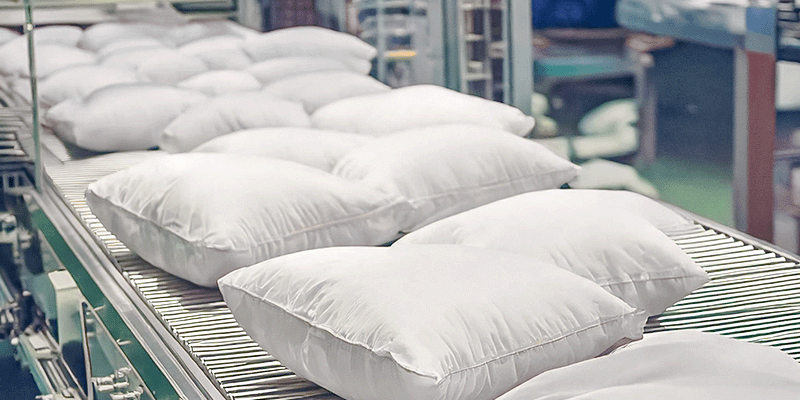
For manufacturers of pillows, mattress toppers, bath textiles and other bedding products, large volumes of fabric must be laid consistently before cutting or further processing begins. As production demand increases, manual fabric spreading can become a limitation in front-end production planning.
The customer in this case is a US bedding manufacturer producing pillows, bedding and related home textile products. Facing high-volume production requirements, the manufacturer needed to improve its previous manual fabric laying process and establish a more suitable method for preparing multiple fabric layers before cutting. The customer therefore introduced multi-roll heavy-duty woven fabric spreading equipment to support heavy rolls, multi-layer laying and longer production runs.
Customer Background: A Bedding Manufacturer Managing High-Volume Fabric Laying
Bedding and home textile manufacturing can involve substantial fabric spreading requirements. Compared with short production runs, large-volume production of pillows, mattress-related products and home textiles places greater pressure on the process that prepares material before cutting.
For this type of manufacturer, fabric spreading needs to address several practical questions:
-
Can fabric be laid consistently and aligned appropriately before cutting?
-
Are operators required to perform repetitive spreading work for long periods?
-
Can heavy fabric rolls be loaded and handled effectively?
-
Can the spreading process support the required cutting and production schedule?
-
Can multiple fabric layers be prepared consistently for subsequent operations?
The customer had previously relied on manual fabric spreading. As output requirements increased, it began evaluating equipment capable of supporting larger-volume fabric preparation and heavy material handling.
Production Challenge: Manual Fabric Spreading Could Not Efficiently Support High-Volume Demand
Manual fabric spreading generally requires several operators to lay, smooth and align fabric before cutting. In a high-volume bedding production environment, this can create several limitations.
1. Spreading Capacity Depends Heavily on Manual Work Pace
When a factory must prepare large quantities of fabric within limited working hours, manual output depends on staffing, physical effort and the consistency of repeated operations. If the cutting process requires a continuous supply of prepared material, insufficient spreading capacity can affect the wider production schedule.
2. Repetitive Laying Creates Operator Burden
Fabric spreading involves repeated handling, smoothing and alignment. When rolls are heavy or production volume is high, the physical and repetitive demands on operators can increase.
3. Multi-Layer Preparation Requires Consistent Laying Conditions
Bedding and related high-volume textile products may require multiple fabric layers before cutting. If alignment, tension or laying conditions vary, production teams may need to spend additional time confirming material preparation before cutting.
4. Heavy Roll Loading Affects Operational Planning
For factories handling large or heavy fabric rolls, loading arrangements affect day-to-day operation. When roll changes rely heavily on manual handling, both personnel allocation and equipment utilisation may be constrained.
According to the original case record, the manual fabric spreading process required multiple workers and offered limited output within an eight-hour shift. The customer therefore sought equipment designed for higher-volume fabric laying and heavy-roll handling.
Solution: Introducing Multi-Roll Heavy-Duty Woven Fabric Spreading Equipment
To improve fabric preparation before cutting, the customer introduced the J3 multi-roll heavy-duty woven fabric spreading machine.
The equipment is designed for high-volume, multi-layer woven fabric spreading, with heavy-roll handling and multi-roll configuration suited to continuous production environments.
Equipment Configuration for This Application
| Equipment Capability | Application Value in This Case |
|---|---|
| Supports up to 6 fabric rolls | Suitable for high-volume, multi-layer fabric laying |
| Handles rolls up to 300 kg each | Supports heavy-roll production requirements |
| Ground-level loading design | Simplifies roll loading and operating arrangements |
| Automatic edge alignment | Helps maintain edge position during spreading |
| Adjustable tension control | Supports fabric laying according to material conditions |
| Maximum travel speed of 95 m/min | Supports high-volume spreading operations |
| Touchscreen interface | Assists operators with machine settings and operation |
| Multilingual interface | Supports use by diverse production teams |
Why Multi-Roll Spreading Fits High-Volume Bedding Production
Bedding and selected home textile production may involve large quantities of relatively consistent woven fabric spreading. Under these conditions, multi-roll equipment can support a more continuous front-end preparation process.
1. Supporting Multi-Layer Fabric Laying
When production requires many layers of material to be prepared before cutting, a multi-roll configuration can support substantial spreading work and reduce the dependence on repeated manual laying.
2. Handling Heavy Fabric Rolls
Bedding and related home textile materials may be supplied in larger rolls. Equipment designed for heavy rolls and ground-level loading is relevant for factories handling large batches over long operating periods.
3. Supporting Fabric Conditions Before Cutting
Automatic edge alignment and adjustable tension control can assist operators in maintaining spreading conditions according to fabric requirements, forming part of more consistent preparation before cutting.
4. Reallocating Operator Tasks
In a manual workflow, several operators may spend extended periods laying and smoothing fabric. With equipment in place, personnel can focus on roll loading, machine operation, fabric confirmation and production monitoring.
Case Result: Improved Spreading Capacity and Workflow Consistency
According to the recorded results of this project, before equipment introduction, manual fabric spreading processed approximately 1,200 to 1,500 layers in an eight-hour working period. After introducing multi-roll heavy-duty spreading equipment, spreading output reached approximately 4,000 to 4,500 layers within the same working period.
| Comparison Point | Previous Manual Spreading Process | After Introducing Multi-Roll Heavy-Duty Spreading |
|---|---|---|
| Spreading Method | Multiple operators manually laid and arranged fabric | Equipment performed multi-layer spreading with operator control and monitoring |
| Eight-Hour Spreading Output | Approximately 1,200–1,500 layers | Approximately 4,000–4,500 layers |
| Operator Focus | Repeated laying, smoothing and alignment | Loading, setup, monitoring and abnormality confirmation |
| Heavy Roll Handling | Highly dependent on manual operation arrangements | Supported through ground-level loading and heavy-roll configuration |
| Spreading Control | Dependent on operator practice and working conditions | Supported by edge alignment and adjustable tension functions |
| Suitable Production Situation | Lower-volume processes or operations with sufficient labour allocation | High-volume, multi-layer woven production with heavy-roll requirements |
Practical Management Value of the Case
The significance of this project was not limited to increased spreading quantity. It also enabled the manufacturer to review how fabric preparation before cutting was managed.
1. Supporting More Stable Front-End Preparation for High-Volume Orders
When spreading equipment can keep pace with large fabric preparation requirements, the factory can plan front-end operations more effectively around subsequent cutting and production needs.
2. Moving Operator Focus from Repeated Laying to Equipment Management
After equipment introduction, personnel can focus more on loading, settings, fabric checking and abnormality handling rather than spending most of their time manually spreading material.
3. Improving Heavy-Roll Handling Conditions
Ground-level loading and heavy-roll capability are relevant for manufacturers that frequently handle large rolls, particularly in home textiles, medical textiles and other high-volume woven applications.
4. Supporting More Consistent Preparation Before Cutting
Automatic edge alignment and adjustable tension control assist in maintaining fabric spreading conditions, giving the cutting process a more controlled starting point.
Which Manufacturers Should Evaluate Heavy-Duty Multi-Roll Spreading Equipment?
Not every production environment requires heavy-duty multi-roll equipment. This equipment direction is more relevant for manufacturers with requirements such as:
-
Producing pillows, mattress-related products, bath textiles or other home textile items.
-
Producing isolation gowns, masks or other medical textile items requiring large-volume multi-layer spreading.
-
Handling larger or heavier fabric rolls.
-
Relying on multiple operators for extended manual spreading work.
-
Experiencing front-end preparation bottlenecks under high-volume orders.
-
Requiring equipment support for edge alignment, tension adjustment and spreading consistency.
-
Operating longer production runs that require stable front-end processes.
Factories mainly handling short batches, highly varied materials or production conditions outside high-volume woven spreading should assess alternative spreading configurations rather than applying this case directly.
What Should Factories Confirm Before Investing in Fabric Spreading Equipment?
Before evaluating heavy-duty spreading equipment, manufacturers can prepare the following information.
1. Material and Roll Requirements
Confirm whether production mainly handles woven fabric, nonwoven material or other textiles, as well as roll weight, diameter, material width and spreading method requirements.
2. Current Spreading Bottleneck
Review how many operators are required for manual spreading, how much material can be prepared per shift and whether the current process affects cutting or delivery scheduling.
3. Stable Demand for Multi-Roll and Multi-Layer Production
If a factory only occasionally requires high-volume spreading, its preferred equipment configuration may differ from a factory continuously processing large-volume orders.
4. Loading Space and Operating Layout
Heavy-duty equipment implementation requires consideration of roll movement, loading routes, spreading table arrangement and operator safety planning.
5. Expected Improvement Indicators
Before implementation, factories can identify what they plan to observe, such as spreading output per shift, operator allocation, waiting time, spreading abnormalities and preparation efficiency before cutting.
Conclusion
For bedding and home textile manufacturers, fabric spreading is an important preparation stage before cutting and high-volume production. When manual operations no longer support heavy rolls, multi-layer fabric laying or increasing output requirements, manufacturers may need to review their equipment configuration and operator arrangement.
This case demonstrates how multi-roll heavy-duty woven fabric spreading equipment can support high-volume laying through heavy-roll handling, ground-level loading, automatic edge alignment and adjustable tension control.
Actual equipment results still need to be evaluated according to fabric type, product requirements, layer count and production layout. For factories producing pillows, bedding, home textiles or medical textile products at volume, fabric spreading is a practical process to review first.



Article Classification
Recent Articles
- What Changes When Fabric Defect Data Reaches the Cutting Plan?
- How Can Food Factories Catch Problems Before Shipping?
- From Metal to Bones: How to Pick the Right Food Safety Machine
- From Nonwovens to Automotive Interiors: Choosing the Right Fabric Spreading Machine
- How Garment Factories Can Prepare for Smaller Orders?