
 0
0



- Home
- Blog
- Applications & Solutions
- How to Plan Machinery for a New Garment Factory?
How to Plan Machinery for a New Garment Factory?
According to Statista Market Insights, global apparel market revenue was about USD 1.79 trillion in 2024. The market is large, but a large market does not mean easy competition. Euromonitor also noted that global apparel and footwear sales grew only moderately at around 2% in constant terms in 2024. For garment manufacturers, entering the market is only the first step. The real challenge is building long-term order stability.
For manufacturers preparing to start a new factory or expand an existing production line, equipment matters, but equipment is not the first question. The first questions should be: What products will the factory make? What fabrics will it handle? What customers will it serve? What quality and delivery requirements must it meet?
A factory producing knitted sportswear will not need the same preparation, cutting, processing and inspection setup as a factory producing underwear, shirts, bedding or medical protective products. This is why garment factory planning should not begin with an equipment catalog. It should begin with product positioning and process needs.
Decide the Product Direction Before Planning Equipment
A common mistake in garment factory planning is comparing machine prices and specifications before confirming the main product. Machines are not simply good or bad. The key is whether they fit the products the factory wants to make.
If the factory mainly produces sportswear and yoga wear, it needs to consider stretch fabrics, comfort, cut-part stability and local bonding. If the main products are underwear and close-fitting apparel, the fabric is often lighter and thinner, and the factory may care more about a smooth appearance, elasticity and seamless bonding. If the factory makes shirts and uniforms, interlining fusing, collar and cuff shaping, pressing and appearance consistency become more important. If the factory produces home textiles, the focus may be large rolls, multi-layer spreading, cutting efficiency and final inspection. If the factory produces medical or protective products, material control, stable output and required inspection procedures may be more important.
Before purchasing equipment, the factory should first confirm the main product type, target customers, fabric type and width, expected order quantity, style variation, special processing needs such as bonding, heat pressing, seamless processing or needle detection, and whether customers require quality records or pre-shipment inspection. The clearer the product direction, the more practical the layout, equipment and workforce planning will be.
Compliance and Customer Requirements Should Come Before Equipment
The requirements a garment factory faces depend on its location, labor arrangement, product type and target sales market. Before official operation, a factory may need to confirm business registration, factory registration, labor conditions, working hours, wages, occupational safety, fire safety, electricity, steam, machinery and building safety.
If products are exported, the factory may also need to consider product labeling, material information, customer audits, quality records, pre-shipment inspection and supply chain data. If the factory works with international brands, customers may also have clearer requirements for production transparency, responsible sourcing and quality processes.
These requirements should not be added only after the factory is built and the machines are purchased. If a customer requires needle detection before shipment, the factory should reserve inspection space in the packing or shipment process. If production involves steam, heat pressing or finishing, energy supply, ventilation, space and safety layout should be confirmed in advance. If products require quality and inspection records, machine data and management processes should be considered together. Compliance and quality requirements are not only paperwork. They directly affect factory layout, equipment selection and workforce planning.
Factory Layout Is Not Only About Total Space
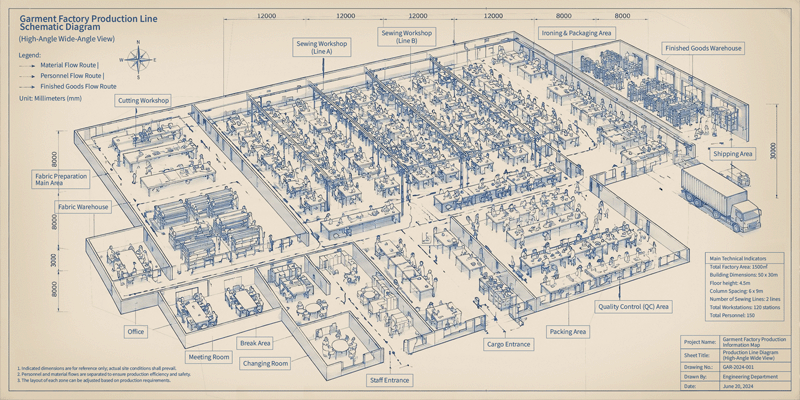
Whether a factory has enough space cannot be judged only by total floor area. The real question is whether materials can move smoothly from receiving to shipment. Fabric and trims enter the factory, then move through inspection, preparation, spreading, cutting, processing, sewing, pressing, quality inspection, packing and shipment. If the flow between these steps is poor, handling, waiting and management costs will increase.
The warehouse area needs to consider how fabric rolls, interlining, thread, zippers, buttons, labels and packing materials are stored. Whether fabric should be separated by batch, shade or quality status will also affect space planning.
Fabric preparation and cutting room space need to cover fabric inspection, relaxing, shrinking, spreading and cutting equipment. Cutting table length, fabric width, roll loading method and operator movement all affect actual production efficiency.
Processing and finishing areas need to consider whether fusing, heat pressing, ironing, seamless or ultrasonic equipment require independent electricity, steam or ventilation. The temporary storage and movement of semi-finished goods between processes should also be planned.
Quality inspection and shipment areas should prevent finished goods from being mixed again, contaminated or placed together with abnormal products. If the factory needs needle detection, checkweighing, scanning or sorting, these machines should connect naturally with packing flow.
Good factory layout is not only placing machines inside the building. It is about allowing materials, people, work in process and finished goods to move smoothly through production.
Garment Equipment Should Be Planned as a Full Process
Garment equipment should not be treated as separate purchases. A better approach is to review the complete process and identify what each stage needs to solve.
After fabric arrives, the factory first needs to confirm material condition. Are there fabric defects? Is the fabric length correct? Does the fabric need relaxing or shrinking? If these issues are discovered only after cutting, the factory may face rework, material shortage and delivery pressure. At this stage, factories can evaluate fabric inspection equipment, AI fabric inspection, fabric relaxing machines and shrinking machines. Fabric inspection and AI inspection help the factory understand quality information, while relaxing and shrinking equipment help prepare fabric before cutting according to material properties.
The next stage is the cutting room. The cutting room is where fabric use and production planning meet. Factories need to evaluate spreading equipment, automatic cutting equipment and whether heavy-duty, multi-roll or data-enabled spreading equipment is needed based on fabric type, order volume, layer count and cutting method.
If the factory handles large volumes of woven fabric, home textiles or heavy rolls, roll loading and multi-layer spreading become important. If the factory handles multiple styles, small batches or replenishment orders, flexibility and changeover convenience may be more important than output alone.
Fabric processing and bonding also depend on the product. Shirts may need interlining fusing. Sportswear may need heat pressing or local bonding. Underwear and functional apparel may require seamless bonding or ultrasonic processing. These machines should be evaluated according to fabric, product structure and quality testing results. Sewing and pressing remain core processes in most garment factories. Sewing equipment, operator skills, process arrangement and finishing equipment all affect final appearance and quality.
Finally, pre-shipment quality confirmation may be required. Depending on product and customer requirements, factories may need needle detection, checkweighing, barcode scanning, packing or data records. If these processes are not planned early, the packing area can become crowded or inspection flow may be incomplete.
Complete equipment planning should connect fabric, cutting, processing, finishing and quality inspection instead of buying individual machines first and deciding where to place them later.
Automation Level Depends on Orders and People
Garment factories can use manual, semi-automatic or more automated equipment. The choice should not be based only on the idea that more automation is always better. If the factory mainly handles large-volume orders of one style, machine capacity and stability may be important. If the factory mainly handles small batches, multiple styles or replenishment orders, flexibility, changeover speed and ease of setting may matter more.
Fabric type also affects equipment selection. Thick fabric, thin fabric, stretch fabric, knitted fabric, woven fabric, home textile fabric and protective material all create different requirements for inspection, spreading, cutting and processing equipment.
Factories also need to consider worker capability. Automated machines still require setting, daily maintenance, abnormal handling and quality judgement. If workers do not yet have these skills, equipment introduction must include training. Installation alone is not enough.
Space, electricity, steam, compressed air, ventilation and future expansion should also be part of the evaluation. The value of automation should be built on real process problems and measurable improvement goals, not only on whether the machine sounds advanced.
Worker Capability and Quality Systems Matter as Much as Equipment
Even if a factory purchases suitable equipment, the machines may not deliver expected results if operators are not trained or quality procedures are unclear.
When starting or expanding a garment factory, workforce planning should include fabric receiving and quality inspection staff, cutting room equipment operators, sewing and processing technicians, pressing and finishing workers, pre-shipment quality inspection staff, machine maintenance and abnormal reporting staff, and production planning and material management staff.
After equipment is introduced, worker roles may also change. Fabric inspection equipment can help build quality information, but people still need to confirm abnormalities and decide how to handle them. Automatic spreading and cutting equipment can perform repetitive work, but workers still need to set parameters, confirm material conditions and handle machine issues. Inspection equipment can provide results, but the factory still needs clear rejected goods handling and recordkeeping processes.
Factories should establish basic systems, including fabric receiving standards, defect handling methods, equipment operation and maintenance procedures, rejected goods and rework reporting, pre-shipment inspection flow and training plans for new and existing workers. Equipment and worker capability must be developed together for the production line to operate reliably over the long term.
Equipment Suppliers Should Not Be Chosen by Price Alone
For a new factory or production line expansion, equipment purchasing is a major investment. Price is important, but it should not be the only standard.
Factories should confirm whether the equipment suits their main products and fabrics, rather than looking only at the highest specifications in a catalog. It is also important that the supplier can suggest a reasonable configuration based on fabric type, product structure, production volume and quality needs.
In processes such as fabric inspection, spreading, cutting, fusing, seamless processing or ultrasonic processing, fabric and product conditions directly affect machine suitability. Whether the supplier can support sample testing, material evaluation or processing parameter confirmation can influence how smoothly the machine is introduced.
If the factory plans to expand gradually, it is useful to know whether the supplier covers front-end preparation, processing, finishing and quality inspection equipment. This can make future communication and integration easier.
Installation, operation training, maintenance support, spare parts availability and after-sales service also affect whether equipment can be used reliably for a long time. If the factory wants to view machine status, production data or quality information in the future, the possibility of data use and future expansion should be considered early.
Equipment purchasing does not end when the machine is delivered. Long-term support affects operating cost and production stability.
Clarify These Points Before Buying Equipment
Before purchasing equipment, the factory can first complete an internal review.
First is product positioning. What garments will the factory produce? Who are the target customers? How high are the quality requirements? Will the factory export or work with brands?
Second is material condition. Main fabric types, width, elasticity, weight, roll size and sourcing all affect equipment selection.
Third is order type. Will the factory mainly produce large volumes of one style, or will it handle multi-style, small-batch, replenishment and urgent orders?
Fourth is production flow. Has the factory planned inspection, preparation, spreading, cutting, processing, sewing, pressing, inspection and packing?
Fifth is quality requirement. Will the factory need defect standards, inspection records, needle detection, checkweighing, scanning or other pre-shipment procedures?
Sixth is factory condition. Can the space, flow, electricity, steam, loading, ventilation, storage and safety layout support machine operation?
Seventh is workforce condition. Are operator numbers, skill needs, training plans and maintenance responsibilities clear?
Finally, the factory should decide investment priority. Which process affects delivery, quality or material use the most? Which area should be improved first?
Once this information is clear, discussions with equipment suppliers can move beyond specifications and prices and focus on actual production needs.
Bring Equipment Planning Back to Products and Process
Different garment factories need different equipment configurations. A factory producing sportswear, underwear, shirts, home textiles or medical products will require different workflows because of material, volume, processing and quality requirements.
OSHIMA provides equipment across multiple stages of garment manufacturing, including fabric inspection and AI fabric inspection, fabric relaxing and shrinking, automatic spreading and automatic cutting, fabric fusing, heat pressing, seamless bonding and ultrasonic processing, pressing, packing and back-end equipment, as well as needle detection and checkweighing. Some equipment can also be evaluated for data application and smart manufacturing expansion according to factory needs.
Equipment introduction should not focus only on one machine. It should be considered together with the factory’s products, materials, capacity, quality standards and future growth plan. The global apparel market is large, but stable orders still depend on product positioning, quality management, delivery capability, equipment configuration and service reliability.
For manufacturers preparing to start a new factory or expand an existing line, the first step is not buying machines immediately. It is clarifying product direction, material conditions, compliance and quality requirements, then planning the factory, workforce and equipment according to the complete production flow.
From fabric inspection, preparation, spreading, cutting, processing and finishing to pre-shipment inspection, every step affects whether the factory can receive orders steadily and grow over time. When product direction is clear, workflow is reasonable and equipment selection matches material and capacity needs, a garment factory is much more likely to build long-term competitiveness.


Article Classification
Recent Articles
- What Changes When Fabric Defect Data Reaches the Cutting Plan?
- How Can Food Factories Catch Problems Before Shipping?
- From Metal to Bones: How to Pick the Right Food Safety Machine
- From Nonwovens to Automotive Interiors: Choosing the Right Fabric Spreading Machine
- How Garment Factories Can Prepare for Smaller Orders?