
 0
0



- Home
- Blog
- Applications & Solutions
- Can Garment Machinery Be Used for Medical Protective Products?
Can Garment Machinery Be Used for Medical Protective Products?
During the early months of the COVID-19 pandemic, manufacturers around the world were under pressure to increase the supply of masks, isolation gowns and protective clothing. In March 2020, the World Health Organization was already reporting substantial pressure on supplies of medical masks and other personal protective equipment.
For textile and garment factories, this created an unusual production situation. The end products were different, but many of the manufacturing steps still involved processes the industry already knew well: handling large rolls of material, spreading before cutting, joining nonwoven materials and sealing selected seams.
During the pandemic, some factories were able to apply existing fabric-processing experience and machinery to selected stages of medical protective-product production. A spreading machine could prepare material for cutting, ultrasonic equipment could join suitable nonwovens, and hot-air equipment could seal specified seams. The equipment itself might have been familiar, but the material, product construction and finished-product requirements still determined how each process needed to be used.
Existing Equipment Still Has to Fit the Product
A factory that already produces garments may have much of the basic fabric-processing experience required for protective clothing, but the production conditions can be quite different.
Isolation gowns and protective garments may use nonwovens, coated materials or laminated fabrics rather than conventional apparel fabrics. Some products are sewn, some use ultrasonic bonding in selected areas, and others require seam tape after the main joining process.
This means existing machinery cannot be judged only by how it is normally used in apparel production. Material composition, thickness, number of layers, joining method, seam construction and the required finished performance all affect whether the same process can be carried over.
Garment factories already deal with this when changing from one fabric to another. A setting that works well for one material may not work for the next. Medical protective products follow the same production principle, although the material and product requirements can be quite different from conventional apparel.
Spreading Becomes More Demanding as Volume Increases
Before joining or seam treatment begins, the material still has to be prepared for cutting.
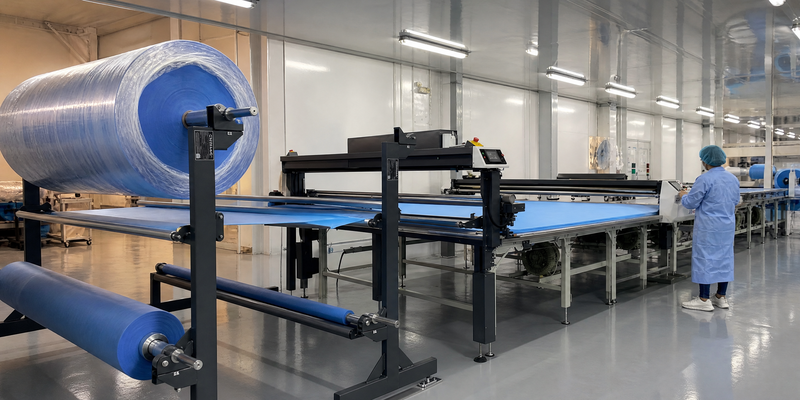
For isolation gowns, protective garments and some mask-related production, large quantities of material may need to be loaded, spread and prepared continuously. As the number and weight of rolls increase, repeated loading and handling can add considerable labour to the front end of the cutting process.
Layer placement, material tension and edge alignment also affect what happens next. When production volume rises, maintaining consistent spreading conditions across a large quantity of material becomes more difficult when much of the process depends on manual handling.
Multi-roll spreading is one way of handling this type of production.
Within this application, OSHIMA's J3 multi-roll woven fabric spreading machine can operate with up to six rolls at the same time, with each roll weighing up to 300 kg. Mechanical clamps, powered feeding arms and automatic edge alignment assist with feeding and positioning the material, while ground-level loading reduces the need to lift large rolls into a higher loading position.
The J3 has also been used for high-output applications including medical masks and isolation gowns. Its role remains the same as in other cutting-room applications: preparing larger quantities of material in a controlled manner before they move into cutting and later assembly.
Where Ultrasonic Bonding Fits
The production route begins to change more noticeably after cutting.
Many masks and medical textile products use nonwoven or thermoplastic materials that can be joined through ultrasonic processing. Instead of using thread, ultrasonic equipment applies high-frequency vibration at the joining point to bond suitable material layers.
Depending on the product construction, the same process can also be used for cutting or edge finishing.
OSHIMA's MB9018B ultrasonic sewing machine provides sewing, cutting and bonding functions and supports interchangeable roller patterns for different applications. Medical uses include masks and surgical gowns.
In actual production, ultrasonic equipment is normally assigned to the parts of the product designed for this type of joining. It should not be treated as a general replacement for every sewing operation.
Material composition, thickness, number of layers and bonding area all affect the result. Factories therefore still need to test the actual material and determine suitable processing conditions before moving into continuous production.
For an apparel factory, the joining technology may be different, but the production discipline is familiar. Stable output still depends on keeping the material, machine settings and required bond condition under control.
Seam Sealing Comes After the Main Assembly
Some protective garments require another operation after the main panels have already been joined.
Where coated, laminated or otherwise sealable materials are used, selected seams may be covered with seam tape using hot air. The tape is applied over the joined area according to the construction required for the product.
The process is already familiar in rainwear, outdoor clothing and other functional garments. In medical protective clothing, similar equipment may be used around body seams, sleeve joints and other specified areas.
The seam is normally formed first through sewing or another joining process. Seam tape is then applied using suitable temperature, pressure and feed speed. Tape selection and compatibility with the garment material are equally important because films, coatings and laminated structures can respond differently to heat.
Seam sealing therefore needs to be considered together with the earlier joining process rather than as an isolated finishing operation. The final result depends on how the seam was constructed before it reaches the sealing machine as well as on the sealing conditions themselves.
The protective performance of the finished garment is also not determined by seam-sealing equipment alone. Material construction, seam design and final product testing remain part of the completed product requirement.
Fusing Is Used in More Limited Applications
Fusing machinery has a more specific role in this type of production.
In apparel manufacturing, continuous fusing machines are commonly used to bond fabric and fusible interlining for components such as collars and cuffs. Similar heat-and-pressure processing may also be relevant to certain layered medical textile products where the materials are designed to be thermally bonded.
The suitability of the process depends heavily on the actual material.
Nonwovens, films, coatings and laminated structures can respond very differently to temperature, pressure and processing time. Excessive heat can affect surface condition or dimensional stability, while insufficient processing may leave the bond inconsistent.
For this reason, actual production materials should be tested before setting a fusing process. Bonding condition, dimensional change and surface appearance all need to be reviewed using the same material construction that will eventually enter production.
Settings used for conventional apparel may provide a starting reference, but they should not automatically be carried over to a different medical textile material.
Garment Machinery Beyond Conventional Apparel
The COVID-19 pandemic brought unusual production requirements to textile and garment manufacturers. During that period, equipment normally used for spreading, bonding, fusing and seam sealing was also applied to masks, isolation gowns, protective clothing and other medical textile products.
These applications were possible because many of the underlying manufacturing processes were already familiar to the textile industry. What changed was the material being processed, the product construction and the performance expected from the finished item.
Garment machinery can therefore support selected stages of medical protective-product production, but the equipment is only one part of the process. Material suitability, joining method, seam construction and finished-product requirements still determine how each production stage needs to be handled.
The products may be different, but the manufacturing principle remains the same: the process has to match the material and the requirements of the finished product.


Article Classification
Recent Articles
- What Changes When Fabric Defect Data Reaches the Cutting Plan?
- How Can Food Factories Catch Problems Before Shipping?
- From Metal to Bones: How to Pick the Right Food Safety Machine
- From Nonwovens to Automotive Interiors: Choosing the Right Fabric Spreading Machine
- How Garment Factories Can Prepare for Smaller Orders?