
 0
0



- Home
- Blog
- Equipment Knowledge
- What Happens to Fabric Before Spreading and Cutting?
What Happens to Fabric Before Spreading and Cutting?
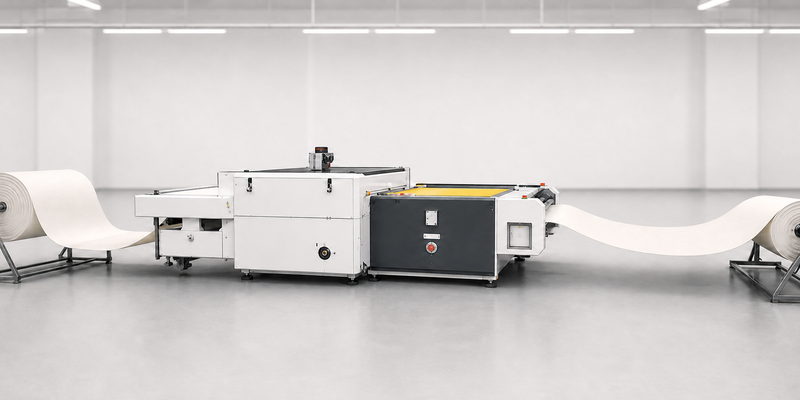
When a fabric roll reaches the cutting room, the production schedule usually says the next step is spreading and cutting. The fabric itself may not be ready at the same time. Knitted fabrics, stretch materials and rolls that have been tightly wound or transported for long periods can still retain tension after they are opened.
Once the fabric is spread and cut, any instability in the material becomes more difficult to correct. Cut parts may recover, shrink or change dimension after leaving the cutting table, affecting matching, sewing alignment and finished measurements. In more noticeable cases, the result can be additional quality handling or recutting.
This is why fabric preparation before cutting needs to be considered separately from cutting accuracy. Depending on the material and the type of dimensional change involved, factories may use natural relaxation, steam-assisted relaxing or steam preshrinking. These processes are related, but they solve different production problems.
Fabric Can Look Ready Before It Is Stable
Fabric passes through knitting or weaving, dyeing, finishing, rolling, storage and transportation before reaching the cutting room. During these stages, it can be stretched, compressed or held under tension in different directions.
This is particularly noticeable with knitted and stretch fabrics. Once the roll is opened, the structure may gradually recover toward its natural condition. Cutting too early means that part of this recovery may take place after the pieces have already been cut.
Heavy denim, coated textiles, laminated fabrics and other specialised materials bring different considerations. Their behaviour may be influenced by construction, finishing, roll weight or the way heat and moisture affect the material.
For the cutting room, the issue is therefore not simply whether the roll has arrived. It is whether the fabric condition is sufficiently stable for spreading and cutting.
Relaxing and Preshrinking Address Different Problems
Fabric relaxing is mainly used to release tension remaining in the material from rolling, transportation and previous processing. It is particularly relevant to knitted and stretch fabrics because these structures can continue to recover after being removed from tension.
Preshrinking deals more directly with dimensional change. Steam, temperature and cooling are applied under controlled conditions so that part of the fabric's shrinkage behaviour can be addressed before cutting and later garment processing.
A factory dealing mainly with residual tension therefore has a different requirement from one dealing with measurable shrinkage after heat, steam or washing. Both processes take place before cutting, but the choice should follow the behaviour of the fabric rather than treating relaxing and preshrinking as the same process.
Natural Relaxation Still Works but Requires Time and Space
Many factories relax fabric by opening or laying it out before cutting and allowing it to recover naturally. For suitable fabrics and production schedules, this remains a practical method.
The difficulty becomes more noticeable when several rolls need to be prepared at the same time. Fabric occupies cutting-room space while it rests, while opening, laying, collecting and moving the material adds handling. Results can also vary according to how different operators arrange and stack the fabric.
Fabric relaxing equipment helps organise this part of the process without changing the basic principle that the material still needs time to recover.
Within this process, OSHIMA offers the UW-2/2L/2M non-steam fabric relaxing series for knitted and woven fabrics. The equipment feeds and plaits the material for relaxation and includes automatic stop sensing and rewinding functions. Depending on the fabric, the relaxing period is generally around 12 to 24 hours.
The waiting period does not disappear. What changes is how the fabric is opened, arranged and handled during that time, making relaxation easier to incorporate into the cutting-room workflow.
Steam Relaxing When the Cutting Schedule Is Tighter
A 12- to 24-hour relaxing period does not fit every production schedule. Where the fabric is suitable for steam treatment and the factory needs to move the material into spreading sooner, steam-assisted relaxing can shorten the tension-release period.
OSHIMA's UW-2S/2LS/2MS steam relaxing series applies steam during the relaxing process for knitted and woven fabrics. The typical relaxing period is around 6 to 8 hours, and the machines include automatic stop sensing, rewinding and a fabric-return mechanism.
Different models are available for different fabric widths and roll weights, which becomes relevant when a cutting room handles a broader mix of materials.
Steam relaxing still serves mainly as a pre-cutting tension-release process. Where actual shrinkage is the larger concern, shrinkage testing and suitable preshrinking treatment remain necessary.
When Shrinkage Becomes the Main Concern
Some fabrics require more than tension release. Their dimensions may change after exposure to steam, heat, washing or later garment processing, making preshrinking more relevant before cutting.
Steam preshrinking combines controlled heat and moisture treatment with subsequent cooling. Processing conditions can be adjusted according to materials such as cotton, silk, wool, linen, synthetic fibres and blends.
The level of process control required depends on the fabric.
For regular materials requiring a relatively straightforward steam treatment, the OSHIMA OC-100/100L uses open steam followed by ambient-air drying. Fabric is handled with tension-free plaiting, with mechanical length measurement after treatment.
For materials requiring closer control over steam, temperature and cooling conditions, the OSP-2500 series uses an enclosed steam structure with adjustable steam volume, temperature and preshrinking settings. Strong air-suction cooling follows the treatment to help the fabric return toward a more stable condition.
Coated fabrics, laminated materials and composite textiles can respond differently to heat, steam and movement. For these applications, the OSP-2000II/2000III series combines heating, steam and vacuum cooling across three processing stages, with independent speed control for adjustment according to different material characteristics.
These are different levels of treatment for the same production consideration: managing dimensional change before the material is committed to cut-part dimensions.
What Matters Before Fabric Moves Into Spreading and Cutting
Steam or heat treatment alone does not mean that the material is immediately ready for the next process. Fabric leaving a preshrinking section can still retain heat and moisture, and its condition may continue to change as it cools.
This is where cooling becomes part of the treatment rather than simply an additional machine function. Air-suction or vacuum cooling helps the fabric return more quickly to a condition suitable for rewinding, spreading or subsequent handling.
The same principle applies to cutting accuracy. CAD marker planning, automatic spreading and automatic cutting can control material utilisation and cut geometry very closely, but they cannot prevent unstable fabric from recovering or shrinking after it has been cut. A cutting machine can follow the pattern accurately while the material itself is still changing.
For this reason, fabric preparation and spreading and cutting should be viewed as part of the same production flow. The appropriate preparation method depends on what is actually happening to the fabric.
Where residual tension is the main issue and the production schedule allows a longer preparation period, non-steam relaxing may be sufficient. Steam relaxing becomes relevant when similar materials need to move into spreading within a shorter timeframe. Where shrinkage testing shows that dimensional change is the larger concern, preshrinking provides a more appropriate process, with the required level of steam, temperature and cooling control depending on the material.
The decision does not need to begin with the most complex equipment. It should begin with the fabrics being processed, how they behave before and after treatment, and how much preparation time the cutting schedule can realistically accommodate.
Conclusion
Fabric preparation before cutting is mainly about dealing with dimensional change at the point where it can still be managed. Once unstable fabric has been spread and cut, the resulting variation is carried into sewing, assembly and finished-garment measurement, where correction usually becomes more difficult.
Relaxing, steam relaxing and preshrinking therefore serve different roles within the same pre-cutting process. The appropriate method depends on whether the main concern is residual tension, available preparation time or shrinkage behaviour.
OSHIMA's related solutions include non-steam fabric relaxing, steam relaxing, open steam preshrinking and enclosed preshrinking systems for different fabric types and processing requirements. The equipment differs in treatment method and level of control, but its position in production is the same: preparing the fabric before it moves into spreading and cutting so the next processes begin with a more stable material condition.


Article Classification
Recent Articles
- The 30-90-180 Day Rule for Industrial Boiler Maintenance
- How Garment Machinery Supports Safety, Compliance and Environmental Management?
- What Happens Before Fabric Goes to the Cutting Table?
- Industrial Iron & Vacuum Table Care: How to Extend Their Lifespan
- Cutting Floor ROI: How the M8s and TAC Save $100K Annually