
 0
0



- Home
- Blog
- Applications & Solutions
- Is a Fabric Spreading Machine Worth It? A Practical ROI Guide for Garment Factories
Is a Fabric Spreading Machine Worth It? A Practical ROI Guide for Garment Factories
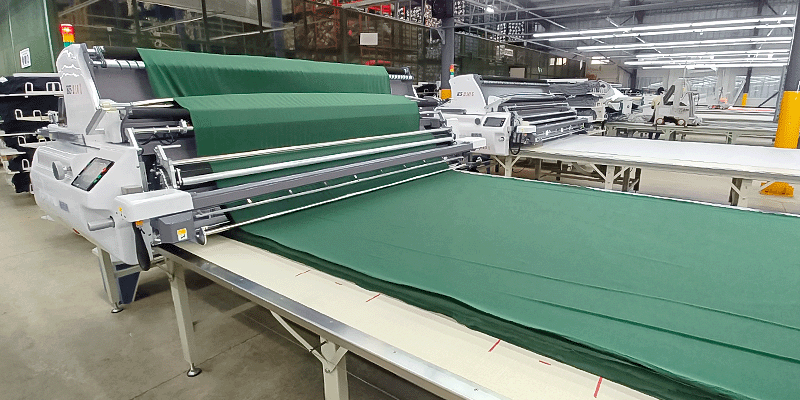
As garment factories receive more orders and production schedules become tighter, manual fabric spreading can quickly become a bottleneck in the cutting room.
Many factory owners and production managers face similar questions:
Can manual spreading still keep up with growing order volume?
Is an automatic fabric spreading machine worth the investment?
How long does it take to recover the equipment cost?
Can automation help solve labor shortage and unstable manpower issues?
For many factories, the decision is not only about buying a machine. It is about whether the cutting room can support higher production volume, more stable quality, and long-term factory growth.
This guide uses a practical cost-saving example to explain how an automatic fabric spreading machine can reduce labor dependency, improve production capacity, and support better factory management.
What Can an Automatic Fabric Spreading Machine Help Save?
Manual fabric spreading usually requires at least two workers, especially when the fabric length is long, the number of layers is high, or the daily production volume is large. The process also depends heavily on worker experience, physical condition, and consistency.
An automatic fabric spreading machine reduces repetitive manual work by automating fabric laying, tension control, edge alignment, and spreading length control. Instead of using several workers to pull and align fabric manually, the operator mainly monitors machine operation, checks fabric condition, and makes adjustments when needed.
For example, if a factory uses two workers for manual spreading and each worker costs NT$190 per hour, the daily labor cost for an 8-hour shift is about NT$3,040. With an automatic fabric spreading machine, the operation may require only one operator, reducing the daily labor cost to around NT$1,520.
In this example, the daily labor saving is about NT$1,520. If the factory operates 25 working days per month, the monthly labor saving can reach about NT$38,000. Over one year, the labor saving alone can exceed NT$390,000.
This does not yet include the additional value from higher spreading capacity, fewer spreading errors, better fabric utilization, and improved cutting room workflow.
| Item | Manual Spreading (2 workers) | Automatic Spreading | ||||
| Daily fabric output | ~1,500 yards | 4,000–5,000 yards | ||||
| Daily labor cost | ~NT$3,040 (2 workers × NT$190/hr × 8 hrs) | ~NT$1,520 (1 operator × NT$190/hr × 8 hrs) | ||||
| Weekly labor hours | 80 hours/week (2 people) | 40 hours/week (1 person) | ||||
| Alignment & tension control | Error-prone due to fatigue | Consistent tension and automatic edge alignment | ||||
| Rework probability | Medium to high (wrinkles, uneven lengths) | Low (machine-based precision) | ||||
Payback Period Example: When Can the Machine Pay for Itself?
A basic automatic fabric spreading machine may cost around NT$500,000, depending on machine type, configuration, fabric width, and optional functions.
Using the sample calculation above:
Equipment cost: about NT$500,000
Daily labor saving: about NT$1,520
Monthly working days: 25 days
Estimated monthly labor saving: about NT$38,000
Based on this example, the payback period would be approximately 13 to 14 months.
This is a simplified estimate based mainly on labor savings. The actual payback period may vary depending on local wages, production volume, shift arrangement, machine model, maintenance cost, and factory workflow.
In some factories, the payback period may be shorter if the machine also helps improve production scheduling, reduce rework, increase fabric utilization, or support night-shift production. For factories with high daily spreading volume, the machine may create value beyond direct labor savings.
Why ROI Is Not Only About Labor Cost
When evaluating an automatic fabric spreading machine, many factories only calculate labor savings. This is understandable, because labor cost is easy to see and easy to calculate. However, the real value of automation is often broader.
First, automatic spreading improves production capacity. Manual spreading may be limited by worker speed, fatigue, and coordination. A fabric spreading machine can maintain a more stable operating rhythm, helping the cutting room prepare more fabric within the same working time.
Second, automatic spreading improves consistency. Manual spreading may lead to uneven tension, edge misalignment, wrinkles, or inaccurate spreading length. These problems can affect cutting quality and may create additional correction work. A machine helps reduce these variations through controlled speed, tension, and edge alignment.
Third, automation reduces dependency on unstable labor supply. In many factories, hiring and retaining skilled operators is becoming more difficult. When spreading work depends too heavily on manual labor, production becomes vulnerable to worker absence, turnover, or skill differences.
Fourth, automation can improve workplace safety. Manual spreading often requires repeated pulling, bending, and handling of fabric rolls. Reducing this workload can help improve the working environment in the cutting room.
For these reasons, the investment value of a fabric spreading machine should not be judged only by direct labor savings. It should also include production stability, quality consistency, workflow efficiency, and long-term labor risk reduction.
What Manual Spreading Cannot Easily Provide
Manual spreading can still work for small production volumes or simple production lines. However, as order volume increases, it becomes harder to maintain stable output and consistent quality.
An automatic fabric spreading machine can provide several advantages that are difficult to achieve with manual work alone.
It can maintain more stable fabric tension during spreading, reducing the risk of stretching or uneven layers. It can support multi-layer and multiple-length spreading, helping factories handle different sizes, styles, or mixed orders more efficiently. It can also reduce repetitive manual work and allow operators to focus on monitoring and quality control.
For factories handling large-volume production, mixed orders, or more frequent style changes, these benefits can directly affect cutting room efficiency.
If the machine is equipped with smart data or IoT functions, it can also help managers better understand machine status, spreading progress, and production performance. This becomes especially useful when a factory operates multiple lines, multiple shifts, or wants to improve production visibility.
Smart Integration Can Shorten the Real Payback Period
For some factories, smart integration is not just an additional feature. It can become an important factor that helps accelerate the return on investment.
When an automatic fabric spreading machine can connect with internal production management systems, such as ERP, MES, or scheduling software, it does more than reduce manual labor. It also improves information flow between the cutting room and production management.
For example, work orders can be sent more directly to the machine, reducing manual task assignment and communication delays. Spreading data, including fabric length, number of layers, and material usage, can be recorded and used for production analysis. If the machine status can be monitored, abnormal stops or fabric shortage can be identified earlier. Reports can also be generated more efficiently, reducing manual data collection and administrative work.
These functions help factories move from “saving labor” to “improving management efficiency.”
However, smart integration also requires preparation. Factories may need system connection planning, operator training, and internal coordination. It is helpful to assign one person with basic ERP or IT knowledge as the communication window between the factory team and the equipment supplier.
With proper setup, smart integration can support better production visibility, improve machine utilization, and reduce management gaps caused by manual reporting.
When Is an Automatic Fabric Spreading Machine Worth Considering?
An automatic fabric spreading machine is especially worth considering when the factory is already facing clear production pressure.
If order volume is increasing but the cutting room cannot keep up, automation may help stabilize the preparation process before cutting. If labor is difficult to hire or workers frequently change, reducing manual dependency can lower operational risk. If spreading quality varies depending on who is operating, a machine can help standardize the process.
It is also worth considering when the factory handles high-volume production, multi-layer spreading, frequent style changes, or mixed orders. In these situations, manual spreading may still be possible, but the hidden cost of inefficiency, rework, and production delays can become significant.
For factories planning future expansion, an automatic fabric spreading machine can also become part of a more scalable production system. Instead of only solving today’s labor problem, it can prepare the cutting room for higher output and better process control.
Key Questions Before Investing in a Fabric Spreading Machine
Before purchasing an automatic fabric spreading machine, factories should first review several practical conditions.
What is the current daily spreading volume?
How many workers are currently needed for fabric spreading?
How much does manual spreading cost per day or per month?
Is the cutting room already limiting production capacity?
Are spreading errors causing rework or material waste?
Is labor recruitment or retention becoming more difficult?
Does the factory need better production visibility or data tracking?
Will the machine be used only for standard fabric spreading, or will it need to connect with ERP, MES, or other management systems?
These questions help the factory estimate not only the equipment cost, but also the operational value of automation.
Conclusion
When asking whether an automatic fabric spreading machine is worth buying, the real question is not only how fast the machine can pay for itself.
The more important question is whether the factory’s current process can still support future production needs.
If manual spreading is already slowing down the cutting room, if labor is unstable, or if spreading quality depends too much on worker experience, the value of automation goes beyond ROI. It becomes part of production stability, quality control, workplace safety, and future factory growth.
An automatic fabric spreading machine can help reduce labor dependency, increase spreading capacity, improve consistency, and support better cutting room management. When combined with smart data functions or system integration, it can also help factories build a more visible and scalable production process.
For factories evaluating automation, the best approach is to calculate labor savings, review current production bottlenecks, and assess whether smart functions are needed for long-term management. OSHIMA can support factories with machine selection, layout planning, payback period estimation, and function matching based on production volume, fabric type, and cutting room workflow.

Article Classification
Recent Articles
- What Changes When Fabric Defect Data Reaches the Cutting Plan?
- How Can Food Factories Catch Problems Before Shipping?
- From Metal to Bones: How to Pick the Right Food Safety Machine
- From Nonwovens to Automotive Interiors: Choosing the Right Fabric Spreading Machine
- How Garment Factories Can Prepare for Smaller Orders?